您的浏览器禁用了JavaScript(一种计算机语言,用以实现您与网页的交互),请解除该禁用,或者联系我们。 [巴克莱银行]:如果美国将欧盟商品的关税提高至30%,怎么办? - 发现报告

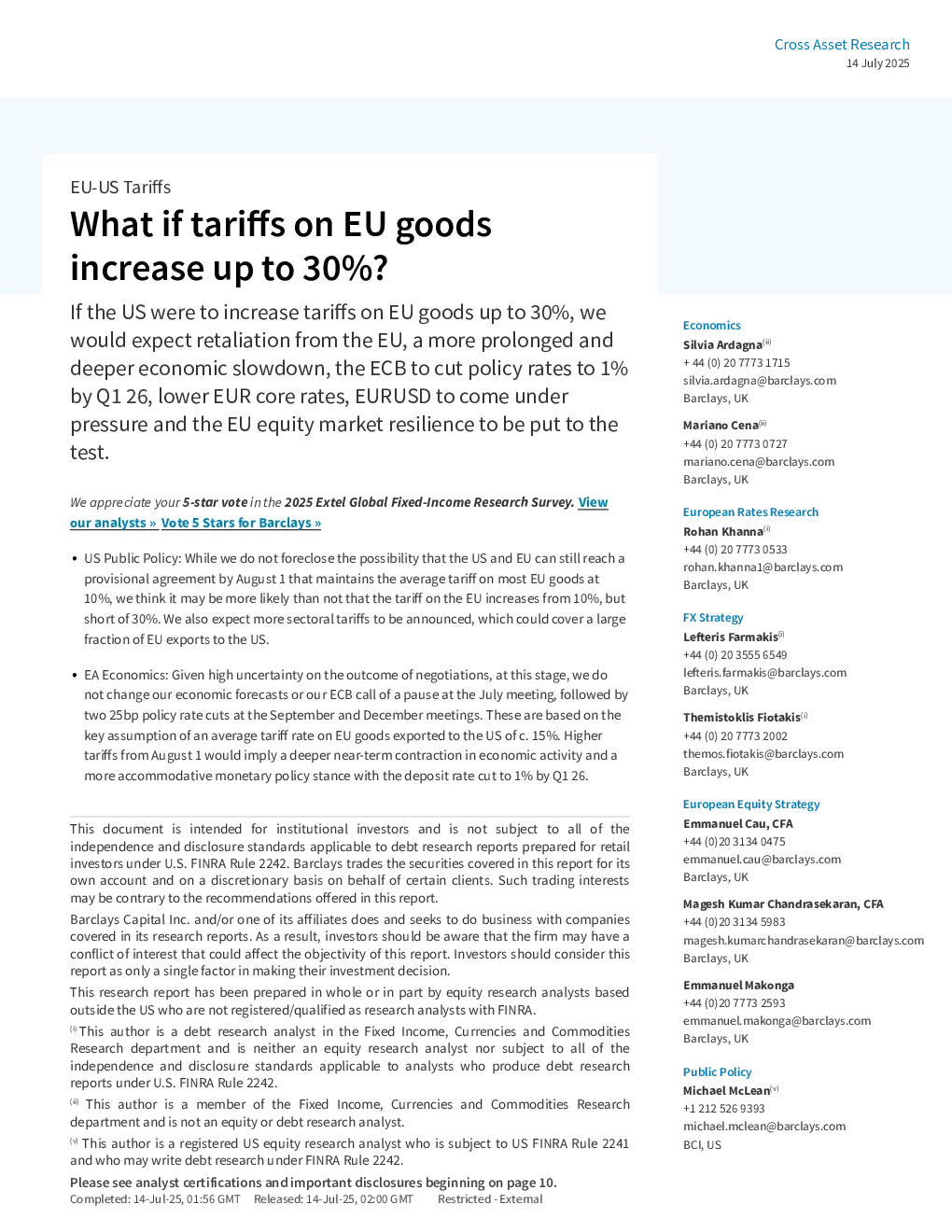
如果美国将欧盟商品的关税提高至30%,怎么办?

2025-07-14 - 巴克莱银行 惊雷
报告封面

Restricted - External EconomicsSilvia Ardagna+ 44 (0) 20 7773 1715silvia.ardagna@barclays.comBarclays, UKMariano Cena+44 (0) 20 7773 0727mariano.cena@barclays.comBarclays, UKEuropean Rates ResearchRohan Khanna+44 (0) 20 7773 0533rohan.khanna1@barclays.comBarclays, UKFX StrategyLefterisFarmakis+44 (0) 20 3555 6549lefteris.farmakis@barclays.comBarclays, UKThemistoklis Fiotakis+44 (0) 20 7773 2002themos.fiotakis@barclays.comBarclays, UKEuropean Equity StrategyEmmanuel Cau, CFA+44 (0)20 3134 0475emmanuel.cau@barclays.comBarclays, UKMagesh Kumar Chandrasekaran, CFA+44 (0)20 3134 5983magesh.kumarchandrasekaran@barclays.comBarclays, UKEmmanuel Makonga+44 (0)20 7773 2593emmanuel.makonga@barclays.comBarclays, UKPublic PolicyMichael McLean+1 212 526 9393michael.mclean@barclays.comBCI, US (ii)(ii)(i)(i)(i)(v) 1As a reminder, the EU hasoffereda deal based on 0% reciprocaltariffson industrial goods only.•Rates: While longs in the EUR front-end, with less than one cut priced by end-2025,offeredasymmetric value, a catalyst was needed to activate it. To the extent that the market treatsthe 30%tariffthreat as credible (and that is a big if), we should see the money market curveflatten as we add more cut-premium to meetings this year, 1y1y ESTR slipping below 1.5%and Bunds sliding to below 2.5%, with the curve bull steepening.•FX: The EUR has been the top-performing anti-dollar currency since Liberation Day. It could,however, be faced with a less rosy environment should President Trump follow through onhis 30%tariffthreat. This is due to a more adverse macro and policy outlook in Europe alongwith fairly limited retaliation by other trading partners, which limits dollar damage.•Equities: The threat of 30% UStariffson the EU will put the TACO trade to test. A full blowntrade war and deeper recession would likely send equities down double digit, as seen in theimmediateaftermathof Liberation day. But we are not quite there yet, and we are scepticaltariffswill settle at the high levels lately threatened by Trump. We think his tolerance forequity and bond market stress is limited, which is likely to set some cap on thetariffshe willultimately impose. So hedging warranted but no panic, and the next few days will likely tellus what level oftariffsmarkets and trading partners are ultimately willing to tolerate. If thesituation de-escalates, we still see a case for EU equities to breakout in H2.Public Policy: US-EUTariffs– where to?On Saturday, President Trump announced that he would implement a 30%tariffon importsfrom the EU, starting on August 1. The letter was dated July 11.One bespoke sentence in the letter stood out to us because it may suggest what Trump isseeking in negotiations with the EU and the deficiency with the agreement under consideration,most likely with reference to agricultural goods1: “The European Union will allow complete,open Market Access to the United States, with noTariffbeing charged to us, in an attempt toreduce the large Trade Deficit." We also think it is notable that the 30% rate, although lowerthan Trump’s ultimatum of a 50%tariffon EU imports of goods in late May, is higher than theoriginal 20% rate announced on April 2, whiletariffrates in the letters to most countries lastweek largely tracked Liberation Day levels.Last week, Commerce Secretary Lutnick said that a framework agreement with the EU was onPresident Trump’s desk for his approval, and “he’s [Trump] thinking about how he wants to playthem.” The deal reportedly would have kept thetariffrate at 10% and provided commitmentsfor exemptions for certain goods, includingaircraft,spirits, and some medical technology. Theletter suggests that President Trump has rejected that deal.As we wrote last week (Public Policy: You’ve got mail), we do not think the EU can secure morefavorable terms than in the UK deal. Last week, the best-case scenario was seen as theannouncement of a framework deal. The worst-case scenario was seen as the EU receiving aletter.Looking ahead, while we expect negotiations between the US and EU to continue for the nextthree weeks and we do not foreclose the possibility that the US and EU can still reach aprovisional agreement by August 1, we thinktariffrates will likely increase by stops and startsover the coming weeks and months. President Trump said last week that he was preparingblankettariffsof 15-20%, which suggests to us that it may be more likely than not that thetariffon the EU increases from 10%, but short of 30%. We also expect more sectoraltariffsto beannounced, which could cover most EU exports to the US. 2 2The letter Presidnet Trump sent to the EU states that: “If for any reason you decide to raise yourTariffsand retaliate,then, whatever the number you choose to raise them by, will be added onto the 30 percent that we charge.”Economics: Risks of a deeper recession and morepolicy easing•In response to the letter sent by President Trump, European Commission (EC) PresidentUrsula von der Leyen did not rule out retali