从2011年3月11日事件中吸取的经验教训
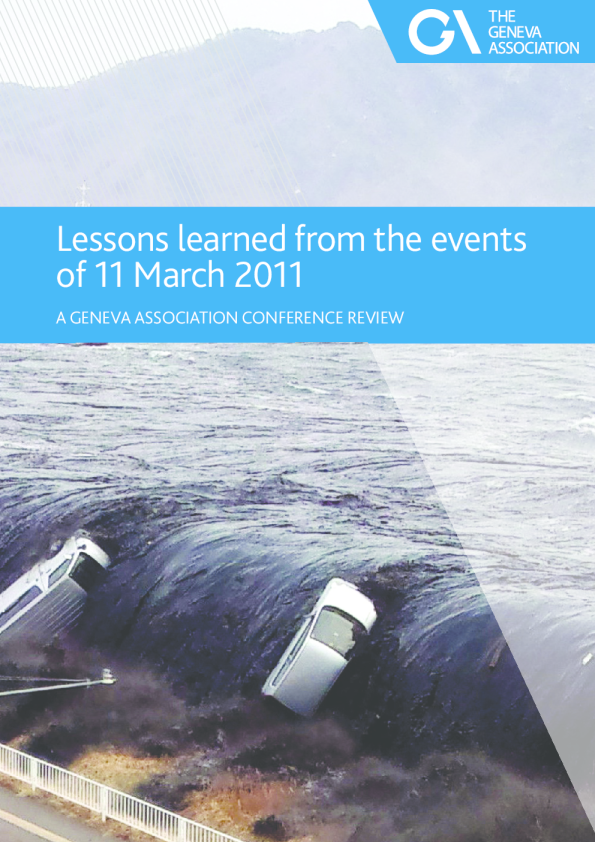
The Geneva Associationthe Geneva Association is the leading international insurance think tank for strategically important insurance and riskthe Geneva Association identifies fundamental trends and strategic issues where insurance plays a substantial role or whichinfluence the insurance sector.through the development of research programmes, regular publications and the organisationof international meetings,the Geneva Association serves as a catalyst for progress in the understanding of risk and insurancematters and acts as an information creator and disseminator.it is the leading voice of the largest insurance groups worldwidein the dialogue with international institutions.in parallel, it advances—in economic and cultural terms—the development andapplication of risk management and the understanding of uncertainty in the modern economy.the Geneva Association membership comprises a statutory maximum of 90 chief executive officers (ceos) from the world’stop insurance and reinsurance companies.it organises international expert networks and manages discussion platforms forsenior insurance executives and specialists as well as policymakers, regulators and multilateral organisations.the GenevaAssociation’s annual General Assembly is the most prestigious gathering of leading insuranceceos worldwide.established in 1973,the Geneva Association, officially the “international Association for thestudy ofinsuranceeconomics”,has offices in Geneva and Basel,switzerland and is a non-profit organisation funded by its members.cover: Miyako, Japan.this picture taken by a Miyakocity official on 11 March 2011 and released on 18 March 2011 shows a tsunamibreeching an embankment and flowing into the city of Miyako iniwate prefecture shortly after a 9.0 magnitude earthquake hitthe region of northern Japan. AfP Photo/JiJiPressp.11:shutterstock/YMZK-Photo; p.12:shutterstock/justasc; p.13:shutterstock/yankane; p.15:shutterstock/watchtheworld andshutterstock/vitezslavvalka; p.19:shutterstock/yankane; p.27shutterstock/Guido Amrein; p.30:shutterstock/semork. management issues.Photo credits: 1www.genevaassociation.org@TheGenevaAssocLessons learned from the eventsof 11 March 2011A GenevAAssociAtion confeRenceReview lessons learned from the events of 11 march 2011Geneva | Route de Malagnou 53,cH-1208 Geneva |tel:+41 22 707 66 00 |fax: +41 22 736 75 36Basel | Sternengasse 17, CH-4051 Basel | Phone +41 61 201 35 20 | Fax +41 61 201 35 29secretariat@genevaassociation.orgwww.genevaassociation.orgnovember 2013Lessons learned from the events of 11 March 2011©the Geneva AssociationPublished bythe Geneva Association (theinternational Association for thestudy ofinsuranceeconomics), Geneva/Basel.The opinions expressed in The Geneva Association newsletters and publications are the responsibility of the authors. Wetherefore disclaim all liability and responsibility arising from such materials by any third parties.Download the electronic version from www.genevaassociation.orgFor more information onThe Geneva Association forthcoming conferences, click here. www.genevaassociation.org5welcome,by Shuzo Sumi, Chairman of the Board, Tokio Marine & Nichido Fire Insurance Co., Ltd, Tokyo. Co-Chairman ofThe Geneva Association’s Climate Risks and Insurance working group6the Geneva Association’s work on thecR+iproject,by Michael Butt, Chairman of the Board of Axis Capital Group;Co-Chairman ofThe Geneva Association’s Climate Risks and Insurance working group7introduction,by John H. Fitzpatrick, Secretary General, The Geneva Association (2012–2014)WOrkSHOp 1—THESTATEOfGlObAl dEVElOpmENTINdISASTEr rISk rEduCTION8current state of global discussions on disaster resilience: the insurance industry and the post-2015global disaster risk reduction framework,by Margareta Wahlström, Special Representative for the United NationsOffice for Disaster Risk Reduction (SRSG) and Head of the United Nations Office for Disaster Risk Reduction (UNISDR)11Disaster management of Japan: viewpoints towards post-2015 Hyogoframework for Action (HfA2),by Soichi Nakajima, Director for International Cooperation, Disaster Management Bureau, Cabinet Office, Government ofJapanWOrkSHOp 2—lESSONSfrOm 11 mArCH12overview of the 2011tohoku earthquake and tsunami,by Fumihiko Imamura, Deputy Director, International ResearchInstitute of Disaster Science, IRIDeS, Tohoku University14the state of stochastic tsunami hazard assessment,by Yo Fukutani, Research Associate, International Research Instituteof Disaster Science, IRIDeS, Tohoku University15Reviewing evacuation procedures,by Yoshi Abe, Research Associate, International Research Institute of Disaster Science,Tohoku University16Review of the insurance industry responses,by Masaaki Nagamura, General Manager, Corporate Social Responsibility,Corporate Planning Department, Tokio Marine & Nichido Fire Insurance Co. Ltd.WOrkSHOp 3—AdVANCEmENTINrISk rESEArCH20implications of 11 March: assessing the earthquake and tsunami risk in other regions of the world,by R