AI智能总结
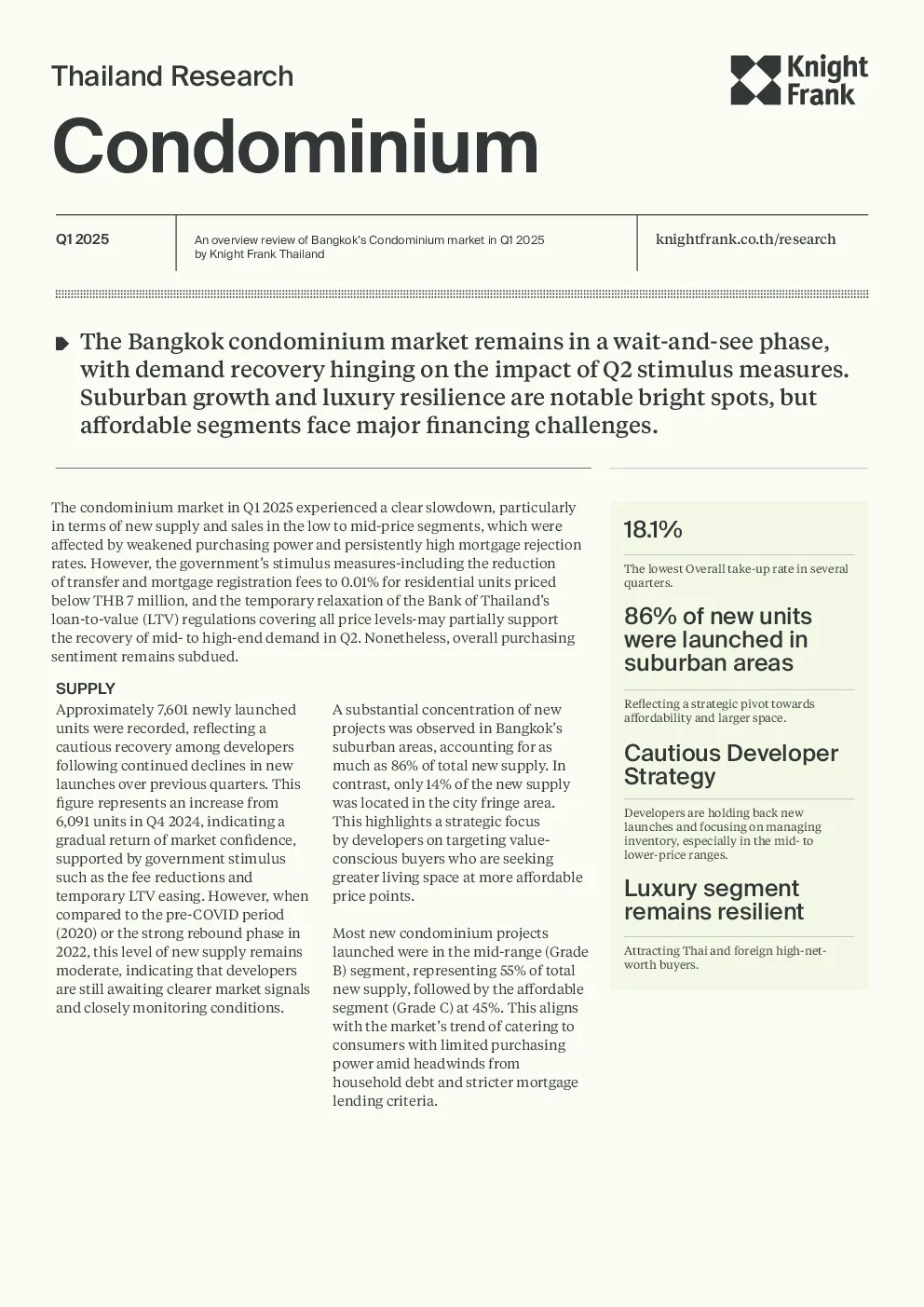
Condominium Q1 2025 knightfrank.co.th/research An overview review of Bangkok’s Condominium market in Q1 2025by Knight Frank Thailand The Bangkok condominium market remains in a wait-and-see phase,with demand recovery hinging on the impact of Q2 stimulus measures.Suburban growth and luxury resilience are notable bright spots, butaffordable segments face major financing challenges. The condominium market in Q1 2025 experienced a clear slowdown, particularlyin terms of new supply and sales in the low to mid-price segments, which wereaffected by weakened purchasing power and persistently high mortgage rejectionrates. However, the government’s stimulus measures-including the reductionof transfer and mortgage registration fees to 0.01% for residential units pricedbelow THB 7 million, and the temporary relaxation of the Bank of Thailand’sloan-to-value (LTV) regulations covering all price levels-may partially supportthe recovery of mid- to high-end demand in Q2. Nonetheless, overall purchasingsentiment remains subdued. 18.1% The lowest Overall take-up rate in severalquarters. 86% of new unitswere launched insuburban areas SUPPLY Reflecting a strategic pivot towardsaffordability and larger space. Approximately 7,601 newly launchedunits were recorded, reflecting acautious recovery among developersfollowing continued declines in newlaunches over previous quarters. Thisfigure represents an increase from6,091 units in Q4 2024, indicating agradual return of market confidence,supported by government stimulussuch as the fee reductions andtemporary LTV easing. However, whencompared to the pre-COVID period(2020) or the strong rebound phase in2022, this level of new supply remainsmoderate, indicating that developersare still awaiting clearer market signalsand closely monitoring conditions. A substantial concentration of newprojects was observed in Bangkok’ssuburban areas, accounting for asmuch as 86% of total new supply. Incontrast, only 14% of the new supplywas located in the city fringe area.This highlights a strategic focusby developers on targeting value-conscious buyers who are seekinggreater living space at more affordableprice points. Cautious DeveloperStrategy Developers are holding back newlaunches and focusing on managinginventory, especially in the mid- tolower-price ranges. Luxury segmentremains resilient Most new condominium projectslaunched were in the mid-range (GradeB) segment, representing 55% of totalnew supply, followed by the affordablesegment (Grade C) at 45%. This alignswith the market’s trend of catering toconsumers with limited purchasingpower amid headwinds fromhousehold debt and stricter mortgagelending criteria. Attracting Thai and foreign high-net-worth buyers. DEMAND underlying demand. It also stemsfrom a widespread wait-and-seeapproach among both consumersand developers. Many are delayingdecisions in anticipation of clearerdetails regarding government stimulusmeasures, which are scheduled totake effect in the next quarter. Thisphenomenon highlights the significantshort-term influence of public policyon market dynamics and suggests thatdelayed purchasing decisions are moreprominent than any structural drop indemand. This points to a market that is temporarily pausing in preparationfor an expected recovery driven byupcoming support measures. Shouldthese policies effectively restore buyerconfidence and ease purchasingconstraints, the market could regainmomentum in the second half of theyear. Condominium demand in Q1 2025remained in a state of adjustment. Ofthe 7,601 newly launched units, only1,377 units were sold, representing atake-up rate of just 18.1%—the lowestin several quarters. This illustrates thatbuying momentum has yet to fullyrecover, despite the gradual rollout ofgovernment stimulus toward the end ofthe previous quarter. The market’s deceleration,particularly on the buyer side, isnot solely attributed to a lack of ASKING PRICE In the city fringe area, prices continuedto climb, reaching THB 128,049 persq m in this quarter-the highest levelin over two years. This indicatesincreasing demand for locations withconvenient access to the city center atstill-reasonable prices. seeking larger living spaces withinlimited budgets. Overall, condominium asking pricesremained stable: In the Central Business District (CBD),the average asking price stood atTHB 239,475 per sq m, maintaining alevel similar to the previous quarter,albeit down from the Q1 2024 peak ofnearly THB 250,000 per sq m. Thisadjustment reflects developers’ effortsto align pricing with real purchasingpower, despite the continued presenceof high-end demand in this location. The price trends across locationsclearly indicate a market that isresponding to differentiated buyerneeds. While high-income buyerscontinue to drive demand in centralzones, suburban areas are seeingsteady price recovery, supported bygenuine end-user demand. In the suburban areas of Bangkok, theaverage asking price was THB 72,776per sq m,