圣基尔达路住宅化完整报告
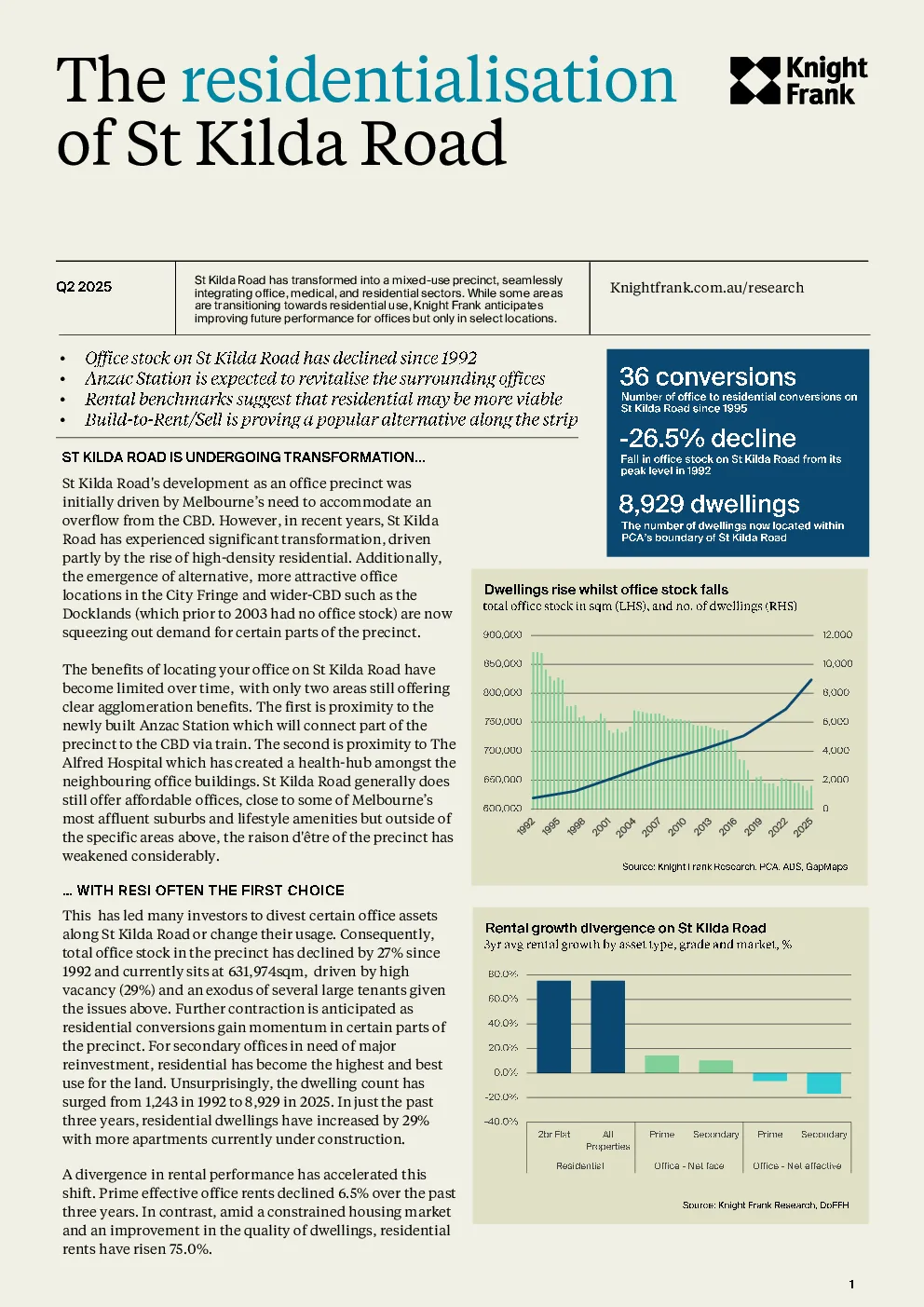
St Kilda Road vacancy is 29.3% but its not equally spreadMarket conditions have remained challenging across mostsub-markets along St Kilda Road. However, opportunitiespersist—particularly for buildings withinclose proximitytothe soon-to-be-completed Anzac Station. This majorinfrastructure addition is expected to revitalise thesurrounding office sub-market, referred to by Knight Frankas the “Anzac” precinct. The new station will provideworkers and residents with a two-minute commute toMelbourne’s CBD.Whilst the Anzac precinct currently records a vacancy rateof 20.0% (only marginally higher than the CBD’s 18.0%), itencompasses 181,575 sqm of office stock—home to thestrip’s highest-quality assets—positioning it as a key officehub. South Melbourne records a slightly lower vacancy rateof 19.6%, though it comprises just 51,944sqm of office stock.With only one building exceeding 5,000 sqm, this area isdominated by smaller owner-occupier and strata-titledbuildings, several of which may face future conversion risk.St Kilda Road’s Medical Hub, strategically located adjacentto The Alfred Hospital, has the lowest vacancy rate acrossall sub-markets at 13.4%. The presence of MonashUniversity’s Preventative Medicine Campus at 553 St KildaRoad, L’Oreal at 564, AIA at 509 and the Alfred HealthClinic at 541 St Kilda Road emphasises the strength of thisprecinct. This outperformance reflects the healthcaresector’s relative insulation from weaker leasing conditionsand its specific agglomeration benefit.Conversely, vacancy rates remain significantly elevated inthe 424–480 and >574 St Kilda Road segments, at 40.6%and 37.0%, respectively. These sub-markets contain thehighest concentration of residential stock on the strip, withmore on the way. Naturally, some of this space is vacantdue to future developments, with 424, 437 and 464equating to 6.5% of total stock. But this trend is expected topersist as secondary office assets in these sub-marketsbecome increasingly unviable for refurbishment. A history of conversions and it's speeding upOffice conversions have been a natural consequence ofthe changing dynamics on St Kilda Rd, there have been36 on record with 18 taking place since 2010. Most officeconversions in the last 15-years have occurred within thesub-markets of South Melbourne and 424–480 St KildaRoad. Due to it historically holding a series of vacantblocks and alternative assets, not many conversions havetaken place on the lower part of St Kilda Road (>574).Thisis now changing, and expectations are that with highvacancy rates, the remaining office space will graduallyconvert over time.Three BTR projects are already underway on St KildaRoad by Barings, Novus, and Home. These sites wereformerly a car park, hotel, and a small residential blockof units. Whilst not office conversions, their constructionfurther highlights the precinct’s shift towards residentialuse on select sites and an increase in popularity of BTRas a preferred investment opportunity for developers.Amongst office conversions are two BTS projects(Orchard Piper’s, Carter Building and Sunnyland’s ParkQuarter, which is over 90% sold already). Others, whichwill imminently begin construction are by Cbus Propertyand Gurner.With a weak rental performance, particularly relative toresidential assets, and a high vacancy rate for offices in424–480 and >574 St Kilda Road, it is hard to make majorrefurbishments add up. Residential conversion doeshowever, and there is already a pipeline ofredevelopments (see table below). Further officeconversions are imminent, including 464 and, in thelower section of the precinct,with615 likely. Outside ofthe viable areas of St Kilda Road, theresidentialisationofthe office precinct continues apace. The perfect solutionto redundant, obsolete offices that are not worthrefurbishing both there and perhaps further afield.