您的浏览器禁用了JavaScript(一种计算机语言,用以实现您与网页的交互),请解除该禁用,或者联系我们。 [巴克莱银行]:康明斯教育系列回顾 - 发现报告

康明斯教育系列回顾

2025-06-16 巴克莱银行 坚守此念
报告封面

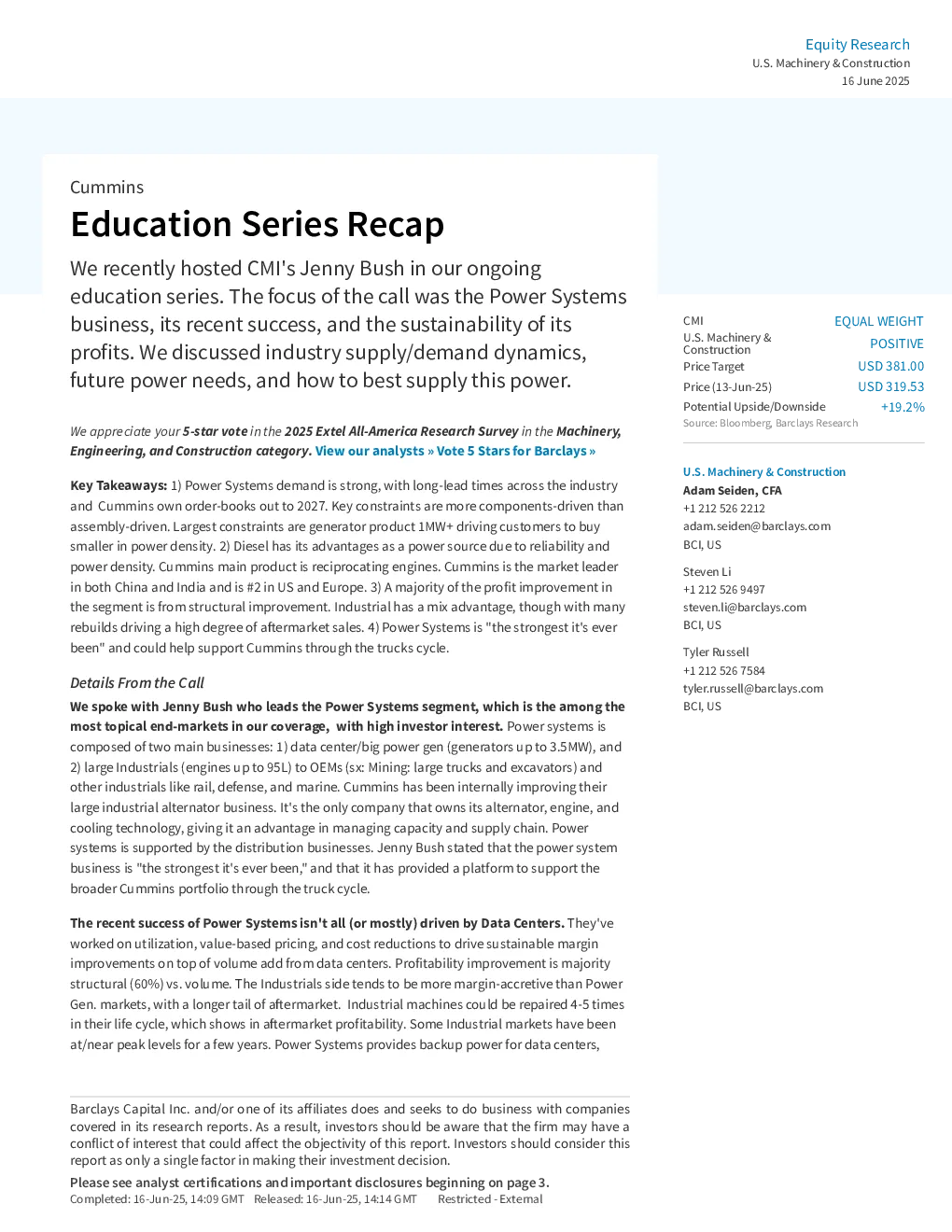
Education Series Recap We recently hosted CMI's Jenny Bush in our ongoingeducation series. The focus of the call was the Power Systemsbusiness, its recent success, and the sustainability of itsprofits. We discussed industry supply/demand dynamics,future power needs, and how to best supply this power. CMIEQUAL WEIGHTU.S. Machinery &ConstructionPOSITIVEPrice TargetUSD 381.00Price (13-Jun-25)USD 319.53Potential Upside/Downside+19.2%Source: Bloomberg, Barclays Research We appreciate your5-star votein the2025Extel All-America Research Surveyin theMachinery,Engineering, and Construction category.View our analysts » Vote 5 Stars for Barclays » U.S. Machinery & Construction Key Takeaways:1) Power Systems demand is strong, with long-lead times across the industryand Cummins own order-books out to 2027. Key constraints are more components-driven thanassembly-driven. Largest constraints are generator product 1MW+ driving customers to buysmaller in power density. 2) Diesel has its advantages as a power source due to reliability andpower density. Cummins main product is reciprocating engines. Cummins is the market leaderin both China and India and is #2 in US and Europe. 3) A majority of the profit improvement inthe segment is from structural improvement. Industrial has a mix advantage, though with manyrebuilds driving a high degree ofaftermarketsales. 4) Power Systems is "the strongest it's everbeen" and could help support Cummins through the trucks cycle. Adam Seiden, CFA+1 212 526 2212adam.seiden@barclays.comBCI, US Steven Li+1 212 526 9497steven.li@barclays.comBCI, US Tyler Russell+1 212 526 7584tyler.russell@barclays.comBCI, US Details From the Call We spoke with Jenny Bush who leads the Power Systems segment, which is the among themost topical end-markets in our coverage, with high investor interest.Power systems iscomposed of two main businesses: 1) data center/big power gen (generators up to 3.5MW), and2) large Industrials (engines up to 95L) to OEMs (sx: Mining: large trucks and excavators) andother industrials like rail, defense, and marine. Cummins has been internally improving theirlarge industrial alternator business. It's the only company that owns its alternator, engine, andcooling technology, giving it an advantage in managing capacity and supply chain. Powersystems is supported by the distribution businesses. Jenny Bush stated that the power systembusiness is "the strongest it's ever been," and that it has provided a platform to support thebroader Cummins portfolio through the truck cycle. The recent success of Power Systems isn't all (or mostly) driven by Data Centers.They'veworked on utilization, value-based pricing, and cost reductions to drive sustainable marginimprovements on top of volume add from data centers. Profitability improvement is majoritystructural (60%) vs. volume. The Industrials side tends to be more margin-accretive than PowerGen. markets, with a longer tail ofaftermarket.Industrial machines could be repaired 4-5 timesin their life cycle, which shows inaftermarketprofitability. Some Industrial markets have beenat/near peak levels for a few years. Power Systems provides backup power for data centers, hospitals, wastewater treatment, etc. and Cummins is the market leader in China/India anda close 2nd in US and Europe. The Industrial business mostly sells to an OEM (like the truck biz), whereas powermarkets are more dependent on the particular characteristics and circumstances of eachspecific unit(besides data center, customers buy 1-2 units at a time) where the customer isoftena contractor/AE&D firm. Datacenters are one of the only applications (besides large-scalerental) where many generators fulfill a single power requirement and 'redundant' equipmentfor backup power is exercised 1-2x per month. We got some insights on Data Center customers and how they vary.1) Hyperscalers - owneverything; 2) Colocation Data Centers - rent space, power, or equipment to a 3rd party; 3)regional data center customer for local use - owned or colocated. Data center customers needmore than generator units (engine, alternator, radiator, controls); they also need the 'balance ofplant' (non gen. set equipment) such as fuel tanks, enclosures, cabling, etc. The adjacentequipment tends to be specialized/customized and is generally served through the distributionbusiness. The Distribution segment is anoften-overlookedpart of Cummins and the Power Systems business. Cummins does not have independent dealers as its peers do, but owns (most) of theirnetwork. Dealers are responsible for placements of product and servicing throughout theaftermarketlife cycle. The local relationship is especially important as this type of equipmentdoesn't travel far (ex. Marine). The Power Systems segment did $1.65bn in revenue in 1Q25, butanother 1 billion of Power Gen. revenue was reported through distribution (for a bettercomparison to CAT E&T, for example). Cummins-owned dealers manage the life-cycle of theproduct a