您的浏览器禁用了JavaScript(一种计算机语言,用以实现您与网页的交互),请解除该禁用,或者联系我们。[气候债券倡议组织]:巴西农业甲烷减排实践的公共激励概述 - 发现报告

巴西农业甲烷减排实践的公共激励概述

AI智能总结
查看更多
巴西农业甲烷减排实践的公共激励概述

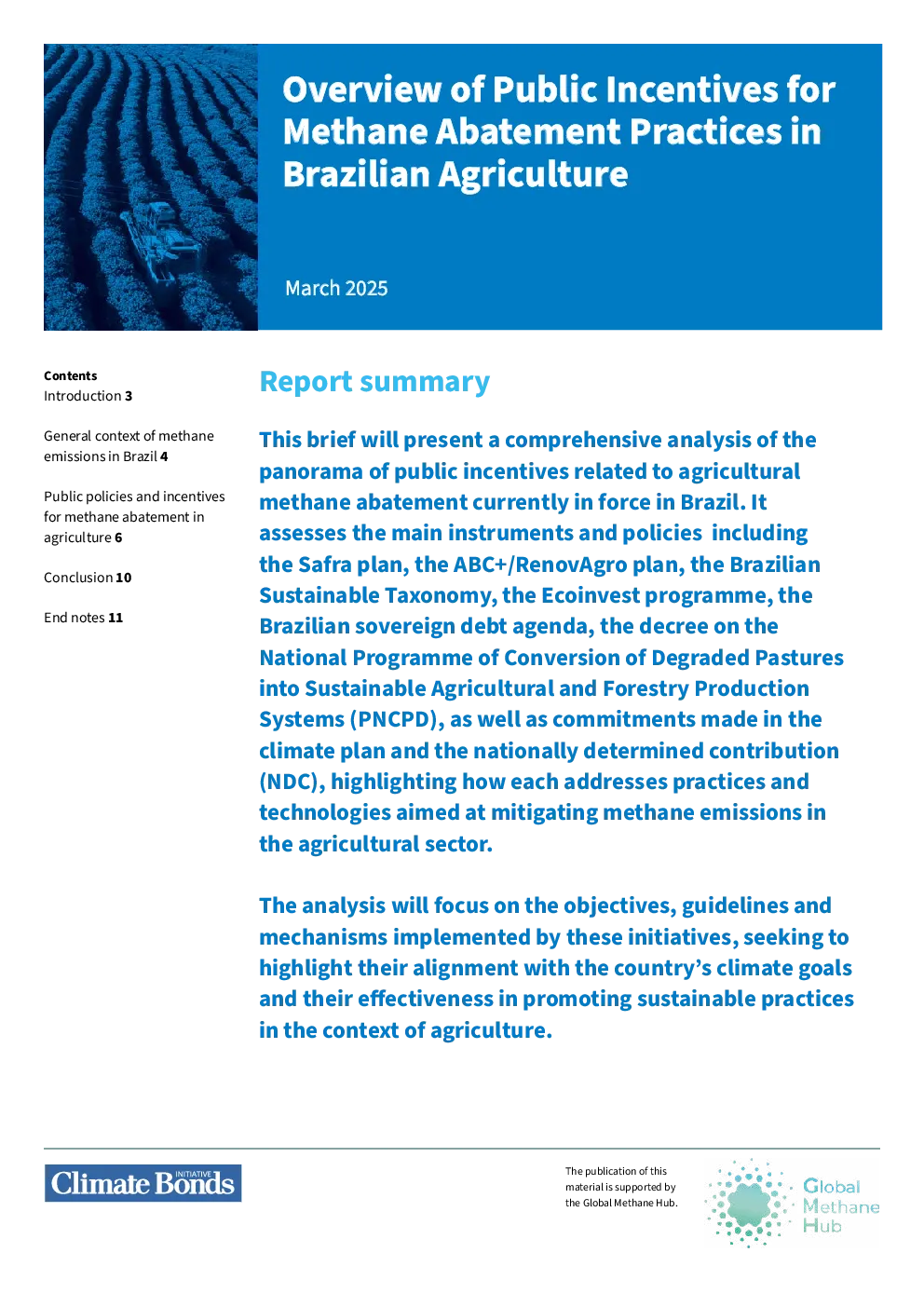
March 2025March 2025 Report summary ContentsIntroduction3 This brief will present a comprehensive analysis of thepanorama of public incentives related to agriculturalmethane abatement currently in force in Brazil. Itassesses the main instruments and policies includingthe Safra plan, the ABC+/RenovAgro plan, the BrazilianSustainable Taxonomy, the Ecoinvest programme, theBrazilian sovereign debt agenda, the decree on theNational Programme of Conversion of Degraded Pasturesinto Sustainable Agricultural and Forestry ProductionSystems (PNCPD), as well as commitments made in theclimate plan and the nationally determined contribution(NDC), highlighting how each addresses practices andtechnologies aimed at mitigating methane emissions inthe agricultural sector. General context of methaneemissions in Brazil4 Public policies and incentivesfor methane abatement inagriculture6 Conclusion10 End notes11 The analysis will focus on the objectives, guidelines andmechanisms implemented by these initiatives, seeking tohighlight their alignment with the country’s climate goalsand their effectiveness in promoting sustainable practicesin the context of agriculture. Introduction 17%Methane accountsfor around 17% ofthe total volume ofGHG released into theatmosphere Methane (CH4) is the second largest contributor to climate change amonggreenhouse gases (GHGs) in terms of volume,accounting for around 17% of the totalvolume of GHGs released into the atmosphere.1Despite this relatively lower volume,the global warming potential of CH4is more than 80 times greater than that of carbondioxide (CO2) during the 20 years following its emission into the atmosphere. Thispotential is due to the amount of energy the gas absorbs while it is in suspension. Incontrast, methane has a much shorter lifetime in the atmosphere than CO2, which hasprofound implications for target setting and metrics.2 Due to its high potency as a GHG and its short stay in the atmosphere, reducingmethane emissions quickly, significantly, and sustainably is crucial to limitingglobal warming in the short term.In this sense, public policies aimed at CH4abatement play a fundamental role both in encouraging investments and newtechnologies, and in directing capital to this end. This brief aims toprovide an overview ofhow current policiesand programmesin Brazil encouragemethane abatementpractices in agriculture(the main CH4emittingsector in the country),in order to serveas a starting pointfor a discussion onimproving theseinstruments. General context of methaneemissions in Brazil 3%Brazil emits around3% of the globalGHG total Brazil is one of the main global emitters of GHG, with around 3% of the world total.3Despite the significant reduction in deforestation between 2022–2023(24%), land use change still accounts for almost half of all the country’s emissionsand individually is the main challenge to be tackled in order to take Brazil on thedecarbonisation path it set out in its commitments. However, there are other importantdecarbonisation levers that can be considered, and methane abatement is anopportunity. 5thBrazil is the fifthlargest methaneemitter in the worldaccording to ClimateObservatory A report from the Climate Observatory’s system for estimating GHG emissions(SEEG) estimates that Brazil is the fifth largest methane emitter in the world,with emissions equivalent to 5.5% of the total global volume of CH4.Based onconsolidated data up to 2020, it was estimated that Brazilian methane emissionswere in the order of 21.7m tonnes, which corresponds to around 565m tonnes of CO2equivalent, around 25% of the country’s total GHG emissions.4 Agriculture is the largest emitter of methane in Brazil, responsible for 72% of thecountry’s total emissions.Other relevant sectors and activities in the context of CH4emissions in the country are waste management, with 16% of the total volume, aswell as land use change, and energy and industrial processes, with 9% and 4% of totalmethane emissions, respectively. 72%Agricultural methaneis responsible for72% of Brazil’s totalemissions Looking at agriculture in detail, livestock farming, mainly due to entericfermentation in cattle, accounts for 92% of all emissions from the sector,followedby animal waste management and irrigated rice cultivation, with 6% and 2% of totalagricultural emissions, respectively. Between 2005–2020, SEEG data shows that the volume of methane emissions inBrazilian agriculture remained virtually stable, at 14.0–14.5m tonnes per year. Whenthe 10% increase in the cattle herd for the period is taken into account, the dataindicates a gain in efficiency in methane emissions per unit of production.5However,the total volume of emissions from Brazilian agriculture remains high, with no clearpath to absolute reduction. Mitigating methane emissions in agriculture requires bothimproving existing practices and adopting innovative solutions. Reducing the herd, which is the most obvious measure for immediately red