RLB起重机指数®香港2022年第4季度
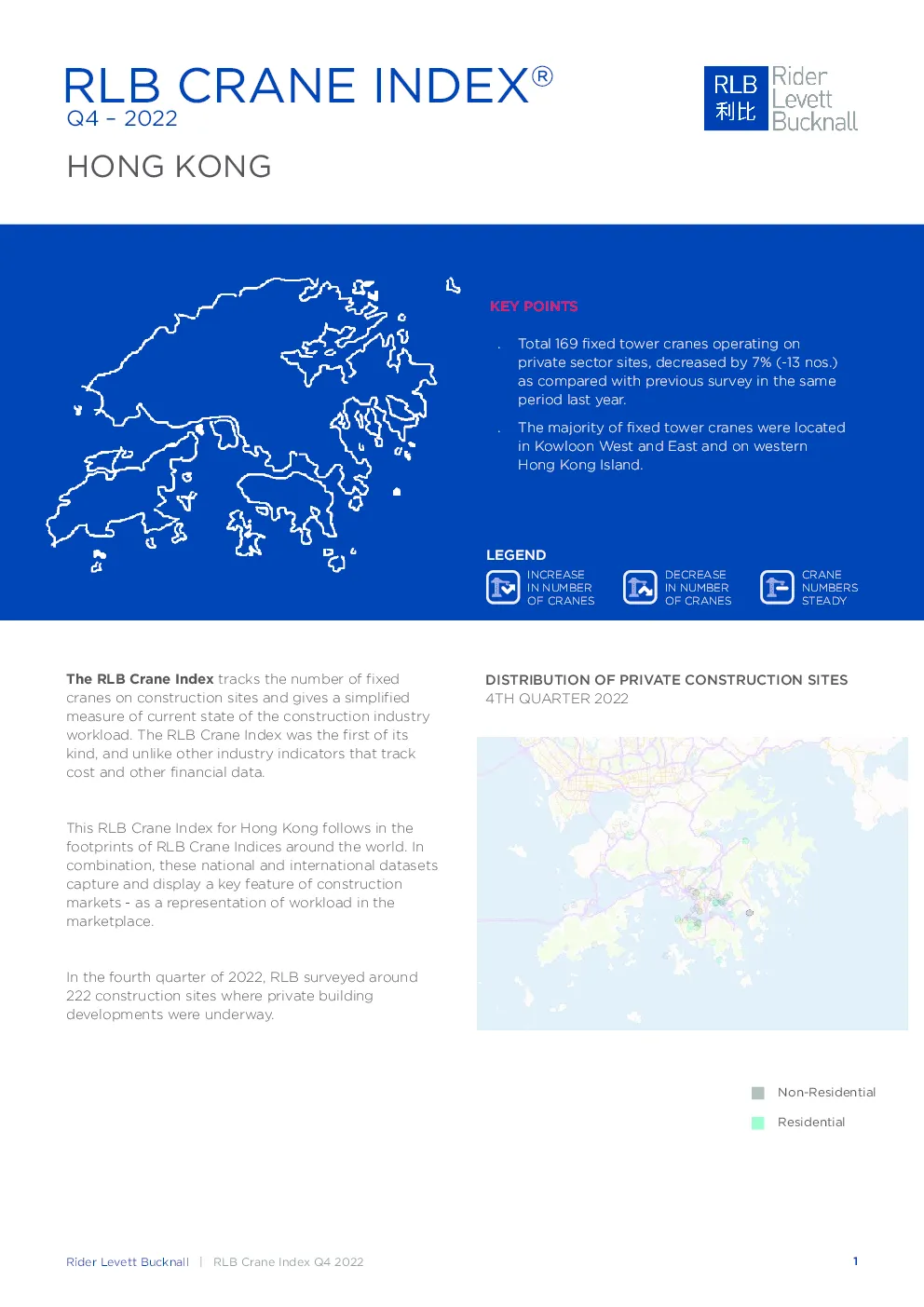
HONG KONG KEY POINTS .Total 169 fixed tower cranes operating onprivate sector sites, decreased by 7% (-13 nos.)as compared with previous survey in the sameperiod last year. .The majority of fixed tower cranes were locatedin Kowloon West and East and on westernHong Kong Island. LEGEND The RLB Crane Indextracks the number of fixedcranes on construction sites and gives a simplifiedmeasure of current state of the construction industryworkload. The RLB Crane Index was the first of itskind, and unlike other industry indicators that trackcost and other financial data. DISTRIBUTION OF PRIVATE CONSTRUCTION SITES4TH QUARTER 2022 This RLB Crane Index for Hong Kong follows in thefootprints of RLB Crane Indices around the world. Incombination, these national and international datasetscapture and display a key feature of constructionmarkets - as a representation of workload in themarketplace. In the fourth quarter of 2022, RLB surveyed around222 construction sites where private buildingdevelopments were underway. Q4 – 2020Q4 – 2022 HONG KONG Factoring out mobile cranes and piling rigs, there were169 fixed tower cranes found on 79 out of the 222private sector construction sites surveyed in the fourthquarter of 2022. OVERALLSTATUS The superstructure construction works on privateconstruction sites were generally centralised in KowloonWest and East and on western Hong Kong Island. Theremaining ones were located in new development areasin Tseung Kwan O and Yuen Long, as can be seen fromthe city centre map. Non-residential development sites were particularlyprominent. 55% of the fixed tower cranes wereoperating for the superstructure construction of non-residential buildings. THE RLB CRANE INDEX LOCALITY MAPS The locality maps offer a pictorial representationof the collected data using a pin locator forthe approximate location and sector of thedevelopment to where cranes are located. Thepins are not an indication of the number ofcranes in that location. The locations of the pinsare indicative only and have been positioned toconvey the general spread of cranes within acity and to indicate the spread of cranes withinmarket sectors. Locality maps have been createdby RLB using map data from various mapsources, such as Google Map, OpenStreetMaporg, Bing Maps, etc.