西北机器人联盟:机器人筹资和扩展内幕指南
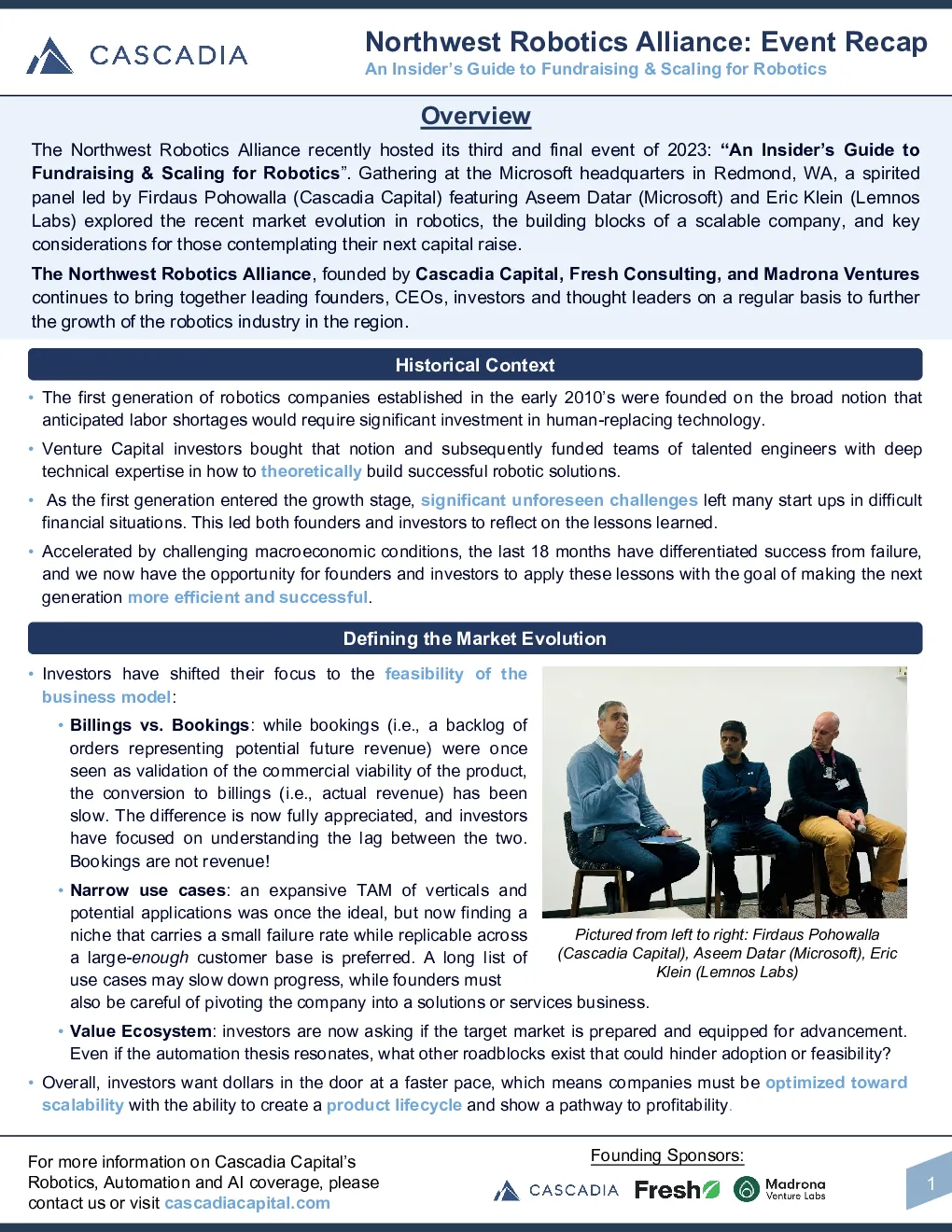
Overview The Northwest Robotics Alliance recently hosted its third and final event of 2023:“An Insider’s Guide toFundraising & Scaling for Robotics”. Gathering at the Microsoft headquarters in Redmond, WA, a spiritedpanel led by Firdaus Pohowalla (Cascadia Capital) featuring Aseem Datar (Microsoft) and Eric Klein (LemnosLabs) explored the recent market evolution in robotics, the building blocks of a scalable company, and keyconsiderations for those contemplating their next capital raise. The Northwest Robotics Alliance, founded byCascadia Capital, Fresh Consulting, and Madrona Venturescontinues to bring together leading founders, CEOs, investors and thought leaders on a regular basis to furtherthe growth of the robotics industry in the region. Historical Context •The first generation of robotics companies established in the early 2010’s were founded on the broad notion thatanticipated labor shortages would require significant investment in human-replacing technology.•Venture Capital investors bought that notion and subsequently funded teams of talented engineers with deeptechnical expertise in how totheoreticallybuild successful robotic solutions.•As the first generation entered the growth stage,significant unforeseen challengesleft many start ups in difficultfinancial situations. This led both founders and investors to reflect on the lessons learned.•Accelerated by challenging macroeconomic conditions, the last 18 months have differentiated success from failure,and we now have the opportunity for founders and investors to apply these lessons with the goal of making the nextgenerationmore efficient and successful. Defining the Market Evolution •Investors have shifted their focus to the feasibility of thebusiness model: •Billings vs. Bookings: while bookings (i.e., a backlog ofordersrepresenting potential future revenue)were onceseen as validation of the commercial viability of the product,the conversion to billings (i.e., actual revenue) has beenslow. The difference is now fully appreciated, and investorshave focused on understanding the lag between the two.Bookings are not revenue! •Narrow use cases: an expansive TAM of verticals andpotential applications was once the ideal, but now finding aniche that carries a small failure rate while replicable acrossa large-enoughcustomer base is preferred. A long list ofuse cases may slow down progress, while founders must Pictured from left to right: Firdaus Pohowalla(Cascadia Capital), Aseem Datar (Microsoft), EricKlein (Lemnos Labs) •also be careful of pivoting the company into a solutions or services business. •Value Ecosystem:investors are now asking if the target market is prepared and equipped for advancement.Even if the automation thesis resonates, what other roadblocks exist that could hinder adoption or feasibility? •Overall, investors want dollars in the door at a faster pace, which means companies must beoptimized towardscalabilitywith the ability to create aproduct lifecycleand show a pathway to profitability. Northwest Robotics Alliance: Event RecapAn Insider’s Guide to Fundraising & Scaling for Robotics Key Components of a Scalable Robotics Company •Product Market Fit vs. Business Market Fit: companies have been successful atidentifying aproduct market fitthat answers the question “are there customers thatwant my product?” However, companies must also be able to identify their valueecosystem and answer the questions that ensure there is abusiness market fit: •Who sells it? Is my pricing structure correct? Is it RaaS or CapEx?•What layers of the technology stack can I buy vs. build?•Who services it? What third parties will I need to rely on?•Can it scale without displacing existing channels?•What are the regulatory challenges? •Team: when building a team that will push the company toward scalability one must consider the following: •Ensuringbusiness-oriented leadersare in place to help establish the business market fit—deep verticalexpertiseis critical to align the product to the business market opportunity.•Right-sizing the team to support maximum efficiency, commercial viability and scale potential. •Capital Efficiency: it is critical to ensure costs are aligned with growth potential and maximize invested capital •Earlier generations of robotics companies felt the need to build the entire technology stack themselves, but thisis no longer necessary. This led tolarger teamswith much higher fixed costs that can now be managed. New Fundraising Benchmarks •Changing Dynamics:in line with the market evolutionand expectations of scalability, performance benchmarksfor successful fundraising effortscontinue to shift: •Pre-Seed / Seed: remains focused on the quality ofthe team•Series A: while $1M in revenue used to be enough,investors have raised the threshold to$2 – $5M•Series B/C:selling becomes the primary focus.Investors are now looking for2 – 3x revenue growthand up to6x customer pipeline growth at eachstage while simultaneously droppi