改善k-12学校氛围的5种方法
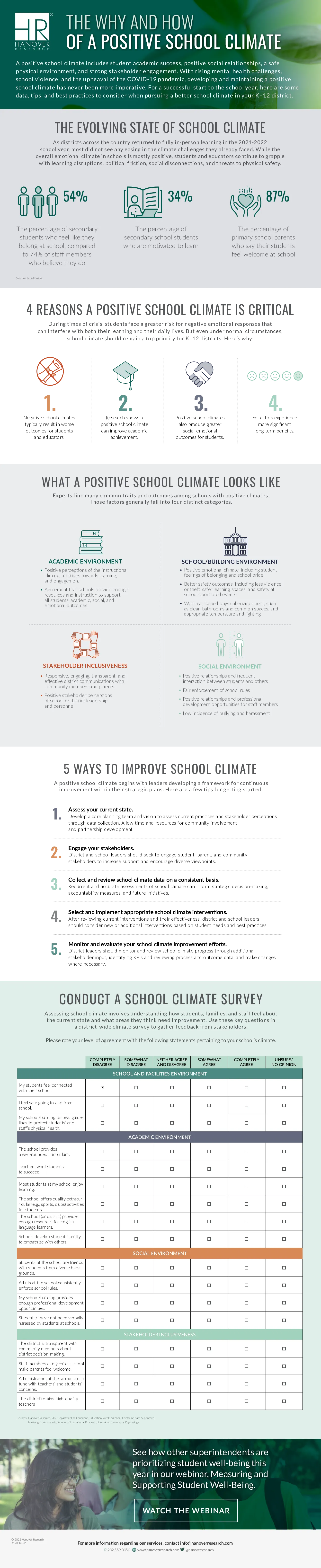
A positive school climate includes student academic success, positive social relationships, a safephysical environment, and strong stakeholder engagement. With rising mental health challenges,school violence, and the upheaval of the COVID-19 pandemic, developing and maintaining a positiveschool climate has never been more imperative. For a successful start to the school year, here are somedata, tips, and best practices to consider when pursuing a better school climate in your K–12 district. THE EVOLVING STATE OF SCHOOL CLIMATE As districts across the country returned to fully in-person learning in the 2021-2022school year, most did not see any easing in the climate challenges they already faced. While theoverall emotional climate in schools is mostly positive, students and educators continue to grapplewith learning disruptions, political friction, social disconnections, and threats to physical safety. 54% The percentage of secondarystudents who feel like theybelong at school, comparedto 74% of staff memberswho believe they do The percentage ofsecondary school studentswho are motivated to learn The percentage ofprimary school parentswho say their studentsfeel welcome at school Sources listed below. 4 REASONS A POSITIVE SCHOOL CLIMATE IS CRITICAL During times of crisis, students face a greater risk for negative emotional responses thatcan interfere with both their learning and their daily lives. But even under normal circumstances,school climate should remain a top priority for K–12 districts. Here’s why: Educators experiencemore significantlong-term benefits.4. Positive school climatesalso produce greatersocial-emotionaloutcomes for students. Negative school climatestypically result in worseoutcomes for studentsand educators. Research shows apositive school climatecan improve academicachievement. WHAT A POSITIVE SCHOOL CLIMATE LOOKS LIKE Experts find many common traits and outcomes among schools with positive climates.Those factors generally fall into four distinct categories. •Positive emotional climate, including studentfeelings of belonging and school pride•Better safety outcomes, including less violenceor theft, safer learning spaces, and safety atschool-sponsored events•Well-maintained physical environment, suchas clean bathrooms and common spaces, andappropriate temperature and lightingSCHOOL/BUILDING ENVIRONMENT •Positive perceptions of the instructionalclimate, attitudes towards learning,and engagement•Agreement that schools provide enoughresources and instruction to supportall students’ academic, social, andemotional outcomes •Positive relationships and frequentinteraction between students and others•Fair enforcement of school rules•Positive relationships and professionaldevelopment opportunities for staff members•Low incidence of bullying and harassmentSOCIAL ENVIRONMENT 5 WAYS TO IMPROVE SCHOOL CLIMATE A positive school climate begins with leaders developing a framework for continuousimprovement within their strategic plans. Here are a few tips for getting started: ACADEMICS1.2.3.4.5.Assess your current state.Develop a core planning team and vision to assess current practices and stakeholder perceptionsthrough data collection. Allow time and resources for community involvementand partnership development.Engage your stakeholders.District and school leaders should seek to engage student, parent, and communitystakeholders to increase support and encourage diverse viewpoints.Collect and review school climate data on a consistent basis.Recurrent and accurate assessments of school climate can inform strategic decision-making,accountability measures, and future initiatives.Select and implement appropriate school climate interventions.After reviewing current interventions and their effectiveness, district and school leadersshould consider new or additional interventions based on student needs and best practices.Monitor and evaluate your school climate improvement efforts.District leaders should monitor and review school climate progress through additionalstakeholder input, identifying KPIs and reviewing process and outcome data, and make changeswhere necessary. CONDUCT A SCHOOL CLIMATE SURVEY Assessing school climate involves understanding how students, families, and staff feel aboutthe current state and what areas they think need improvement. Use these key questions ina district-wide climate survey to gather feedback from stakeholders. Please rate your level of agreement with the following statements pertaining to your school’s climate. See how other superintendents areprioritizing student well-being thisyear in our webinar, Measuring andSupporting Student Well-Being.