您的浏览器禁用了JavaScript(一种计算机语言,用以实现您与网页的交互),请解除该禁用,或者联系我们。[BIS]:人工智能对金融稳定的影响——执行摘要 - 发现报告

人工智能对金融稳定的影响——执行摘要

2025-06-26BIS周***
AI智能总结
查看更多
人工智能对金融稳定的影响——执行摘要

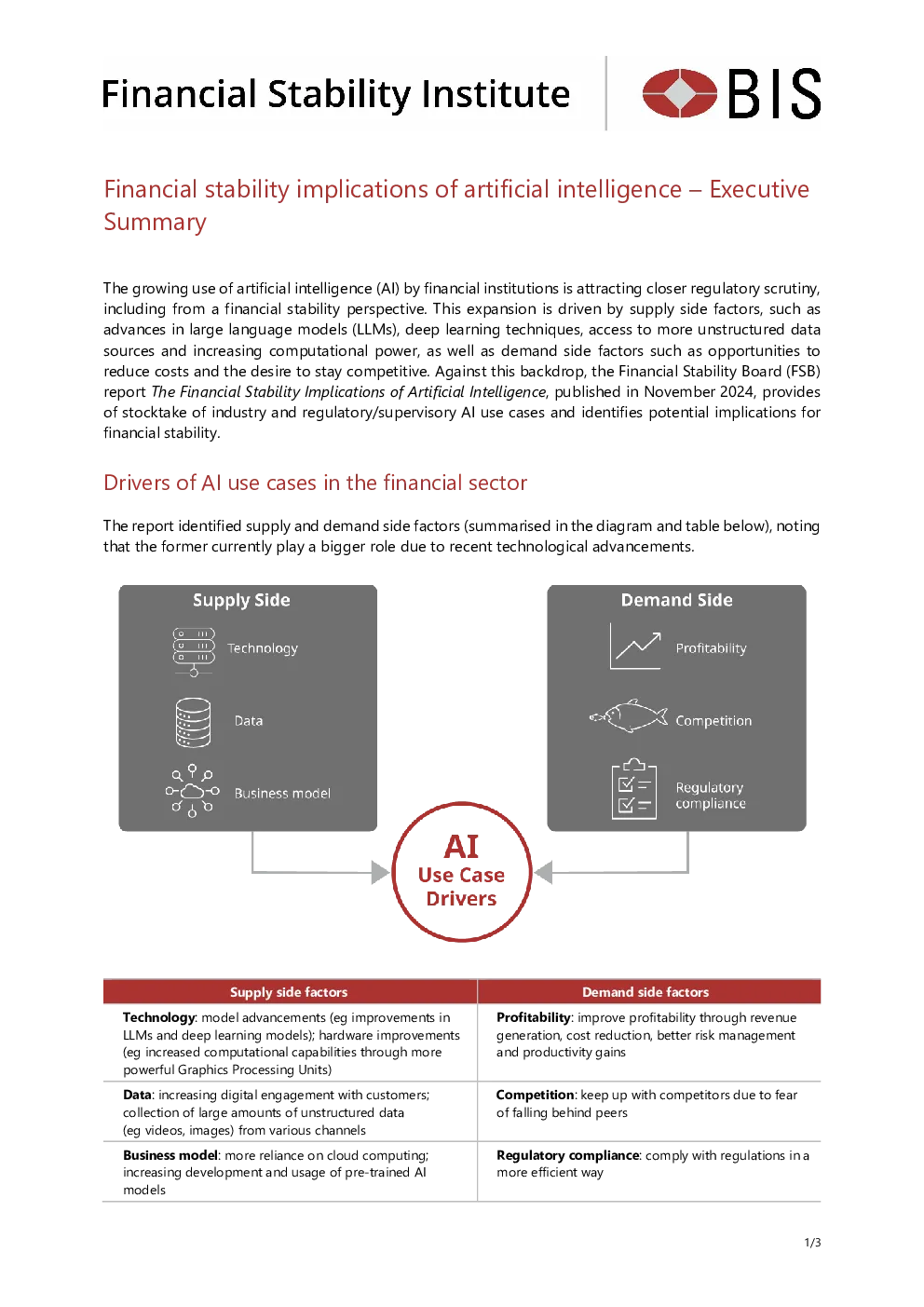
Financial stability implications of artificial intelligence – ExecutiveSummary The growing use of artificial intelligence (AI) by financial institutions is attracting closer regulatory scrutiny,including from a financial stability perspective. This expansion is driven by supply side factors, such asadvances in large language models (LLMs), deep learning techniques, access to more unstructured datasources and increasing computational power, as well as demand side factors such as opportunities toreduce costs and the desire to stay competitive. Against this backdrop, the Financial Stability Board (FSB)reportThe Financial Stability Implications of Artificial Intelligence, published in November 2024, providesof stocktake of industry and regulatory/supervisory AI use cases and identifies potential implications forfinancial stability. Drivers of AI use cases in the financial sector The report identified supply and demand side factors (summarised in the diagram and table below), notingthat the former currently play a bigger role due to recent technological advancements. AI use cases Financial institutions use AI mostly in enhancing internal operations and improving regulatory compliance.At present, use cases for revenue generation are limited, though firms are cautiously experimenting withgenerative AI (gen AI). The report adopts an activity-based framework to classify AI use cases, brokendown by industry and regulatory/official sector, as follows: Regulatory/official sector Supervisory technology (suptech): enhance oversight of payment systems, information collection to support real-timeanalysis of economic activity Supervisory analysis: use of LLMs to analyse textual data sources Supervisory processes: use of LLMs to extract information from inspection documents and summarise/draft inspection Stress testing: model social media interactions in bank runs Financial stability implications of AI The use of AI in financial services without appropriate controls and oversight could amplify certain financialvulnerabilities, with potential implications for financial stability. The key AI-related developments thatcould have financial stability implications include: −wider integration of AI in financial services, with increasing use in core business operations−technological breakthroughs in LLMs and gen AI, enabling new applications but also introducing newrisks−growing reliance on specialised hardware and infrastructure services, concentrated among a fewproviders−increasinguse of unstructured and opaque training data sources,complicating data qualityassessments and model validation Financial authorities face two key challenges in evaluating the financial stability implications of AI thathinder effective vulnerability surveillance: significant uncertainty from rapid innovation and limited dataon AI uptake. It is important to monitor potential financial stability implications that can arise from: −Third-party dependencies and service provider concentration– eg reliance on a few dominantproviders for AI hardware and cloud services −Market correlations– eg widespread use of similar AI models and training data −Cyber vulnerabilities– eg lower barriers for cyber criminals, enabling sophisticated attacks, such asmodel poisoning and disinformation campaigns−Model risk, data quality and governance– eg lack of explainability of AI models and opaque trainingdata, complicating validation and monitoring−Other factors– eg gen AI facilitating fraud, such as deepfakes, synthetic identities and disinformationcampaigns capable of triggering flash crashes or bank runs Policy recommendations The FSB recommends the following actions to address potential financial stability implications of the useof AI in the financial sector: −Close data gaps– improve monitoring of AI adoption through periodic surveys, regulatory reporting,public disclosure and engagement with private sector stakeholders−Review regulatory and supervisory frameworks– assess whether existing supervisory guidelinessufficiently address financial stability risks from AI use cases−Enhance regulatory and supervisory capabilities– promote international cooperation and cross-sectoral sharing of information and good practices, and leverage AI tools to enhance regulatory andsupervisory functions This Executive Summary and related tutorials are also available inFSI Connect, the online learning tool ofthe Bank for International Settlements.