您的浏览器禁用了JavaScript(一种计算机语言,用以实现您与网页的交互),请解除该禁用,或者联系我们。[William Blair]:为什么墨西哥在全球贸易发展中处于有利地位 - 发现报告

为什么墨西哥在全球贸易发展中处于有利地位

AI智能总结
查看更多
为什么墨西哥在全球贸易发展中处于有利地位

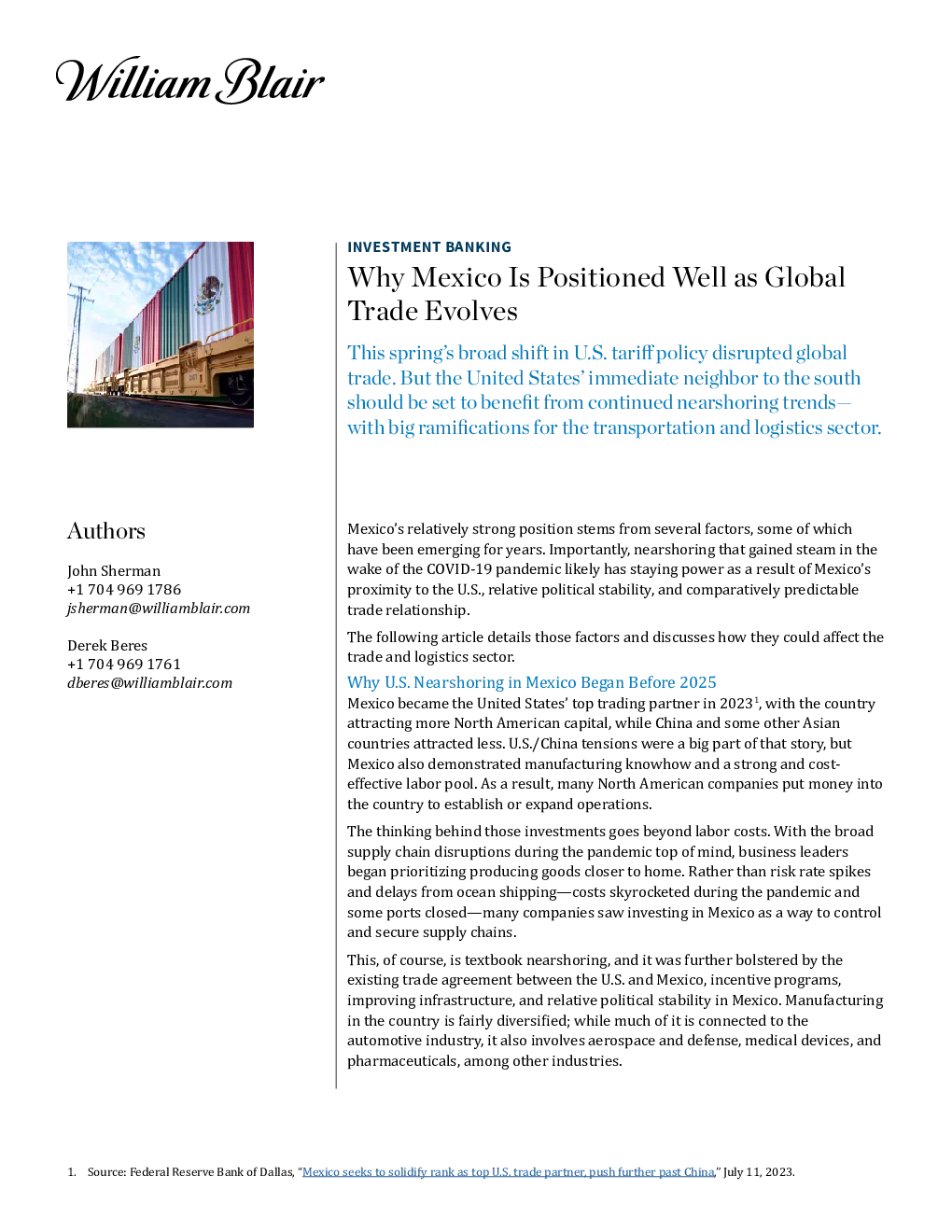
INVESTMENT BANKING Why Mexico Is Positioned Well as GlobalTrade Evolves This spring’s broad shift in U.S. tariff policy disrupted globaltrade. But the United States’ immediate neighbor to the southshould be set to benefit from continued nearshoring trends—with big ramifications for the transportation and logistics sector. Mexico’s relatively strong position stems from several factors, some of whichhave been emerging for years. Importantly, nearshoring that gained steam in thewake of the COVID-19 pandemic likely has staying power as a result of Mexico’sproximity to the U.S., relative political stability, and comparatively predictabletrade relationship. Authors John Sherman+1 704 969 1786jsherman@williamblair.com The following article details those factors and discusses how they could affect thetrade and logistics sector. Derek Beres+1 704 969 1761dberes@williamblair.com Why U.S. Nearshoring in Mexico Began Before 2025Mexico became the United States’ top trading partner in 20231, with the country attracting more North American capital, while China and some other Asiancountries attracted less. U.S./China tensions were a big part of that story, butMexico also demonstrated manufacturing knowhow and a strong and cost-effective labor pool. As a result, many North American companies put money intothe country to establish or expand operations. The thinking behind those investments goes beyond labor costs. With the broadsupply chain disruptions during the pandemic top of mind, business leadersbegan prioritizing producing goods closer to home. Rather than risk rate spikesand delays from ocean shipping—costs skyrocketed during the pandemic andsome ports closed—many companies saw investing in Mexico as a way to controland secure supply chains. This, of course, is textbook nearshoring, and it was further bolstered by theexisting trade agreement between the U.S. and Mexico, incentive programs,improving infrastructure, and relative political stability in Mexico. Manufacturingin the country is fairly diversified; while much of it is connected to theautomotive industry, it also involves aerospace and defense, medical devices, andpharmaceuticals, among other industries. How U.S. Tariff Policy CouldStrengthen Ties With Mexico The busy trade hub ofLaredo, Texas, is locatednear the Mexican border—positioning it well in thecoming years, given thestability of the U.S./Mexicorelation ship, existingtrade agree ments, andother factors. Those factors combined to putMexico in a good spot entering2025, even if some companies mighthave been reconsidering China asthe pandemic faded further intohistory. But President Trump’s tariffannouncement in early April—andhis clear focus on China—has perhapsfurther strengthened Mexico’s hand. Trump’s initial reciprocal tariffsfor much of the world arguably putMexico and Canada in their strongestpositions, as there are no tariffs ongoods from those countries thatqualify for preference under the U.S.-Mexico-Canada Agreement (USMCA).2Trump’s tariff adjustments—the90-day tariff pause on the reciprocaltariffs in April and the 90-dayreduction on tariffs on Chinesegoods to 30% in May3—changed theequation. But Mexico and Canada arestill in a strong position. Laredo Trade Facts4•$339 billion in trade through Laredo in 2024•$128 billion in exports;$211 billion in imports•$85 billion in trade withMexico through Laredo To be sure, the picture is evolvingquickly—and the USMCA is up forreview in 2026. Regardless, trade tiesbetween Mexico and the U.S. will likelygrow, at least in the short and mediumterm, as relative certainty around tariffrates with Mexico—combined withthe factors listed above—make thecountry attractive for investment. a firm grasp on their intended end-markets is important—as is deployingthe latest technologies and processes.C.H. Robinson, in announcing theexpansion of its Laredo footprint to1.5 million square feet in late 2023,noted how the company “meticulouslydesigned” the new facility.8 Primed for More InvestmentAround the Border? Activity around Laredo, Texas, isa good sign that investment in theregion will continue. Located near theindustrial city of Monterrey, Mexico,Laredo is a busy trade hub, with tradein 2024 exceeding $339 billion, up6% from 2023.5This spring, PresidentTrump approved a private company’sapplication to build a commercialelevated guideway in Laredo.6Thatshould improve truck traffic flow atthe border—but new warehouseswere already popping up aroundLaredo, including a 32.71-acre facilitythat ConGlobal announced this year.7 One other factor in Mexico’s favor, atleast, for now is that President ClaudiaSheinbaum has earned Trump’srespect. Continued Mexican politicalstability will be key as to whether U.S.companies continue to invest there,but the investments also will likelyhelp make the country more stable,leading to a stronger economy, jobs,and potentially fewer illegal bordercrossings to the U.S. “It typically takes three trucks tobring a shipment thr