您的浏览器禁用了JavaScript(一种计算机语言,用以实现您与网页的交互),请解除该禁用,或者联系我们。[Jefferies]:亚太量化:美元疲软的影响 - 发现报告

亚太量化:美元疲软的影响

2025-06-10Desh Peramunetilleke、Mahesh Kedia、Nicholas NgJefferies坚***
AI智能总结
查看更多
亚太量化:美元疲软的影响

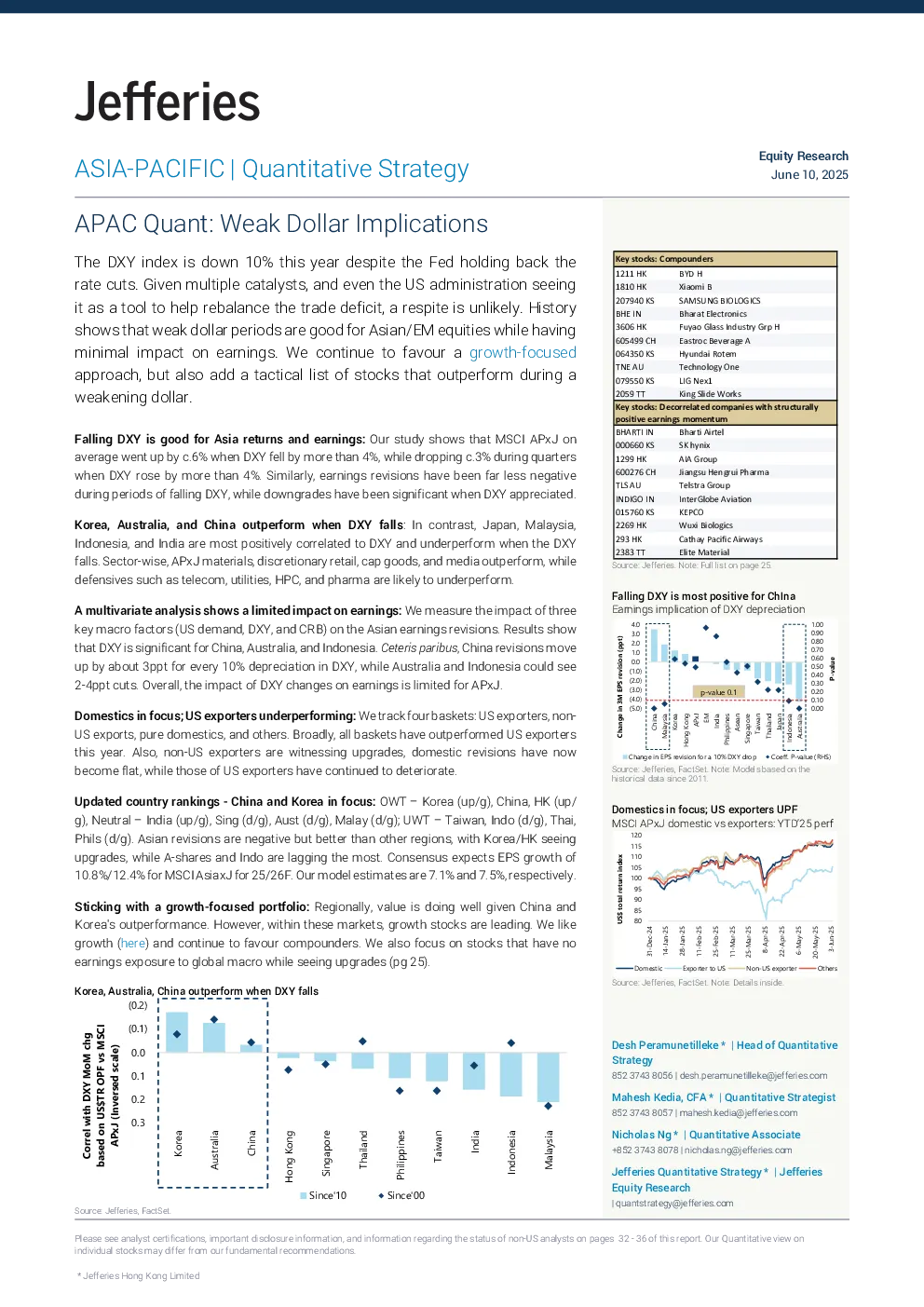
香港 泰国新加坡自'10 印度马来西亚印度尼西亚台湾菲律宾自从'00年起 80859095100105110115120MSCI 阿普捷讯 国内 vs 出口商:2025年迄今为止表现来源:Jefferies,FactSet。注意:详情在内部。852 3743 8056 | desh.peramunetilleke@jefferies.com国内市场受关注;美国出口商UPF美元总回报指数国内出口商对美非美国出口商其他杰富瑞量化策略* | 杰富瑞股票研究| quantstrategy@jefferies.comMahesh Kedia, CFA* | 量化策略师852 3743 8057 | mahesh.kedia@jefferies.com来源:Jefferies,FactSet。注意:模型基于自2011年以来的历史数据。尼古拉斯· Ng* | 定量分析师+852 3743 8078 | nicholas.ng@jefferies.com德什·佩拉穆内蒂莱克* | 量化策略主管25-04-2231-12-2425-04-0814-01-25 28-01-25 11-02-25 25-02-252025年5月6日25-03-25 25-03-2520-05-25 03-06-25 请参阅本报告第32至36页的重要披露信息。目录主题本报告专供杰富瑞客户使用。禁止未经授权的传播。2025年下半年的亚洲路线图美元疲软是亚洲迄今为止回报的重要贡献因素亚洲估值处于重新定价阶段相对于美国亚洲资产比美国资产更具吸引力标普500与中国辉煌10主题 – 美元走弱美元指数下跌有利于亚洲回报和盈利 多元回归模型用于识别美元影响 金融、IT、医疗保健和公用事业部门受美元影响不显著 屏幕:宏观不相关股票 – 市场排名前10 屏幕:若美元走弱,盈利有正面影响的股票 屏幕:若美元走弱,盈利有负面影响的股票 屏幕:与美元负相关的股票 屏幕:与美元正相关的股票 关注国内市场;对美出口商可能进一步表现不佳 屏幕:美国收入敞口高的公司市场展望:韩国上涨,中国保持OWT亚洲下调优于其他地区价值市场在亚洲运行良好;成长股在中国和韩国表现强劲屏幕:潜在复合型股票亚太地区(不含日本)投资组合附录 1:风格指南注意:性能数据截至2025年6月3日收盘。 2第3页 4页 5页6页 7页 8页 9页 10页 11页 12页 14页 15页1617 18 19 20 2122 23 24 31 请参阅本报告第32至36页的重要披露信息。表1:JEFQ 2025年下半年亚洲路线图2025年下半年的亚洲路线图本报告专供杰富瑞客户使用。禁止未经授权的传播。来源:Jefferies时间线主题式宏观条件需求/国内生产总值美国通货膨胀美联储加息美国收益率曲线油价美圆风险对我们呼叫的主要风险股票市场盈利预测风格偏好分红策略偏好国家偏好超重/OPF中性体重过轻/UPF部门偏好超重/OPF中性行业集团排名顶尖关键行业/OPF我们看到亚洲股票存在潜在上行空间,鉴于其相对于美国的估值具有吸引力,以及美元疲软。关税引发全球经济增速放缓,同时美国通胀维持高利率,是这一观点的主要风险。本年度初我们将中国评级定为增持(OWT),尽管近期上涨已减少了估值折价,我们发现其无论是在盈利方面还是在估值方面都具有吸引力,尤其是其私营部门我们已将韩国评级上调至OWT,因其在对美元指数下跌期间表现良好,存在积极修正,且在大选后可能受益于价值释放催化剂。日本对我们而言呈中性,因其评级上调动力放缓,但盈利依然强劲。我们已将印度上调至中性,因其修正达到底部,宏观经济改善,且存在降息预期。鉴于地缘政治、关税以及人工智能环境的不确定性,我们继续对台湾持超配(UWT)观点。我们更青睐盈利具有韧性的成长板块,包括通信服务、可选消费和工业。在亚洲市场,我们继续倾向于成长优于价值。亚洲今年从解放日抛售中恢复后上涨了约10%。虽然关税被推迟,现在焦点在于贸易谈判和潜在的美联储降息。尽管美联储推迟了降息,但DXY指数今年下跌了10%。多个催化剂表明不太可能出现喘息,甚至美国政府也希望美元走弱以帮助减少贸易逆差。 关注关税和美联储相对鲁棒核心通胀率仍高于美联储目标无剪辑熊陡峭70美元达到顶峰后下跌,约10%1) 特朗普对关税的行动导致经济衰退2) 乌克兰-俄罗斯前线的地缘政治恶化上升约10%一些降级APxJ:OPF - 数值;UPF - 低风险日本:OPF - GARP; UPF - 复原前五分位股息收益率,债券代理指标<think>Okay, the user wants me to translate some text into simplified Chinese. Let me check the source text again. The source is "Korea, Si韩国,中国,香港澳大利亚、菲律宾、印度和印度尼西亚台湾、马来西亚和泰国自由裁量,通信服务,财务信息技术,材料,房地产,工业医疗保健,日用品,能源,公用事业商业服务、媒体和可选零售软件、消费者服务与健康医疗 1H'25贸易协议、美国赤字和美联储降息GDP增速放缓持续通货膨胀仍然居高不下经济放缓,再削减2-3刀利牛陡峭50-60美元持续减弱进一步上升降级持续但仍然边缘化APxJ:OPF - 增长;UPF - 价值日本:OPF - 质量和修订;UPF - 价值和高风险高品质产出(HQY),键合代理(BPs)印度,新加坡,澳大利亚,马来西亚菲律宾,泰国,印度尼西亚,台湾通信服务,自由支配的,工业房产,信息技术,医疗保健,日用品公共事业,金融,材料,能源体重过轻/UPF自主零售,媒体,科技硬件交通、材料、能源底部关键领域/UPF 2025年剩余时间美元贬值应继续支撑亚洲表现<think>Okay, the user wants me to translate a specific markdown text intosimplified Chinese. The source text is "Staying overweight Chinaand underweight Taiwan". First, Ineed to make sure I understand the context. It seems like a title ora heading that's discussing the weight status of China and Taiwan. The key here is to translate thephrases "overweight China" and"underweight Taiwan" accuratelywhile keeping the formula notation unchanged.The phrase "overweight China"might be referring to China's population being overweight, so I should translate that as "超重的中国". Similarly, "underweight Taiwan" would be "偏瘦的台湾". However, I need to check if "overweight" and "underweight" are correctly translated. In Chinese, "overweight" is commonly translated as"超重", and "underweight" as "偏瘦".Also, the structure of the originaltext is "Staying overweight Chinaand underweight Taiwan". The word "staying" here might be a typo or a specific term. If it's meant to be "Staying overweight" as in remaining in a state of being overweight, maybe "保持超重的中国"would be appropriate. But the original might be a title, so I shouldcheck if there's a standard way to phrase this in Chinese. Alternatively, if "staying" is part of a formula or notation, maybe it's better to keep it as is. However, the user mentioned keeping the formulanotation unchanged, so I need tosee if "staying" is part of a formula.Wait, the user says to keep the formula notation unchanged. But the original text doesn't have anyformula notation, just text. So maybe the user is referring to not altering the structure of the text, like not adding any markdown. The主要市场降级:澳大利亚、东盟<think>Okay, the user wants me to translatesome markdown text into simplified Chinese. The source text is "Key markets upgraded: Korea, HK, and India". Ineed to make sure I translate that accurately.First, "Key markets upgraded" – "Keymarkets" would be "关键市场" in Chinese. "Upgraded" here probably meansimproved or enhanced. So maybe "升级" or "提升". But in the context of markets, "升级" might be more appropriate. So "关键市场升级".Then the list: Korea, HK, and India. Hong Kong is usually translated as 香港, so HK is 香港. India is 印度. Korea is韩国. So the list becomes 韩国, 香港,and 印度. But in Chinese, when listingitems, we often use "和" for "and". So the translation would be "韩国、香港和印度".Putting it all together: "关键市场升级:韩国、香港和印度". I should check if the formula notation is kept unchanged. The original has a colon after "upgraded", so in Chinese, that's maintainedas ":". Also, the list items are separated by commas and "和". Seems correct.Wait, the user mentio