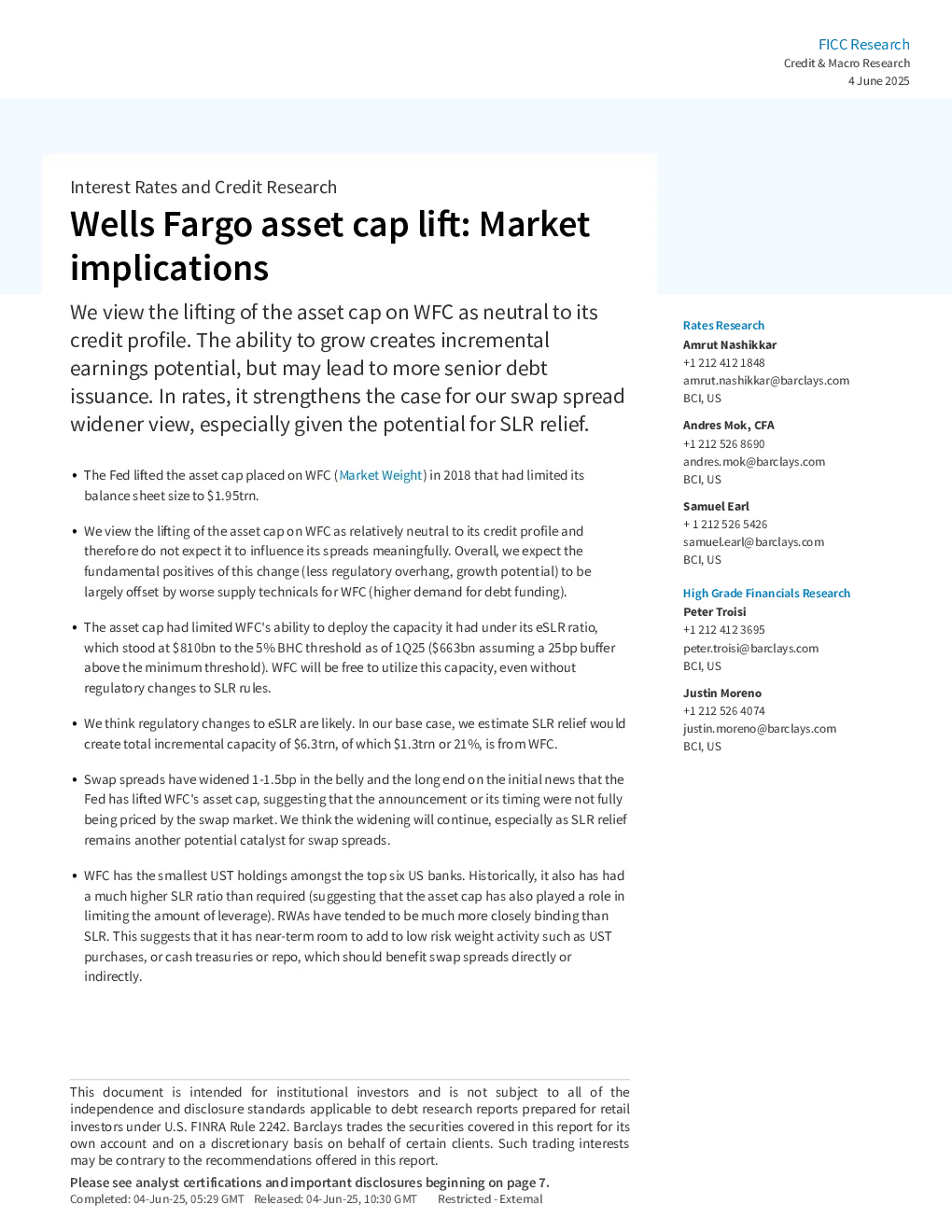
Restricted - External Rates ResearchAmrut Nashikkar+1 212 412 1848amrut.nashikkar@barclays.comBCI, USAndres Mok, CFA+1 212 526 8690andres.mok@barclays.comBCI, USSamuel Earl+ 1 212 526 5426samuel.earl@barclays.comBCI, USHigh Grade Financials ResearchPeter Troisi+1 212 412 3695peter.troisi@barclays.comBCI, USJustin Moreno+1 212 526 4074justin.moreno@barclays.comBCI, US 1This is in addition to the $810bn of capacity WFC has under the current eSLR framework.Credit implications for WFCPeter Troisi BCI, US | Justin Moreno BCI, USWe view theliftingof the asset cap on WFC as relatively neutral to its credit profile and thereforedo not expect it to influence its spreads meaningfully. Overall, we expect the fundamentalpositives of this change (less regulatory overhang, growth potential) to be largelyoffsetbyworse supply technicals for WFC (higher demand for debt funding).WFC 10y holdco senior bonds (5.605% of 2036) closed Tuesday quoted at a g-spread of about+100bp, mid-market, or about 7bp behind BAC 5.464% of 2036 and 10bp cheap to JPM 5.572%of 2036. With the asset cap removed, we see fair value for WFC about 10bp behind JPM,effectivelyflat to where it is currently quoted.On the one hand, this is an explicit acknowledgment of the improvement in WFC's riskmanagement framework and oversight — the Fed cited this in its press release announcing theremoval of the cap. WFC will also now be able to grow its balance sheet beyond the previouslycapped size of $1.95trn, which creates the potential to generate incremental earnings. One wayto estimate the profitability potential of marginal balance sheet deployment is to look at WFC'snet interest margin (ratio of spread income to earning assets), which was 2.73% in 2024 and2.67% in 1Q25.The counter to these fundamental positives is that we expect WFC to grow wholesale-fundedparts of the bank, such as markets, more quickly than its other businesses. This should increaseits overall need for debt funding from the investment grade market (ie, TLAC issuance). Forexample, WFC's CFO said on the 1Q25 earnings call that the asset cap specifically limited itspotential to compete in equity financing, which is a wholesale funded business. For reference,WFC has issued about 20% less senior debt annually than the other Big 6 banks on averagesince the asset cap was instituted in 2018 (see Figure 6 of this report). We believe that gap couldnarrow as it grows its markets businesses.Leverage capacity implicationsThe asset cap limited WFC's ability to deploy the capacity it had under its eSLR ratio (Figure 1),which stood at $810bn to the 5% BHC threshold as of 1Q25 ($663bn assuming a 25bpbufferabove the minimum threshold). This was relatively meaningful, as it was the second largestleverage capacity of the Big 6 banks. Without the asset cap constraint, we believe WFC couldbegin deploying some of this capacity into zero-risk weight assets, which would consumeleverage capacity, dollar-for-dollar, but not consume CET1 capital, which is its most bindingconstraint. WFC would be free to utilize this capacity even without regulatory changes to SLRrules.However, we expect changes to eSLR requirements given increased discussion amongregulators on this topic. This would free up additional leverage capacity for WFC beyond theaforementioned amount, and create new capacity for the other GSIB banks (Figure 2). As wediscussed in SLR Relief - Macro and Micro Implications (20 February 2025), there are two mainways that regulators could approach eSLR relief. The first, which is our baseline expectation, isto reduce the minimum threshold from 5% to a variable level based on each banks' GSIB score.We estimate this change would create total incremental capacity of $6.3trn, of which $1.3trn1or21%, is from WFC.The second potential approach to amending eSLR rules would be to exempt certain zero riskweight assets from the denominator of the ratio (total leverage exposure). This approach could 2 FIGURE 1. Current leverage exposure capacity at US GSIBsSupplementary Leverage Ratio (SLR, $bn)Current RequirementsSLR Requirement Using 50% of Method 1 GSIB SurchargeRequirement*TLE Capacityto 5%TLE Capacity (w/25bpbuffer)Hypothetical SLRRequirementTLE Capacityto New Min.TLE Capacity (w/25bpbuffer)5743623.8%2,0511,6824773104.0%1,3541,096196843.8%9797841,0297444.3%2,0851,694181983.5%9247598106633.5%2,1291,83622218622218612093120933,6082,5419,8648,129*BK and STT capacity in the table is based on T1 leverage ratio because they already have received SLR relief, and therefore it is not as binding as T1 leverage ratio, for whichSource: S&P CapitalIQ, Y-9C filings, Barclays Researchresult in the removal of Treasuries and/or central bank reserves from the calculation, althoughwe think this is less likely for the reasons we discuss in SLR Relief - Macro and MicroImplications. For reference, the Big 6 banks owned $1,725bn of USTs as of 1Q25 ($69bn WFC)and $785bn of Fed reserves ($124bn WFC), see Bank Securities Report: GSIBs drive bala