您的浏览器禁用了JavaScript(一种计算机语言,用以实现您与网页的交互),请解除该禁用,或者联系我们。 [Jefferies]:纸张与包装行业衰退策略手册:CCK和AMCR最具风险回报优势 - 发现报告

纸张与包装行业衰退策略手册:CCK和AMCR最具风险回报优势

2025-06-04 Jefferies Good Luck
报告封面

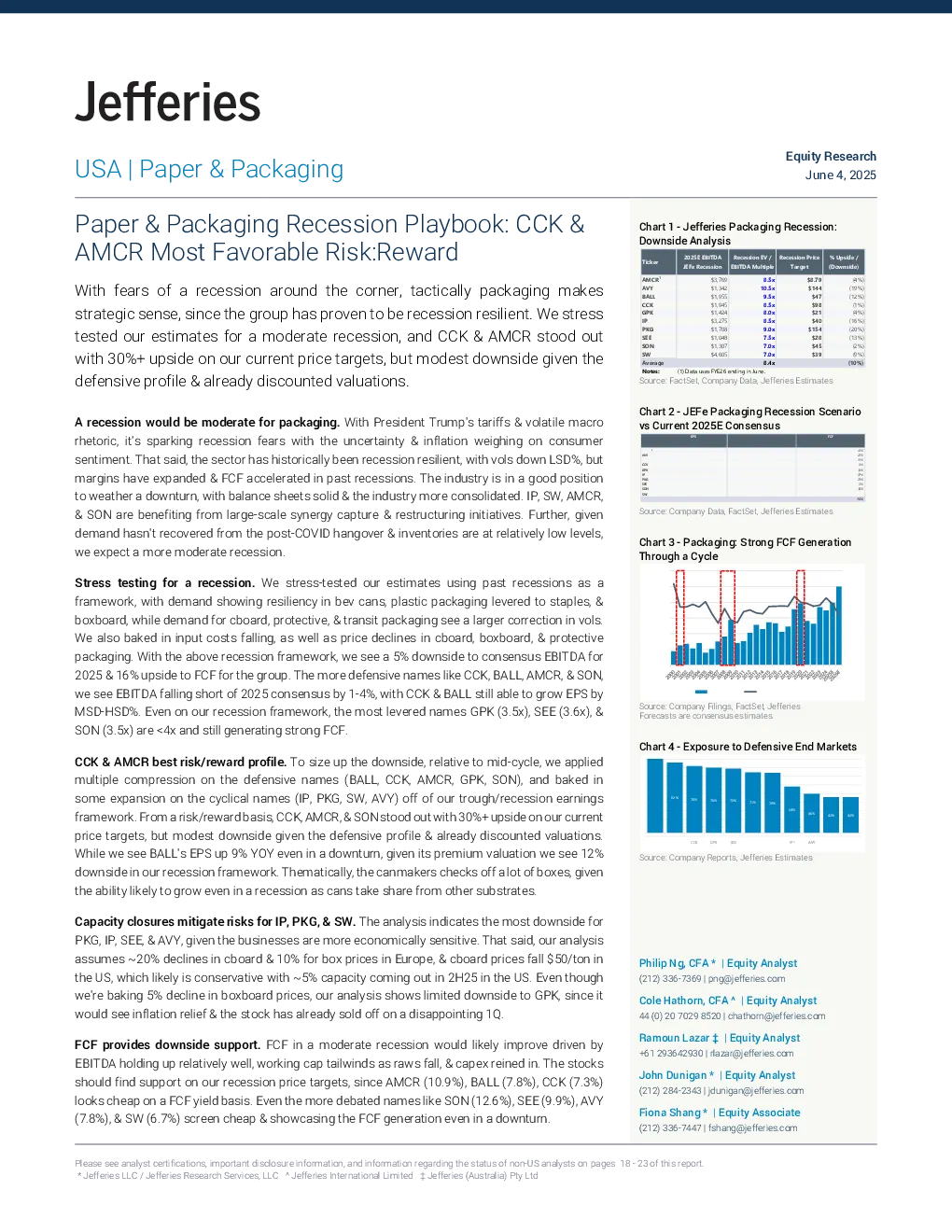
Philip Ng, CFA * | Equity Analyst(212) 336-7369 | png@jefferies.comCole Hathorn, CFA ^ | Equity Analyst44 (0) 20 7029 8520 | chathorn@jefferies.comRamoun Lazar ‡ | Equity Analyst+61 293642930 | rlazar@jefferies.comJohn Dunigan * | Equity Analyst(212) 284-2343 | jdunigan@jefferies.comFiona Shang * | Equity Associate(212) 336-7447 | fshang@jefferies.comSource: Company Reports, Jefferies Estimates Paper & Packaging Recession Playbook: CCK & AMCRMost Favorable Risk:RewardWith President Trump's reciprocal tariffs and volatile macro rhetoric sparking recession fears, weupdated our Recession analysis for the sector. After seeing a correction in demand as consumersadapt to a post-COVID inflationary backdrop, packaging demand had begun to stabilize prior to tariffdiscussions before consumers pulled back in 1Q25 due to the uncertain macro environment. Largecustomers like GIS & FDX have pulled or cut guidance. The uncertainty along with a prolonged periodof inflation has weighed on consumer sentiment and spending power. Within Nielsen's trackedchannels, food and non-alcoholic beverage volumes have remained muted as consumer spendingis stretched and consumers hunt for value.Chart 5 - Packaging: Strong FCF Generation Through a Cycle.$0.00$1.00$2.00$3.00$4.00$5.00$6.00FCF / ShareFCF / ShareSource: Company Filings, FactSet, JefferiesNote: Forecasts are consensus estimates. Packaging sector average forAMCR, AVY, BALL, CCK, BERY, SEE, GPK, IP, PKG, WRK, SW, ATR, SLGN, SON,OI if public.That said, risk from destocking should be somewhat limited in a recession with inventory-to-salesratios across various retail channels are already in line or significantly below the inventory levelsseen during the GFC, limiting the risk from further destocking in both cyclical channels and the moredefensive food & beverage channels. Further, while consumers are once again prioritizing staplesover discretionary spending, consumer spending is still much more heavily weighted towards on-premise channels vs at-home. This relationship typically reverses in recessions, which we havestarted to see since July 2024, and favors defensive packagers like canmakers and boxboardmanufacturers. The trade down to private label has not historically had a meaningful impact on thepackaging companies, since it has a limited impact on margins, and it's neutral on volumes giventhe diversified exposure in private label as well.Please see important disclosure information on pages 18 - 23 of this report.This report is intended for Jefferies clients only. Unauthorized distribution is prohibited. 0.0x0.5x1.0x1.5x2.0x2.5x3.0x3.5x4.0x4.5xNet Debt / Adj. EBITDANet Debt / Adj. EBITDAChart 6 - Exposure to Defensive End Markets.100%82%78%BALLAMCR(ex-BERY)CCKSource: Company Reports, Jefferies EstimatesNotes: * IP includes SMDS for CY24 at £1/$1.278, sales btwn SMDS & IP arenot eliminated, SMDS presented on IFRS basis and combined with IP U.S.GAAP basis. Excludes GCF. ** PKG & SW are based on the US corrugatedindustry end market breakdown. *** SON is pro forma for the Eviosysacquisition as well as the TFP & Thermosafe divestitures. 76%GPK 2 Chart 7 - Total US Food Expenditures At Home vs Away From Home In Constantdollars (LTM)Constant dollars (1988=100).($50,000)($40,000)($30,000)($20,000)($10,000)$0$10,000$20,000$30,000$40,000$50,000Source: USDA ERS, JefferiesGiven the demand hasn't fully recovered post-pandemic and inventories are already at relatively lowlevels, we would expect a recession impact to be more modest than the levels seen during the GFC.Further, the packaging sector has historically been relatively recession resilient, with volumes downLSD%, but margins expanding & FCF accelerating in past recessions.After stress testing our estimates to reflect a moderate recession, the more defensive names likeCCK, BALL, AMCR, & GPK we see EBITDA falling short of consensus by low to mid SD, and CCK andBALL still able to grow EPS by mid to HSD. The more cyclical names like IP, PKG, SW, SEE, & AVYcould see EBITDA fall short of consensus by HSD, given a larger mix in durable and/or discretionarygoods, and could see their price / cost spread turning negative.We see the industry in a good position to weather a downturn, with balance sheets solid & theindustry more consolidated. IP, SW, AMCR, & SON are benefiting from large-scale synergy capture &restructuring initiatives. FCF in a moderate recession would likely improve driven by EBITDA holdingup relatively well, lower working capital outflows as raws fall, and packagers rein in capex. While thegroup isn't recession-proof, the packaging sector has historically proven to be resilient to a macroslowdown, and we've seen broader interest from investors and expect continued fund flow.Chart 9 - Jefferies Packaging Recession: Downside Analysis.Ticker2025E EBITDAJEFe RecessionAMCR1$3,769AVY$1,342BALL$1,955CCK$1,945GPK$1,424IP$3,275PKG$1,708SEE$1,048SON$1,307SW$4,605AverageNotes:(1) Data uses FYE26 ending in June.Source: FactSet, Compan