您的浏览器禁用了JavaScript(一种计算机语言,用以实现您与网页的交互),请解除该禁用,或者联系我们。[汇丰银行]:新兴市场外汇路线图:金发姑娘与三只熊 - 发现报告

新兴市场外汇路线图:金发姑娘与三只熊

2025-05-30Paul Mackel、Nick Andrews、Jingyang Chen、Allison Buck、Joseph Incalcaterra、Joey Chew汇丰银行苏***
AI智能总结
查看更多
新兴市场外汇路线图:金发姑娘与三只熊

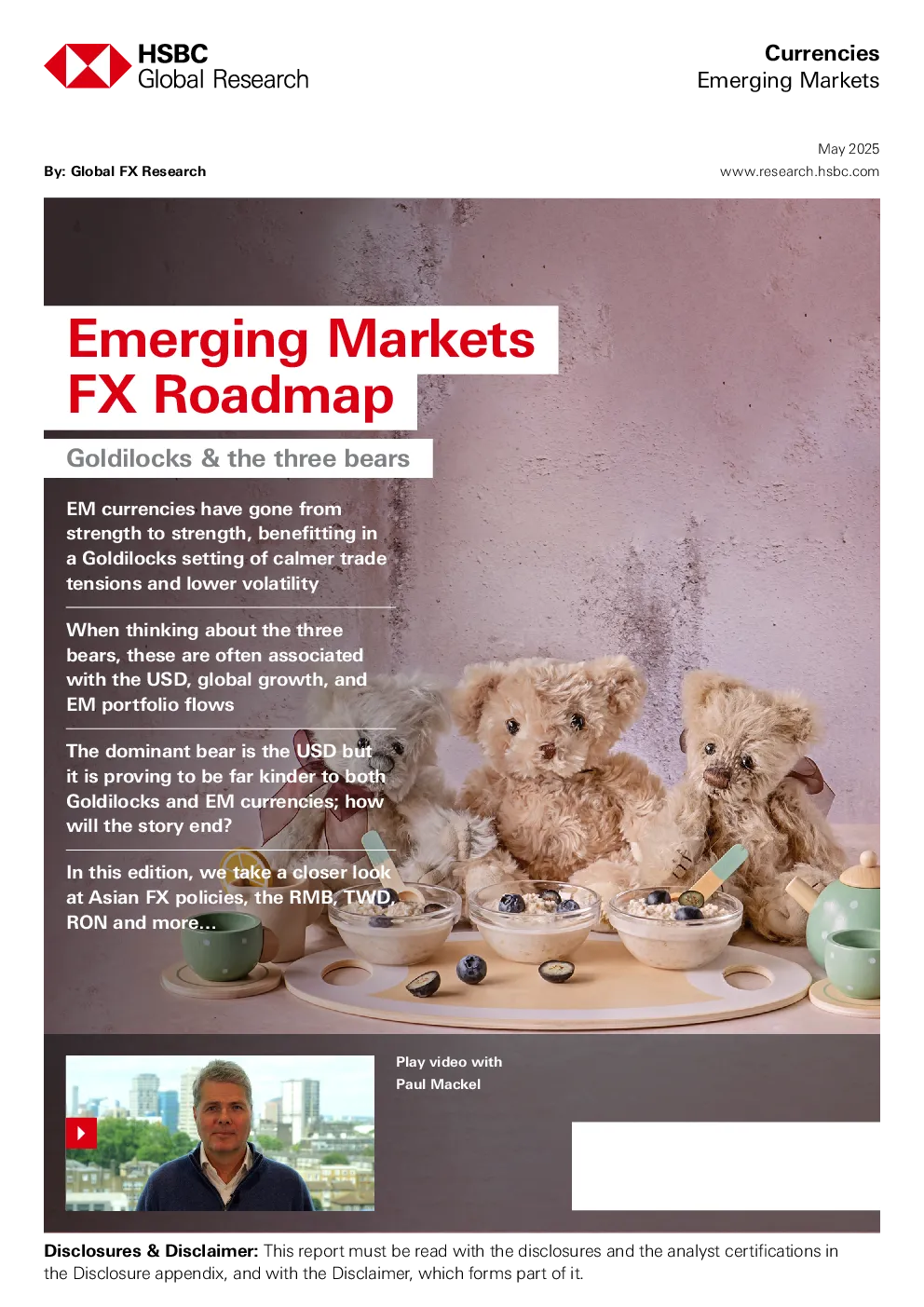
the Disclosure appendix, and with the Disclaimer, which forms part of it.Play video withPaul MackelEmerging MarketsFX RoadmapGoldilocks & the three bearsEM currencies have gone fromstrength to strength, benefitting ina Goldilocks setting of calmer tradetensions and lower volatilityWhen thinking about the threebears, these are often associatedwith the USD, global growth, andEM portfolio flowsThe dominant bear is the USD butit is proving to be far kinder to bothGoldilocks and EM currencies; howwill the story end?In this edition, we take a closer lookat Asian FX policies, the RMB, TWD,RON and more… AsiaIn May, Asian currencies have continued tostrengthenagainstthe USD amid progress in trade talkswith the US (notably India and Korea) and thede-escalation in US-mainlandChina trade tensions.For now, thesetrade talks should be net positive for Asian currencies. They not only carry thepotential for areduction of cyclical headwinds(manufacturing PMIs have already fallen below50 for most Asian economies in April), but could alsoclarify how President Trump’s longstandingconcerns about “currency manipulation”may be addressed (note: the RMB, KRW, SGD, TWDandVND were on the last monitoring list published by the US Treasury in November 2024).US Treasury Secretary Bessent said FX was not discussed during thetradetalks withmainlandChina (Bloomberg, 12 May), but that could only be a matter of time. TheKoreangovernmenthasalready confirmed that FX is one of the topicsfor discussionwith the USadministration (Bloomberg,25 April). If the US were to ask Asian central banks for G7-type FXcommitments–close consultationand timely disclosures regarding FX operations–would thishinder FX reserves accumulation?In April, we turnedcautious onthe USD amid high US policy uncertainty, and therefore nowhold a more constructive view on Asian currencies.Butwe also see limitations as to how muchAsian currencies can strengthen in our forecast horizon, when theglobal economy is weakeningand sinceany sort of global rebalancing and asset diversification would likely take time. Also,Asian central banks can ramp up monetary policy easing if their currencies rise too quickly, whichcould then lead to some correction.There is now greater scope for differentiated paths amongAsian currencies,dependingontheir own trade talks with the US (timeline, conditions), domestic policy mix (reliance on monetaryeasing, versus a more comprehensive approach with fiscal stimulus and structural reforms), currentaccount balances, ability to attract foreign capital inflows, valuations and resident investors’ externalbalance sheet and FX hedging practices (for data, seeAsian FX Focus: Art of dealing with the dollar,2 May, andAsian FX Focus: Falling dominoes, 5 May).We prefer ‘surplus’ currencies that are undervalued, more likely to see trade talks progress, havefewer fiscal issues, and could benefit from some kind of prudent reduction in residents’ FX exposure.The TWD and KRW fit the bill better than the SGD and MYR.While the THB checks thefewestboxes among ‘surplus’ currencies, strong gold prices can explain itsperiodicoutperformance.The RMB is a special case–it has the potential to be an alternative reserve currency in the long term(which provides an ideological incentive for the private sector to gradually follow the official sector indiversifying away from the USD), but it alsohas to overcome a volatile tariff situation and challengingdomestic growth headwinds presently.Among ‘deficit’ currencies, we prefer those that have fewer FX reserves adequacy and fiscal issuesand have better growth and FDI potential.We think the INR and PHP are stronger than the IDRfrom these perspectives.CEEMEAWe remain positive towards the ZAR and TRY. In South Africa, the Government of NationalUnityfounda compromise on the budget, removing a key political risk.We believe that the ZAR is likely toremain strong amid low inflation, high level of real rates and a monetary policy credibility enhancedby the prospect of a lower inflation target. However, the downside potential for USD-ZAR remainsRegional views 1 constrained by the US tariff risk. Until now, the trade balance has recorded comfortable surpluseslimiting the current accountdeficitto less than 1% of GDP. This positive external position is crucial.Even though terms of trade are supportive, US trade policy is a threat.In Türkiye, the central bank still plays a key role for the TRY by tightening monetary conditions viainterest rates and macro-prudential instruments. It is worth emphasising that the CBRT sees real FXappreciation as necessary to help lower inflation, which implies a change in the TRY’s momentum innominal terms would be needed to achieve this objective. The most likely scenariois for a slow movehigher by USD-TRY in the coming months.We are more cautious on CEE currencieseven if they have benefited from central banks’ prudentcommunication around the monetary policy outlook.The interest rate compressionis set tocontinue and put