您的浏览器禁用了JavaScript(一种计算机语言,用以实现您与网页的交互),请解除该禁用,或者联系我们。[世界卫生组织]:世卫组织视力和眼部护理资源 - 发现报告

世卫组织视力和眼部护理资源

AI智能总结
查看更多
世卫组织视力和眼部护理资源

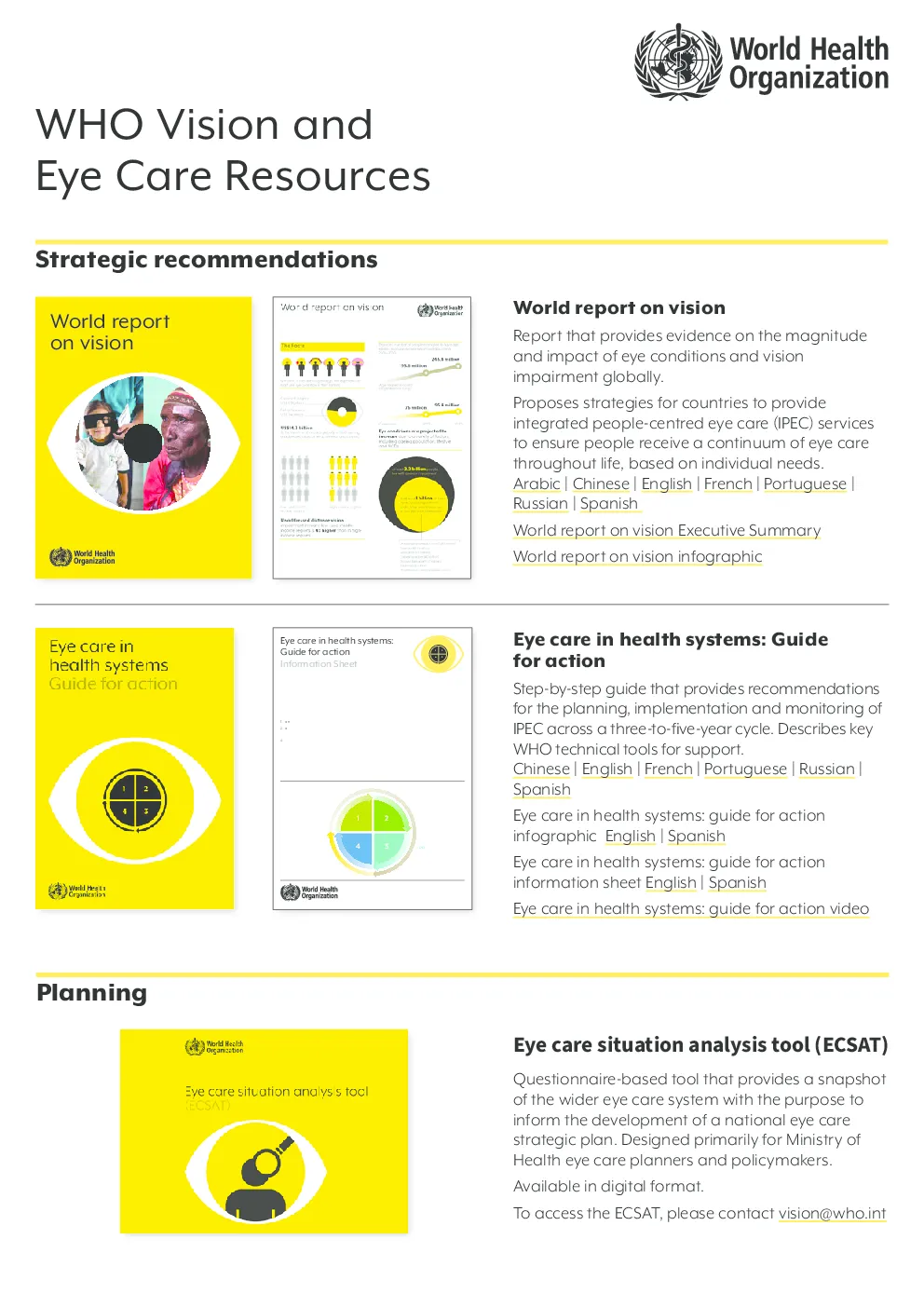
World report on visionReport that provides evidence on the magnitudeand impact of eye conditions and visionimpairment globally.Proposes strategies for countries to provideintegrated people-centred eye care (IPEC) servicesto ensure people receive a continuum of eye carethroughout life, based on individual needs.Arabic|Chinese|English|French|Portuguese|Russian|SpanishWorld reporton vision Executive SummaryWorld report on vision infographicEye care in health systems: Guidefor actionStep-by-step guide that provides recommendationsfor the planning, implementation and monitoring ofIPEC across a three-to-five-year cycle. Describes keyWHO technical tools for support.Chinese|English|French|Portuguese|Russian|SpanishEye care in health systems: guide for actioninfographicEnglish|SpanishEye care in health systems: guide for actioninformation sheetEnglish|SpanishEye carein health systems: guide for action videoEyecaresituationanalysistool(ECSAT)Questionnaire-based tool that provides a snapshotof the wider eye care system with the purpose toinform the development of a national eye carestrategic plan. Designed primarily for Ministry ofHealth eye care planners and policymakers.Available in digital format.To access the ECSAT, please contactvision@who.int Package of eye care interventions(PECI)Package that provides a set of minimumevidenced-based eye care interventions across thecontinuum of care and the required materialresources at each level of health systems.Chinese|English|French|SpanishMeDevIs, the Priority Medical Devices InformationSystem, is an open access electronic database ofmedical devices developed by WHO.TheUHC Compendiumis a database of healthservices and intersectoral interventions designed toassist countries in making progress towardsuniversal health coverage.ToolforAssessmentofRehabilitationServicesandSystems(TARSS)Questionnaire-based tool to carry out situationanalysis of vision rehabilitation services. ThroughTARSS, countries will identify priority areas of workto improve the provision of vision rehabilitation,assistive technology and support services forpeople with irreversible vision impairment.To access the TARSS, please contactvision@who.intTool for the assessment of diabeticretinopathy and diabetesmanagement systems (TADDS)Questionnaire-based tool to carry out situationanalysis of diabetes care and prevention andtreatment of diabetic retinopathy. Through TADDS,countries will identify priority areas of work toimprove diabetic eye care services.To access the TADDS, please contactvision@who.intRefractive error situation analysis tool(RESAT)Questionnaire-based qualitative assessment tool toevaluate the current status of refractive errorservices and to monitor progress towards universalrefractive error service coverage. Through RESAT,countries will identify priority areas of work toimprove refractive error services.To access the RESAT, please contactvision@who.int Guide to applyingthe WHO Eye CareCompetencyFrameworkHuman resources development Learning on TAP: blended learningresourceOpen-access, online platform to support training inassistive technology and sensory health. Modulesare available in multiple languages. Currentmodules on vision include:–Vision and hearing screening for school-agechildren: covers how to identify and supportchildren with vision or hearing difficulties tohelp them learn and thrive in school.–Assistive technology: modules with focus onidentifying individuals with vision needs,providing near-vision spectacles, and makingappropriate referrals.For more information, contact:assistivetechnology@who.intorvision@who.intor visitLearning on TAPCompetency-based refractive errorteams (CRET)Practical resource designed to support the deliveryof high-quality, team-based refractive error services.CRET offers a structured approach to workforceplanning by clearly defining roles and responsibilities,standardizing training requirements, and facilitatingbetter coordination between occupational groupsand across public and private sectors.EnglishEye care competency framework (ECCF)Toolthatprovidesasetofcomprehensivecompetenciesandactivitiesforeyecareworkers.Can be used by education and training institutions,policymakers and regulation authorities, eye careservice providers, and nongovernmentalorganizations to develop or assess competency-based training of human resources.Chinese|English|French|SpanishThe Guide to applying theECCFprovides a step-by-step approach on how users can adapt and usethe ECCF in their context. Guidance on theanalysis and use ofroutine healthinformation systems:eye and ear caremoduleFinancingMonitoring and evaluation Report on the 2030 targets on effectivecoverage of eye careTo monitor progress towards the 2030globaltargetsendorsed by Member States at the 74thWorld Health Assembly on effective cataractsurgical coverage (eCSC) and effective refractiveerror coverage (eREC), WHO periodically reports onboth global indicators.First report, 2022:EnglishUpdated data oneREC, 2025R