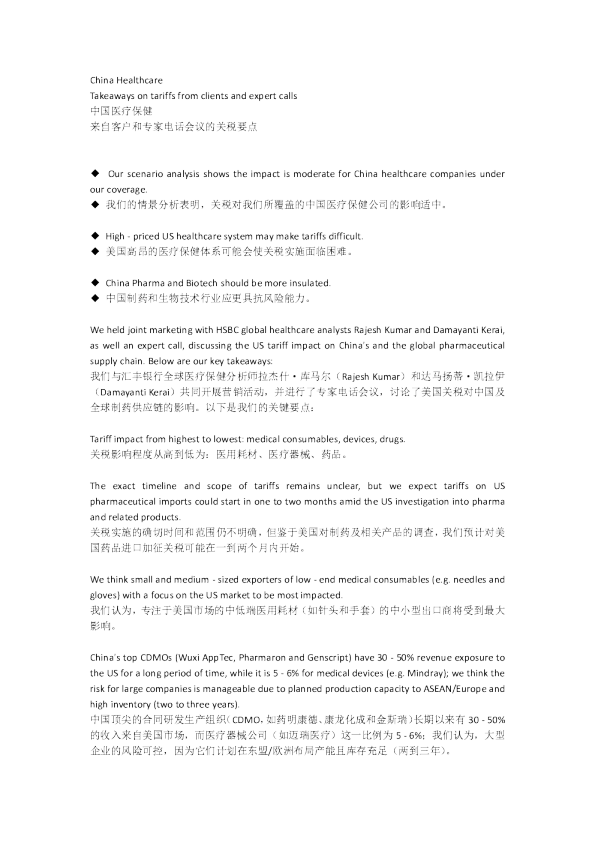
要点:GEV、关税、XEL、NEE、DUK、NI、PPL、PEG PWR、D、PCG及BE AEP
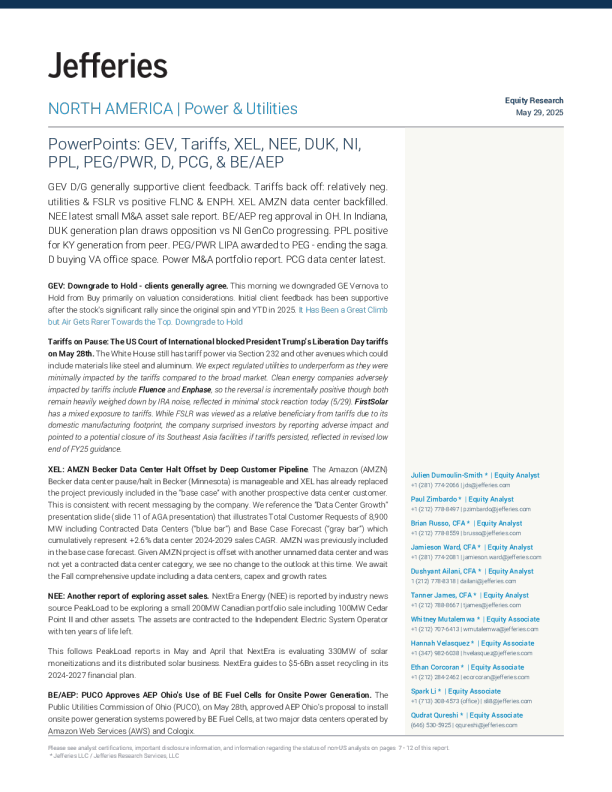
Julien Dumoulin-Smith * | Equity Analyst+1 (281) 774-2066 | jds@jefferies.comPaul Zimbardo * | Equity Analyst+1 (212) 778-8497 | pzimbardo@jefferies.comBrian Russo, CFA * | Equity Analyst+1 (212) 778-8559 | brusso@jefferies.comJamieson Ward, CFA * | Equity Analyst+1 (281) 774-2081 | jamieson.ward@jefferies.comDushyant Ailani, CFA * | Equity Analyst1 (212) 778-8318 | dailani@jefferies.comTanner James, CFA * | Equity Analyst+1 (212) 788-8667 | tjames@jefferies.comWhitney Mutalemwa * | Equity Associate+1 (212) 707-6413 | wmutalemwa@jefferies.comHannah Velasquez * | Equity Associate+1 (347) 982-6038 | hvelasquez@jefferies.comEthan Corcoran * | Equity Associate+1 (212) 284-2462 | ecorcoran@jefferies.comSpark Li * | Equity Associate+1 (713) 308-4573 (office) | sli8@jefferies.comQudrat Qureshi * | Equity Associate(646) 530-5925 | qqureshi@jefferies.com Please see important disclosure information on pages 7 - 12 of this report.This report is intended for Jefferies clients only. Unauthorized distribution is prohibited. BE/AEP: Ohio approval of fuel cells is a constructive development (Cont.)Bloom's systems willoperate under a six-year agreement with AWS and a 15-year agreement with Cologix. Financial termsremain confidential under trade secret protections granted by PUCO.This decision runs parallel to the data center tariff cost allocation more largely. Hearings on thematter were held earlier this year, with a final decision still pending. In AEP's case there wasintervention from Constellation (CEG) and other notable parties.Other parties that commented on the application include Ohio Manufacturers’ Association EnergyGroup (OMAEG), Retail Energy Supply Association (RESA), Ohio Consumers’ Counsel (OCC), andOne Power. Among other issues, these parties argued that the statute merely permits AEP Ohio toconstruct, but not own, the underlying assets. However, PUCO sided with AEP Ohio on this one citinglittle ambiguity in regard to the ultimate objective of the relevant statute at issue.While a positive, we note that based on our prior conversations, AEP was confident that PUCO wouldgrandfather the AMZN and Cologix deals. This comes on the heels of SB2 overhang which raises thequestion of where AEP can deploy the remaining 900MW. Our conversations with AEP suggest that theutility sees opportunities for additional future fuel cell deployments in other states such as Indiana, withpotential orders in 2025 to take advantage of the tax credits. It remains to be seen how much fuel cellsplay a roll in AEP's 3Q/EEI capex refresh.In its recent earnings call, MTAR (key supplier to BE) noted it has been gaining wallet share with BE andexpects to ship 4,000 units to BE (vs 3,300 units in ~CY24). Assuming 15 hot boxes = 1MW (still needconfirmation here), would imply 267MW shipped to BE in CY25.DUK: Duke faces intensifying regulatory pushback on $3.3Bn gas build-out.Duke Energy Indianahas filed for approval (Cause #46193) to construct two 738 MW combined cycle natural gas unitsat its Cayuga site for $3.3Bn, replacing retiring coal units scheduled to close in 2029-2030. Theproject represents DUK's largest generation investment in Indiana since the troubled Edwardsportfacility, with financing costs projected at $5.3bn over the asset life. Intervenors including the CitizensAction Coalition and Indiana Office of Utility Consumer Counselor (OUCC) have mounted aggressiveopposition, citing affordability concerns with residential bills projected to increase $16-29 per monthonce the project is operational. The OUCC recommends outright denial, arguing the utility failed toadequately evaluate lower-cost alternatives including converting existing Cayuga units to gas ratherthan full replacement.Portfolio concentration risk escalates as gas reaches 80%.Duke's generation strategy wouldtransform its Indiana portfolio from 75% coal today to nearly 80% natural gas by 2035, creatingsubstantial fuel price volatility exposure for ratepayers who must bear the pass-through commodityprice risk. The company's 2024 integrated resource plan (IRP) modeling said that converting Cayugato gas (Blend 1) would save ratepayers ~$100m annually vs. new construction (Blend 2), yetmanagement. selected the higher-cost option without adequate justificationaccording to intervenortestimony. This portfolio imbalance becomes particularly problematic given Duke's planned 2x1 CCaddition at Gibson by 2032, adding another 1,438 MW of gas capacity before its next IRP filing in2027.Regulatory landscape shifts dramatically against Duke's strategy.Recent executive ordersfrom President Trump and Indiana Governor Braun explicitly support coal plant life extensions,fundamentallyaltering the regulatory and political backdrop underpinning DUK’s retirementassumptions. Governor Braun's April 2025 directive mandates evaluation of extending everyremaining Indiana coal plant, while we believe that federal Environmental Protection Agency (EPA)Rule 111 is likely to face repeal or modification. DUK