案例研究:VxWorks为泰雷兹的机敏级潜艇潜望镜提供动力
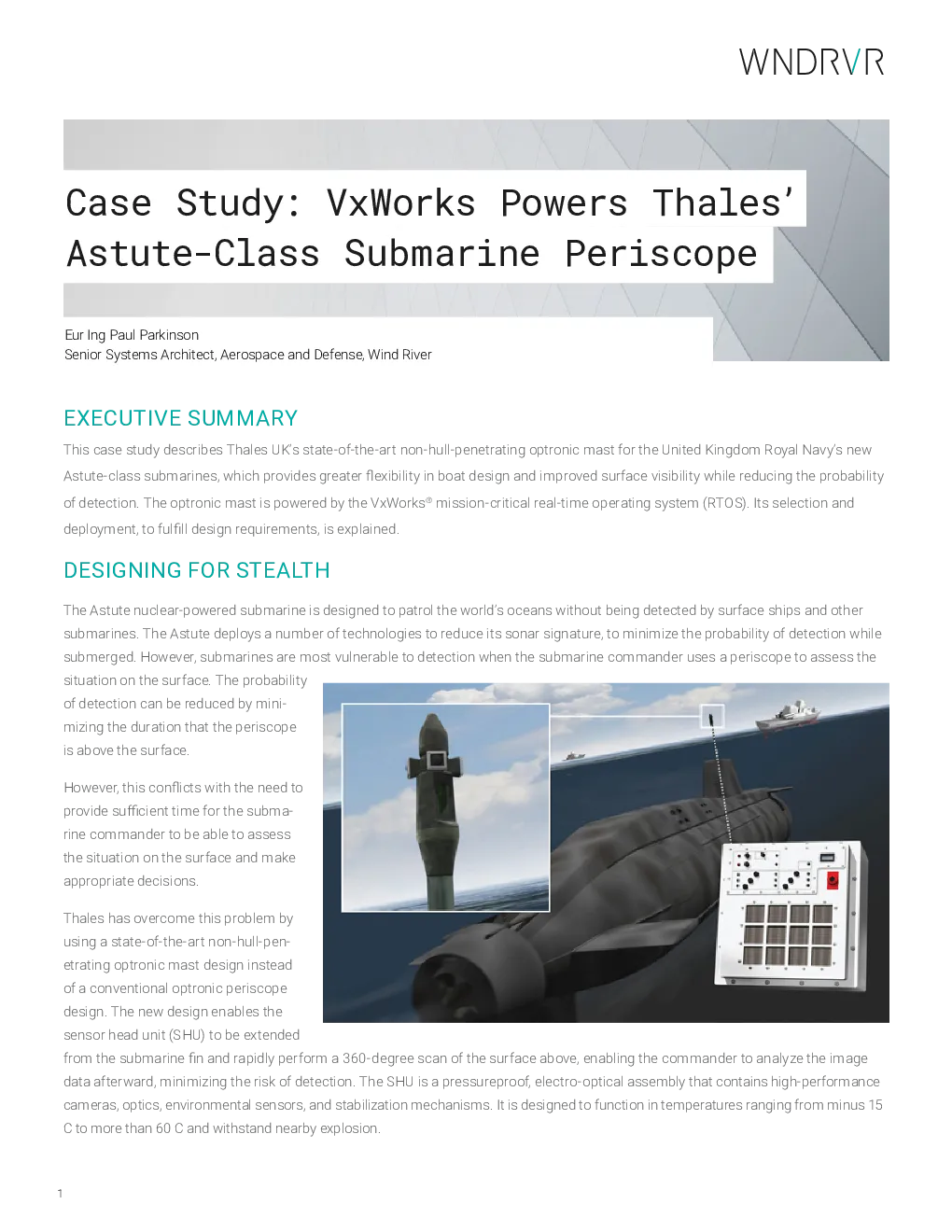
Eur Ing Paul ParkinsonSenior Systems Architect, Aerospace and Defense, Wind River EXECUTIVE SUMMARY This case study describes Thales UK’s state-of-the-art non-hull-penetrating optronic mast for the United Kingdom Royal Navy’s newAstute-class submarines, which provides greater flexibility in boat design and improved surface visibility while reducing the probabilityof detection. The optronic mast is powered by the VxWorks®mission-critical real-time operating system (RTOS). Its selection anddeployment, to fulfill design requirements, is explained. DESIGNING FOR STEALTH The Astute nuclear-powered submarine is designed to patrol the world’s oceans without being detected by surface ships and othersubmarines. The Astute deploys a number of technologies to reduce its sonar signature, to minimize the probability of detection whilesubmerged. However, submarines are most vulnerable to detection when the submarine commander uses a periscope to assess the situation on the surface. The probabilityof detection can be reduced by mini-mizing the duration that the periscopeis above the surface. However, this conflicts with the need toprovide sufficient time for the subma-rine commander to be able to assessthe situation on the surface and makeappropriate decisions. Thales has overcome this problem byusing a state-of-the-art non-hull-pen-etrating optronic mast design insteadof a conventional optronic periscopedesign. The new design enables thesensor head unit (SHU) to be extended from the submarine fin and rapidly perform a 360-degree scan of the surface above, enabling the commander to analyze the imagedata afterward, minimizing the risk of detection. The SHU is a pressureproof, electro-optical assembly that contains high-performancecameras, optics, environmental sensors, and stabilization mechanisms. It is designed to function in temperatures ranging from minus 15C to more than 60 C and withstand nearby explosion. The SHU is used in two configurations on the Astute class sub-marine. It provides extensive electronic surveillance measures(ESM) through dual redundant high-definition color video opera-tion. The SHU also enables extended capabilities with the twomasts providing infrared and low-light operation respectively,with 3-axis image stabilization to subpixel accuracies, as well asa laser rangefinder. such as temperatures as low as minus 30 C during operation on asubmarine and severe shock on military fast jets and helicopters. For the new design, the Thales Computers V4G4c quadPowerPC 7410 AltiVec commercial off-the-shelf (COTS) boardwas selected. The quad processor design provided some com-monality with the quad DSP architecture previously used, butthere were a number of significant architectural differences thatpresented Thales with some development challenges. Theseincluded mapping the software architecture from the DSP to thegeneral-purpose processor and migrating from a scheduler andthe Texas Instruments DSP Ada compiler to the VxWorks RTOSand AdaCore GNAT Ada compiler. The migration from the DSPto the general-purpose platform is a significant step; however,Thales has standardized on Wind River platforms for devicesoftware and uses a common toolset and software architectureacross projects wherever possible. This standardized approachenables Thales to leverage skills within the engineering organiza-tion across projects. Inside the submarine hull, the mast control unit (MCU) coordi-nates overall system activity, controlling a number of other unitsand communicating with the submarine’s tactical, data, andcombat systems. The MCU controls the equipment that raisesand lowers the SHU out of the submarine fin, as well as theazimuth drive module that rotates the SHU and forms part of thestabilization system. This requires deterministic, high-standardservo control to compensate for the submarine’s movement inthe water. A clear image is critical to mission success. THE ROLE OF SOFTWARE The optronic mast uses an Ada application developed usingAdaCore GNAT running on the VxWorks RTOS, providing a reli-able system that is essential for this mission-critical application.The application controls the stabilization system, video, andthermal camera, communication with the in-hull systems, and allof the mechanisms and motors in the SHU. “VxWorks has a pedigree that makes it an obvious choice for usein a high-reliability, safety-related environment. Added to this, itssupport for multiple platforms has allowed Thales to rationalizeits use of third-party RTOSes and thereby reduce target plat-form variability from one project to the next. This consistencybetween projects, through standardization on VxWorks, resultsin development cost savings,” said Jack Cunningham, Head ofDiscipline (Software) for Thales UK’s optronics business. The MCU in the submarine hull uses two processors runningVxWorks to raise and lower the SHU out of the submarine fin, andit also controls the azimuth drive module that rotates the SHU andforms part o