AI智能总结
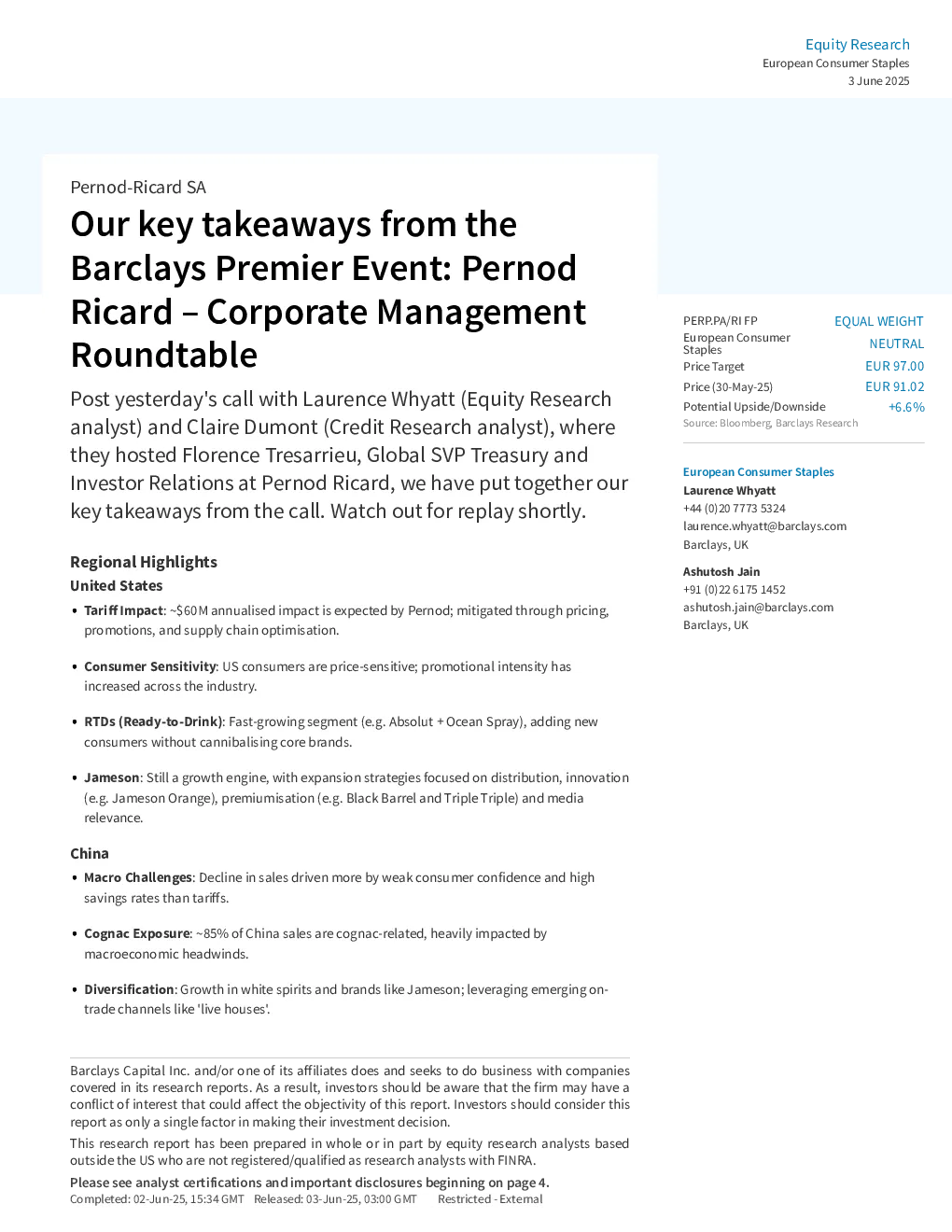
Restricted - External PERP.PA/RI FPEQUAL WEIGHTEuropean ConsumerStaplesNEUTRALPrice TargetEUR 97.00Price (30-May-25)EUR 91.02Potential Upside/Downside+6.6%Source: Bloomberg, Barclays ResearchEuropean Consumer StaplesLaurence Whyatt+44 (0)20 7773 5324laurence.whyatt@barclays.comBarclays, UKAshutosh Jain+91 (0)22 6175 1452ashutosh.jain@barclays.comBarclays, UK •TariffOutlook:Tariffsremain a political issue; any resolution could benefit GTR (Global•Travel Retail).India•Growth Market: Second-largest market (12% of net sales), with high-single-digit growth•expected to continue.•FTA with UK: Seen as a positive development, though implementation depends on state-•level ratification.•Portfolio Strength: Strong positioning with both international premium brands and local•whiskies.Strategic Themes•Cyclical vs. Structural Headwinds:The company emphasised that current challenges in key•markets like the US and China arecyclical, not structural. It attributes recentsoftnessindemand to post-COVID normalisation, inflationary pressure, interest rate hikes andtemporaryshiftsin consumer behaviour. It remains confident that mid-single-digit growth inthe US is achievable once macroeconomic conditions stabilise.•Premiumisation & Moderation:A key trend is that consumers aredrinking less but better.•This aligns with the company’s premium portfolio strategy. Pernod views moderation not as athreat but as an opportunity to capture value through higher-qualityofferings.•Gen Z Insights:The company provided a nuanced breakdown of Gen Z behaviour:•°Age segmentation matters: Gen Z spans ages 15–28, and behaviour varies significantly°across subgroups.■Ages 15–21: Underage drinking has dropped significantly – seen as a positive societal■shift.■Ages 21–24: This group is highly price-sensitive due to student debt and inflation,■leading to moderation driven by economics rather than preference.■Ages 24–28: Consumption picks up as they enter the workforce and gain disposable■income.°Category impact:°■Gen Z drinksless frequently, whichaffectsbeer and winemore than spirits.■■Spirits remain relevant foroccasional,celebratory consumption, and penetration■among Gen Z has actually increased.°RTDs (Ready-to-Drink)are seen as a gateway for Gen Z, especially women, to engage with°spirits in a convenient and approachable format.•Cannabis•°The company doesnot see cannabis as a threatto spirits consumption.°°Cannabis and spirits servedifferentconsumption occasions:°■Spirits:Social, celebratory, communal■ 2 ■Cannabis:More solitary or relaxed settings■°No current evidence ofcannibalisationof spirits by cannabis.°°Pernod is monitoring the space but views it asnon-disruptivefor now.°GLP-1 Drugs (e.g. Ozempic)°While not discussed in depth, GLP-1 drugs were acknowledged as part of the broader°conversation aroundmoderation and health-conscious behaviour.°The company didnot cite any direct impactfrom GLP-1 usage on alcohol consumption°trends.°Pernod’s stance remains thateconomic factors(inflation, interest rates) are the primary°drivers of current demandsoftness– not structural healthshifts.Financial Performance & OutlookFY25 Outlook: Organic sales expected to decline slightly (low single digits), but operatingmargins are being defended through cost and cash initiatives.EfficiencyTargets: €900M inefficienciesexpected by FY25, with an additional €1B targetedthrough FY29.Cash Focus: Strong emphasis on cash generation, with an 80% conversion target to supportstrategic investments and financial priorities.Credit & Capital StructureLeverage: Currently above 3x, but expected to normalise as strategic investments taperoffpost-FY25.Investment Cycle: Strategic investments peaked in FY24 (~€1.5B), expected to normalise to~€1B from FY26.Share Buybacks: Conditional on leverage returning below 3x andsufficientcash availability. •••••••••••••• 3 Analyst(s) Certification(s):We, Ashutosh Jain and Laurence Whyatt, hereby certify (1) that the views expressed in this research report accurately reflect our personal views aboutany or all of the subject securities or issuers referred to in this research report and (2) no part of our compensation was, is or will be directly orindirectly related to the specific recommendations or views expressed in this research report.Important Disclosures:Barclays Research is produced by the Investment Bank of Barclays Bank PLC and itsaffiliates(collectively and each individually, "Barclays"). Allauthors contributing to this research report are Research Analysts unless otherwise indicated. The publication date at the top of the report reflects thelocal time where the report was produced and maydifferfrom the release date provided in GMT.Availability of Disclosures:Where any companies are the subject of this research report, for current important disclosures regarding those companies please refer to https://publicresearch.barclays.com or alternatively send a written request to: Barclays Research Compliance, 745 Seventh Avenue, 13th Floor, New York