您的浏览器禁用了JavaScript(一种计算机语言,用以实现您与网页的交互),请解除该禁用,或者联系我们。 [汇丰银行]:欧元区采购经理人指数(5月,初值):没有缓解 - 发现报告

欧元区采购经理人指数(5月,初值):没有缓解

2025-05-22 汇丰银行 大熊
报告封面

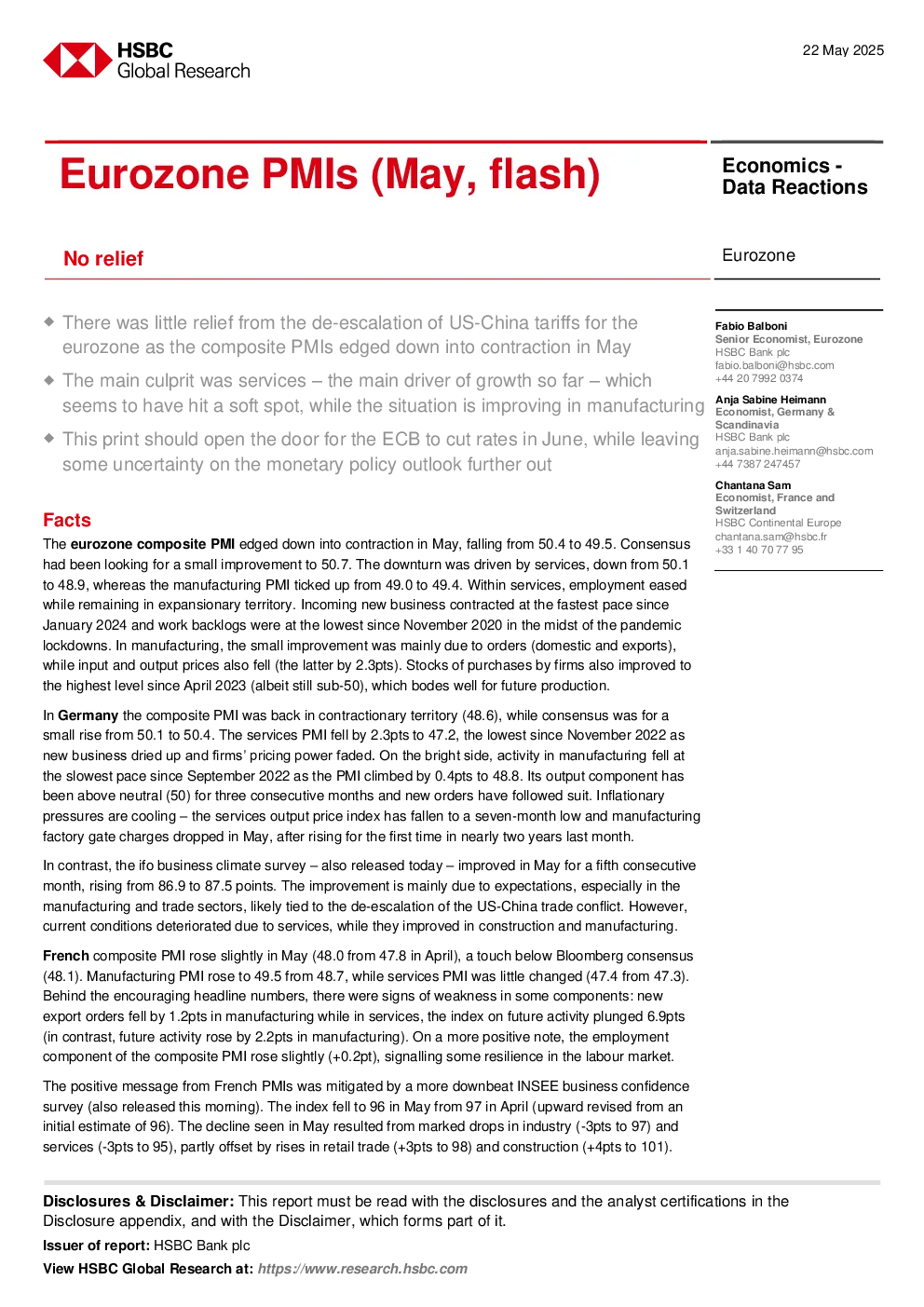
Fabio BalboniSenior Economist, EurozoneHSBC Bank plcfabio.balboni@hsbc.com+44 20 7992 0374Anja Sabine HeimannEconomist, Germany &ScandinaviaHSBC Bank plcanja.sabine.heimann@hsbc.com+44 7387 247457Chantana SamEconomist, France andSwitzerlandHSBC Continental Europechantana.sam@hsbc.fr+33 1 40 70 77 95Economics-Data ReactionsEurozone ◆◆◆ 2ImplicationsThere wasn’t much sign of relief from the eurozone, despite the good news coming from the de-escalationof the US-China tradetensions (data for the survey were collected between 12-20 May, hence after the announcement of a 90-day suspension of thereciprocal tariffs).Granted, it is possible that the underlying uncertainty on the landing zone for US tariffs is still affecting firms’sentiment–in particularwith little progress made so far on a US-EU trade deal. It was reported in the newswires earlier today that the EU has put forward anew proposal to the US to try and unblock the situation, but with many obstacles remaining particularly when it comes to EU non-tariffbarriers and digital tax(MNI, 22 May). Evenso, there were some good indications from the manufacturing sector, with firmsseemingly keener to embark on new production, even though front-loading ahead ofpossiblehighertariffs might be playing a role.The bad news came from services–the main driver of eurozone growth in recent years–where the sharp contractions in incomingnew business and work backlogs in services point to more subdued growth for the sector ahead.Indications on prices were alsomixed. Input prices fell in manufacturing, likely driven by lower energy prices, but continuedto rise fairly rapidly (and well abovehistorical averages) in services, likely due to ongoing large pay increases. Firms, though, seems to be absorbing this withintheirmargins, with output prices falling in manufacturing and easing in services, pointing to limited pricing power and subdued demand.This print should open the door for one more 25bp rate cut by the ECB in June, as wehadexpected (seeECB Preview (Jun), 22May), helped also by the likely drop in inflation in May after April’s upside surprise (seeHeading below 2%, 19 May). After June, theoutlook is more uncertain. The PMIs point to a stalling labour market after two positive months, but it remains fairly resilient overall.Withservices inflationstillelevated, and limited data between the June and July meetings, the ECB will likely pause in July. Absent adeterioration of the US tariff situation, our base caseisthat June might be the last cut. But if the economy fails to improve over thesummer, and with plenty of disinflationary forces out there, risks are skewed towards more cuts, with Belgian Central Bank GovernorPierre Wunsch–usually a hawk–recently also admitting that rates might need to be “mildly supportive” (Bloomberg, 20 May).1.Theeurozone PMIs edged down in May as the services sector continues to softenSource:Macrobond, HCOB/S&P Global PMIs, HSBC Disclosure appendixAnalyst certificationThe following analyst(s), who is(are) primarily responsible for this document, certifies(y) that the opinion(s), views or forecastsexpressed herein accurately reflect their personal view(s) and that no part of their compensation was, is or will be directly orindirectly related to the specific recommendation(s) or views contained in this research report: Fabio Balboni, Anja SabineHeimann and Chantana SamThis document has been prepared and is being distributed by the Research Department of HSBC and is intended solely for theclients of HSBC and is not for publication to other persons, whether through the press or by other means.This document does not provide individually tailored investment advice and should not be construed as an offer or the solicitationof an offer to buy or sell any securities or to participate in any trading strategy. The information contained within this document isbelieved to be reliable but we do not guarantee its completeness or accuracy.Any opinions expressed herein are subject tochange without notice.HSBC may hold a position in, buy or sell on a principal basis or act as a market maker in any financialinstrument discussed herein.HSBC and its affiliates will from time to time sell to and buy from customers the securities/instruments (including derivatives) ofcompanies covered in HSBC Research on a principal or agency basis.Analyst(s) are paid in part by reference to the profitability of HSBC which includes investment banking revenues.Additional disclosures1This report is dated as at 22 May 2025.2All market data included in this report are dated as at close 22 May 2025, unless a different date and/or a specific time ofday is indicated in the report.3HSBC has procedures in place to identify and manage any potential conflicts of interest that arise in connection with itsResearch business. HSBC's analysts and its other staff who are involved in the preparation and dissemination ofResearch operate and have a management reporting line independent of HSBC's Investme