五月月度调整
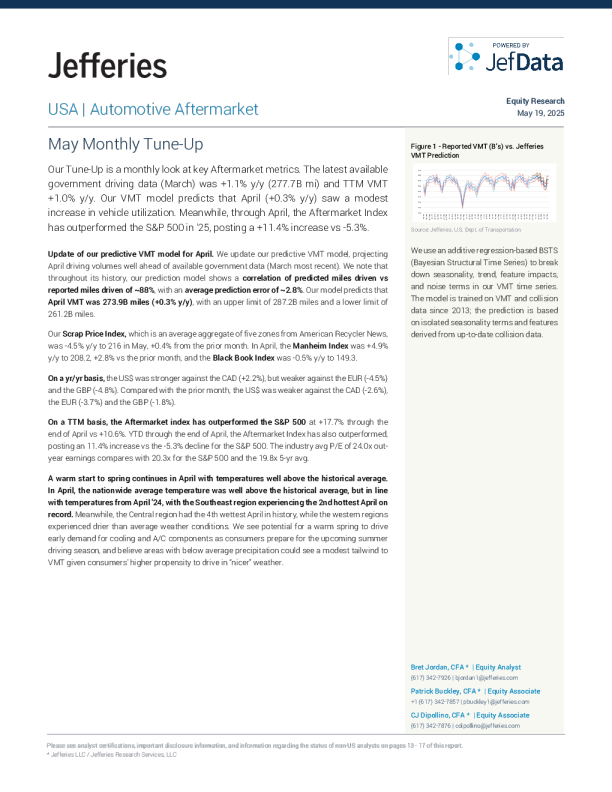
Bret Jordan, CFA * | Equity Analyst(617) 342-7926 | bjordan1@jefferies.comPatrick Buckley, CFA * | Equity Associate+1 (617) 342-7857 | pbuckley1@jefferies.comCJ Dipollino, CFA * | Equity Associate(617) 342-7876 | cdipollino@jefferies.comFigure 1 - Reported VMT (B's) vs. JefferiesSepNov-22Jan-23Mar-23May-23Jul-23Sep-23Nov-23Jan-24Mar-24May-24Jul-24Sep-24Nov-24Jan-25Mar-25Source: Jefferies, U.S. Dept. of TransportationWe use an additive regression-based BSTS(Bayesian Structural Time Series) to breakdown seasonality, trend, feature impacts,and noise terms in our VMT time series.The model is trained on VMT and collisiondata since 2013; the prediction is basedon isolated seasonality terms and featuresderived from up-to-date collision data.Equity ResearchMay 19, 2025 We update our predictive VMT model, projecting April driving volumes.This month, we updateour proprietary predictive VMT model, capable of projecting April miles driven well in advance ofavailable government data, which lags significantly (~1-2 months). Our predictive model produces astrong correlation of projected miles driven vs reported values at ~88%. Furthermore, our historicalaverage prediction error is just ~2.8%. Our model predicts that April VMT was 273.9B miles (+0.3%y/y), with an upper limit of 287.2B miles and a lower limit of 261.2B miles. In our view, our predictiveVMT model provides a significantly more timely read-through to driving trends and the potentialAftermarket implications.Figure 2 - Reported VMT (B's) vs. Jefferies VMT Prediction.150170190210230250270290310Jan-18Mar-18May-18Jul-18Sep-18Nov-18Jan-19Mar-19May-19Source: Jefferies, U.S. Dept. of TransportationMiles Driven and Fuel Prices.March's miles driven (most recent available data) increased +1.1% yr/yr to 277.7B miles, as TTM miles driven increased +1.0% yr/yr to 3.283T miles. Vehicle utilization sawencouraging continued growth in '24 with y/y expansion trending +LSD%, signaling a positive read-through for continued growth into '25. Fuel prices saw a sequential increase in April, but continuedy/y moderation, with national regular average fuel prices decreasing -12.2% yr/yr to $3.17 per gallon,+2.4% from March.Figure 3 - Monthly Miles Driven (Bs) and Fuel Prices.050100150200250300350Jan-11Dec-11Nov-12Oct-13Sep-14Miles Driven (millions of miles)Source: Jefferies Auto Aftermarket Team, Dept. of Transportation, Dept. of Transportation, Dept. of EnergyPlease see important disclosure information on pages 13 - 17 of this report.This report is intended for Jefferies clients only. Unauthorized distribution is prohibited. Jul-19Sep-19Nov-19Jan-20Mar-20May-20Jul-20Sep-20Nov-20Jan-21Mar-21May-21Jul-21Sep-21Nov-21Jan-22Mar-22May-22Jul-22Sep-22Nov-22Jan-23Mar-23May-23Jul-23Sep-23Nov-23Jan-24Mar-24May-24Jul-24Sep-24Nov-24Jan-25Mar-25$1.50$2.50$3.50$4.50$5.50Aug-15Jul-16Jun-17May-18Apr-19Mar-20Feb-21Jan-22Dec-22Nov-23Oct-24Fuel pricesFigure 4 - Trailing 12-Month Miles Driven (Bs).2,6002,7002,8002,9003,0003,1003,2003,3003,400Jan-11Mar-12May-13Source: Jefferies Auto Aftermarket Team, Dept. of Transportation, Dept. of Transportation Figure 5 - Miles Driven 2005-Current.150170190210230250270290310Jan-05Feb-06Mar-07Source: Jefferies Auto Aftermarket Team, Dept. of TransportationJob creation tops expectations in April while the unemployment rate holds steady.As roughlyone-third of miles driven are estimated to be employment-related (commuting and for work-relatedpurposes), we see a continuation of COVID-related WFH marginally limiting vehicle travel in '25 vspre-pandemic, but we view the current state of the US job market positively, despite concerns abouta slowdown. We note that the seasonally adjusted unemployment rate was flat m/m in April at 4.2%,while seasonally adjusted nonfarm payrolls increased by +177K (vs expected +135K) comparedwith the revised gain of +185K (vs initial +228K) in March.Figure 6 - Unemployment Rate, Seasonally Adjusted.0%2%4%6%8%10%12%14%16%03/31/200002/28/200101/31/200212/31/200211/28/200310/29/200409/30/200508/31/2006Source: Jefferies, US Department of Labor, FactSetPlease see important disclosure information on pages 13 - 17 of this report.This report is intended for Jefferies clients only. Unauthorized distribution is prohibited. 07/31/200706/30/200805/29/200904/30/201003/31/201102/29/201201/31/201312/31/201311/28/201410/30/201509/30/201608/31/201707/31/201806/28/201905/29/202004/30/202103/31/202202/28/202301/31/202412/31/2024Figure 7 - Nonfarm Payrolls, Seasonally Adjusted.12012513013514014515015516002/29/200001/31/200112/31/200111/29/200210/31/200309/30/200408/31/200507/31/2006Source: Jefferies, US Department of Labor, FactSet Figure 8 - Miles Driven Breakout - 2022.To/From Work: 25.7%Shopping: 18.1%Visit Friends/Relatives: 4.9%School/Church: 4.1%Other: 1.3%Source: Jefferies, NHTSRegional Miles Driven.March regional travel data (most recent available) showed an increase in y/y vehicle utilization trends, with the Southwest (+2.6%), and the West North Central