您的浏览器禁用了JavaScript(一种计算机语言,用以实现您与网页的交互),请解除该禁用,或者联系我们。[汇丰银行]:美国银行与消费金融:回归基础:在不确定的世界中比较贷款损失准备金水平 - 发现报告

美国银行与消费金融:回归基础:在不确定的世界中比较贷款损失准备金水平

金融2025-05-26汇丰银行ζ***
AI智能总结
查看更多
美国银行与消费金融:回归基础:在不确定的世界中比较贷款损失准备金水平

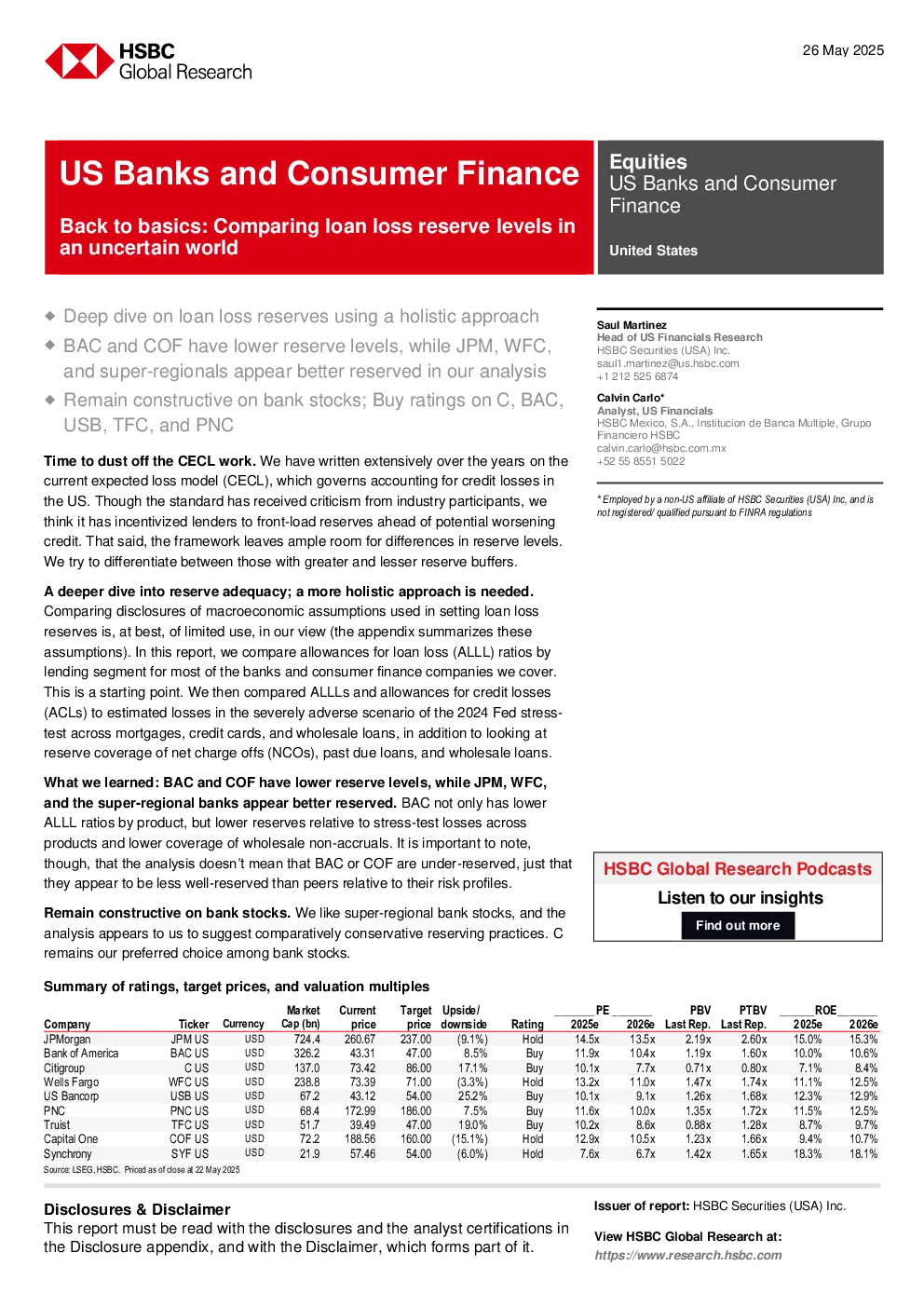
Disclosures & DisclaimerThis report must be read with the disclosures and theanalyst certifications inthe Disclosure appendix, and with the Disclaimer, which forms part of it.Deep diveonloan lossreservesusing a holistic approachBACandCOFhave lowerreserve levels, while JPM,WFC,and super-regionalsappear better reservedinouranalysisRemainconstructive on bank stocks;Buy ratingson C, BAC,USB, TFC, and PNCTime to dust off the CECL work.We have writtenextensively over the yearson thecurrent expected loss model (CECL), which governs accounting for credit losses intheUS.Thoughthe standard has received criticism from industry participants,wethink it has incentivizedlenders tofront-load reservesahead of potential worseningcredit. That said, theframeworkleavesample roomfor differences in reserve levels.We try todifferentiatebetween thosewithgreaterand lesserreserve buffers.A deeper dive intoreserve adequacy; a more holisticapproach is needed.Comparingdisclosuresofmacroeconomic assumptions used in setting loan lossreserves is, at best,of limited use, in our view(theappendixsummarizes theseassumptions).In this report, we compare allowancesfor loan loss(ALLL) ratios bylending segment for most of the banks and consumer finance companies we cover.This isa starting point. We thencomparedALLLsand allowances for credit losses(ACLs) to estimated lossesin the severely adverse scenario of the 2024 Fed stress-testacross mortgages, credit cards, and wholesale loans, in addition to lookingatreserve coverage ofnet charge offs(NCOs), past due loans, and wholesale loans.What we learned:BACandCOFhave lower reservelevels, while JPM, WFC,andthesuper-regional banks appear better reserved.BACnot only has lowerALLL ratios by product, but lower reserves relative to stress-test lossesacrossproducts and lower coverage ofwholesale non-accruals.It is important to note,though, that the analysis doesn’t mean thatBAC or COFare under-reserved, just thatthey appear to be less well-reservedthan peersrelative to their risk profiles.Remain constructive on bank stocks.Welikesuper-regional bankstocks, and theanalysis appears to us to suggest comparatively conservative reserving practices.Cremains our preferred choiceamong bank stocks.Summary ofratings, target prices, and valuation multiplesMarketCurrentTargetUpside/CompanyTickerCurrencyCap (bn)priceprice downsideRating2025eJPMorganJPMUSUSD724.4260.67237.00(9.1%)Hold14.5xBank of AmericaBAC USUSD326.243.3147.008.5%Buy11.9xCitigroupC USUSD137.073.4286.0017.1%Buy10.1xWells FargoWFC USUSD238.873.3971.00(3.3%)Hold13.2xUS BancorpUSB USUSD67.243.1254.0025.2%Buy10.1xPNCPNC USUSD68.4172.99186.007.5%Buy11.6xTruistTFC USUSD51.739.4947.0019.0%Buy10.2xCapital OneCOF USUSD72.2188.56160.00(15.1%)Hold12.9xSynchronySYF USUSD21.957.4654.00(6.0%)Hold7.6xSource:LSEG, HSBC. Priced as of close at22 May 2025US Banksand Consumer FinanceBack to basics:Comparing loan loss reservelevelsinanuncertainworld ◆◆◆ 2026e15.3%10.6%8.4%12.5%12.9%12.5%9.7%10.7%18.1% Hard economic data in the US has been resilient. However,the impacts of tariffsand fiscalpolicy challengesare unclear andsentiment indicatorsraise questions about theeconomicoutlook.In addition, concerns about credit qualityin some lending categories and for privatecredit providers have been rising.Hence,it is a good time toagainfocuson credit qualityoutlooks and reserve strength, in our view.In this report, wecompare theloan loss reserve levels of the banks and consumer financecompanieswe cover.We believe that an unusually large range of economic outcomesispossible, with differing implications for credit quality.Ultimately, however, lenders with moreelevatedloan lossreserve levels are better positioned if economic and credit conditions worsenorif credit quality remains benign. Higher loan loss reserve levelsnot onlybuffer capital fromhigher credit lossesin a downturn,butthey also allow for reserve releases toboostreportedearnings and capital if loss experience turns out better than what is embedded in reserveassumptions.CECL back in focus; our framework for comparing loan lossreserve levelsOn1 January 2020, the current expected loss model (CECL, orFASBASC 326)wentinto effectfor SEC filers, fundamentally changing accounting for credit losses in the US.While the priorincurred loss model required companies to estimate losses (typically over the subsequent twelvemonths) only once a loss eventoccurred, CECL requiredcompanies to hold loan loss reservesequal to the expected losses on all loans over the entire life of the loans. In effect, the accountingstandard means that banks must make reserves up front upon origination even though theseloans do not yet show signs of impairment.Equally important, banksmustrecalibrate reservelevels on existing loans based on changing expectations of loan losses due to alterations inmacroeconomic assumptions and experience of loan losses thatdifferfrom assumptionsusedinreserving.The effects of the accounting change were far-reaching.Projecting lifetim