您的浏览器禁用了JavaScript(一种计算机语言,用以实现您与网页的交互),请解除该禁用,或者联系我们。[康奈尔大学&伯罗奔尼撒大学]:AI智能体与代理式AI:概念分类、应用与挑战 - 发现报告

AI智能体与代理式AI:概念分类、应用与挑战

AI智能体与代理式AI:概念分类、应用与挑战

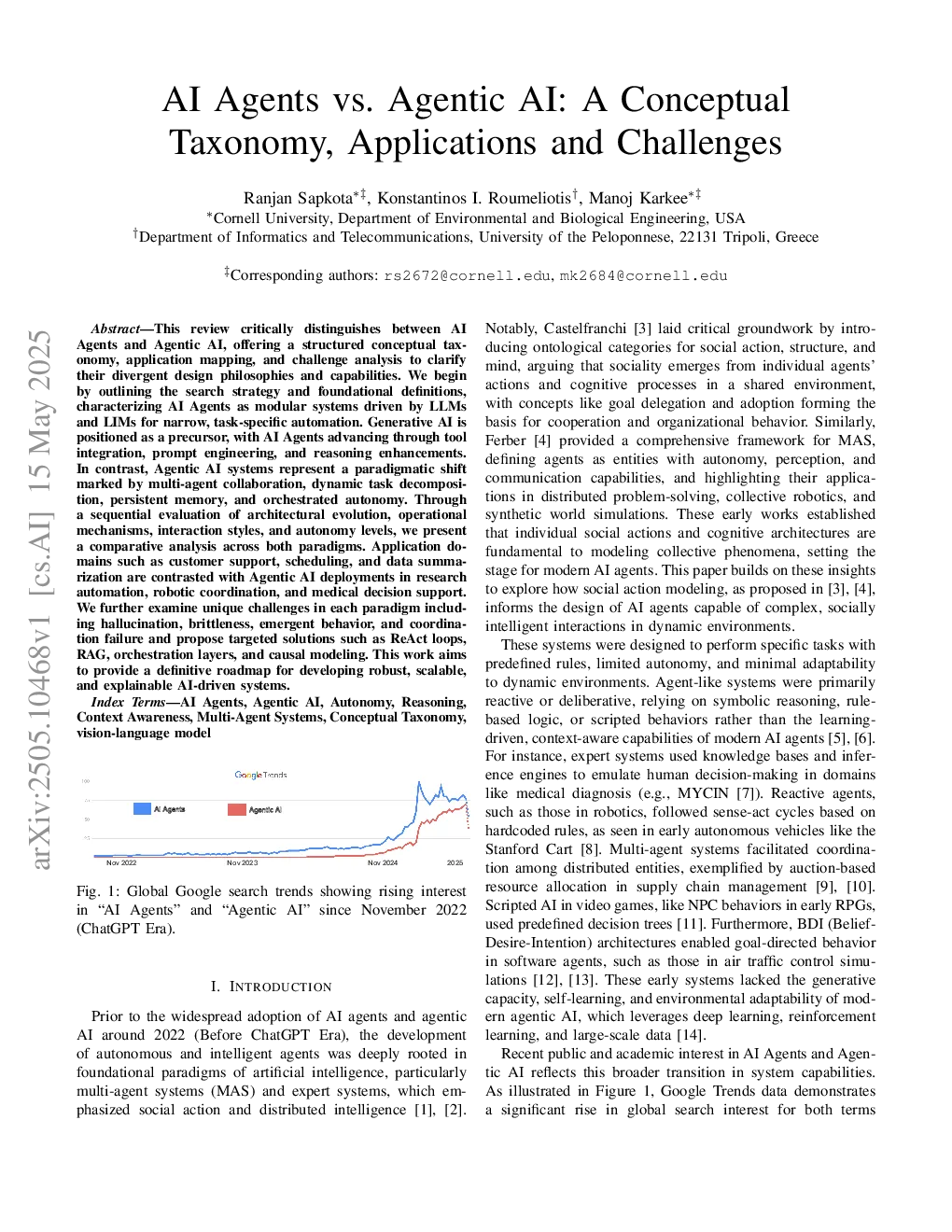
†Nov2022 tant to delineate the technological and conceptual boundariesbetween AI Agents and Agentic AI. While both paradigmsbuild upon large LLMs and extend the capabilities of gener-ative systems, they embody fundamentally different architec-tures, interaction models, and levels of autonomy. AI Agentsare typically designed as single-entity systems that performgoal-directed tasks by invoking external tools, applying se-quential reasoning, and integrating real-time information tocomplete well-defined functions [17], [37]. In contrast, Agen-tic AI systems are composed of multiple, specialized agentsthat coordinate, communicate, and dynamically allocate sub-tasks within a broader workflow [14], [38]. This architec-tural distinction underpins profound differences in scalability,adaptability, and application scope.Understanding and formalizing the taxonomy between thesetwo paradigms(AI Agents and Agentic AI)is scientificallysignificant for several reasons. First, it enables more precisesystem design by aligning computational frameworks withproblem complexity ensuring that AI Agents are deployedfor modular, tool-assisted tasks, while Agentic AI is reservedfor orchestrated multi-agent operations. Moreover, it allowsfor appropriate benchmarking and evaluation: performancemetrics, safety protocols, and resource requirements differmarkedly between individual-task agents and distributed agentsystems. Additionally, clear taxonomy reduces developmentinefficiencies by preventing the misapplication of design prin-ciples such as assuming inter-agent collaboration in a systemarchitected for single-agent execution. Without this clarity,practitioners risk both under-engineering complex scenariosthat require agentic coordination and over-engineering simpleapplications that could be solved with a single AI Agent.Since the field of artificial intelligence has seen significantadvancements, particularly in the development of AI Agentsand Agentic AI. These terms, while related, refer to distinctconceptswith different capabilities and applications.Thisarticle aims to clarify the differences between AI Agents andAgentic AI, providing researchers with a foundational under-standing of these technologies. The objective of this study isto formalize the distinctions, establish a shared vocabulary,and provide a structured taxonomy between AI Agents andAgentic AI that informs the next generation of intelligent agentdesign across academic and industrial domains, as illustratedin Figure 2.This review provides a comprehensive conceptual and archi-tectural analysis of the progression from traditional AI Agentsto emergent Agentic AI systems. Rather than organizing thestudy around formal research questions, we adopt a sequential,layeredstructure that mirrors the historical and technicalevolution of these paradigms. Beginning with a detailed de-scription of our search strategy and selection criteria, wefirst establish the foundational understanding of AI Agentsby analyzing their defining attributes, such as autonomy, reac-tivity, and tool-based execution. We then explore the criticalrole of foundational models specifically LLMs and LargeImage Models (LIMs) which serve as the core reasoning andperceptual substrates that drive agentic behavior. Subsequent following the emergence of large-scale generative models inlate 2022. This shift is closely tied to the evolution of agentdesign from the pre-2022 era, where AI agents operated inconstrained, rule-based environments, to the post-ChatGPTperiod marked by learning-driven, flexible architectures [15]–[17]. These newer systems enable agents to refine their perfor-mance over time and interact autonomously with unstructured,dynamic inputs [18]–[20]. For instance, while pre-modernexpert systems required manual updates to static knowledgebases,modern agents leverage emergent neural behaviorsto generalize across tasks [17]. The rise in trend activityreflects increasing recognition of these differences. Moreover,applications are no longer confined to narrow domains likesimulations or logistics, but now extend to open-world settingsdemanding real-time reasoning and adaptive control. This mo-mentum, as visualized in Figure 1, underscores the significanceof recent architectural advances in scaling autonomous agentsfor real-world deployment.The release of ChatGPT in November 2022 marked a pivotalinflection point in the development and public perception ofartificial intelligence, catalyzing a global surge in adoption,investment, and research activity [21]. In the wake of thisbreakthrough, the AI landscape underwent a rapid transforma-tion, shifting from the use of standalone LLMs toward moreautonomous, task-oriented frameworks [22]. This evolutionprogressedthrough two major post-generative phases:AIAgents and Agentic AI. Initially, the widespread success ofChatGPT popularized Generative Agents, which are LLM-based systems designed to produce novel outputs such as text,images, and code from user prompts [23], [24