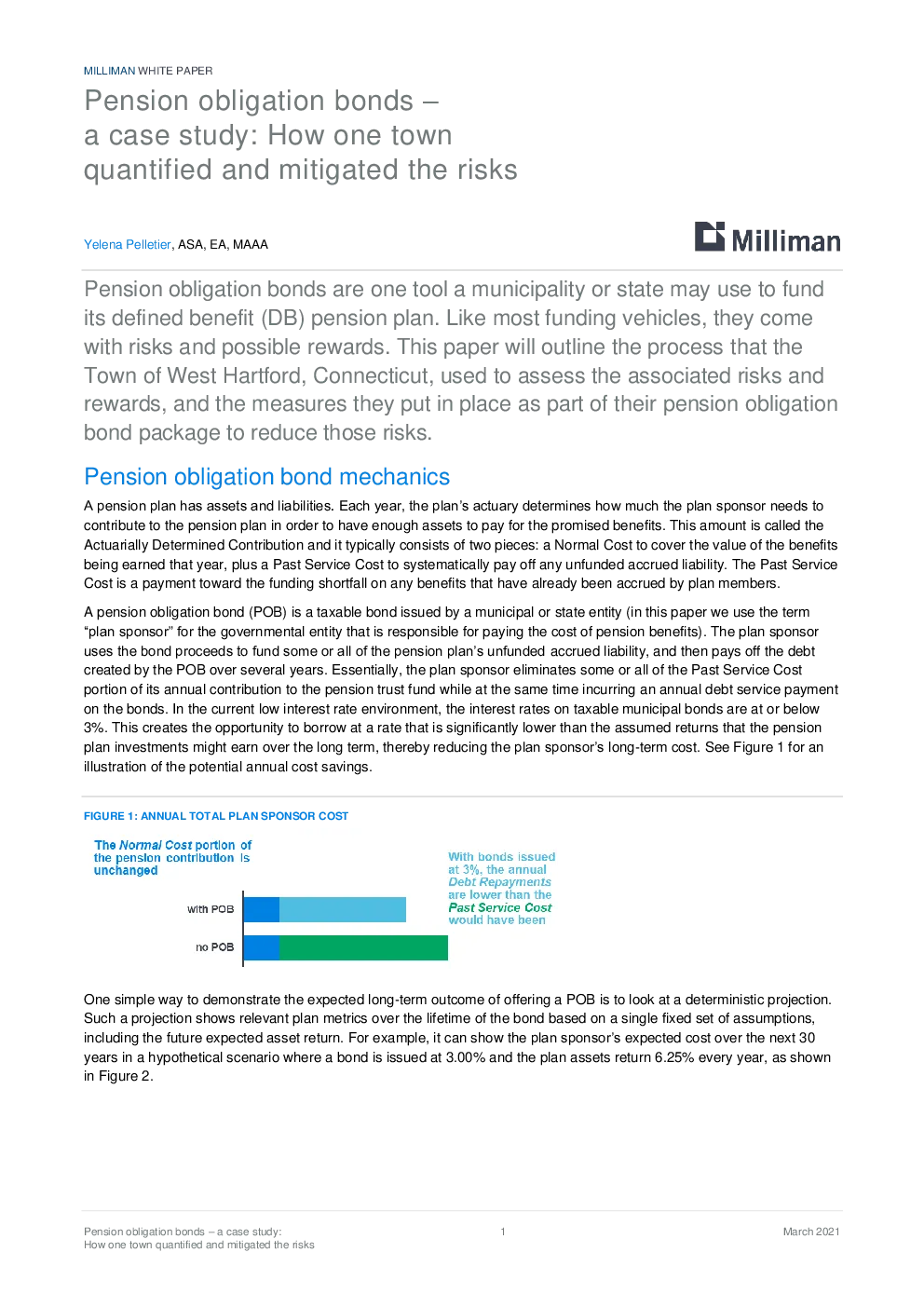
Pension obligation bonds (POBs) are a tool for municipalities to fund defined benefit (DB) pension plans, offering potential cost savings through lower borrowing rates compared to expected investment returns. However, they come with significant risks, primarily investment risk, where underperformance can increase costs, and overperformance might lead to higher costs due to debt service obligations.
The Town of West Hartford, Connecticut, considered POBs to improve its pension plan's funded status (40% funded) amid declining market performance and rising contribution requirements. Milliman developed a stochastic projection model to quantify risks by analyzing 10,000 investment scenarios over 30 years, comparing outcomes with and without POBs.
Key findings from the model:
- Median cost savings with POBs ($629 million vs. $737 million without POBs).
- Higher cost in worst-case scenarios (95th percentile) with POBs.
- Variability in outcomes: POBs reduce low-cost scenarios but increase high-cost scenarios.
- Metrics analyzed: total cost over life, highest one-year cost, and funded ratio at end of period.
West Hartford implemented risk mitigation strategies:
- Conservative assumptions: Used a 6.25% interest rate assumption instead of the 6.31% expected return.
- Dollar cost averaging: Gradually invested bond proceeds over six quarters to avoid immediate market losses.
- Strong funding policy: Continued funding Normal Cost even if overfunded (up to 150%).
- Reserve fund: Established a general fund reserve to cover exceeding contribution increases (above 5% year-over-year).
- Addressing GFOA concerns: Structured bonds without complex features, limited issuance to debt capacity, and consulted on credit rating impacts.
Each mitigation measure involved a trade-off between risk reduction and potential reward loss. The stochastic model helped quantify these impacts, ensuring informed decision-making. Proper plan governance and funding policy were emphasized as crucial for POB success.
Conclusion: POBs can offer cost savings but require careful risk assessment and mitigation strategies. Stakeholders should consult with actuaries, investment advisors, and financial experts, and consider features like conservative assumptions, dollar cost averaging, strong funding policies, and reserve funds to manage risks effectively.