部分之和:对立面具有吸引力
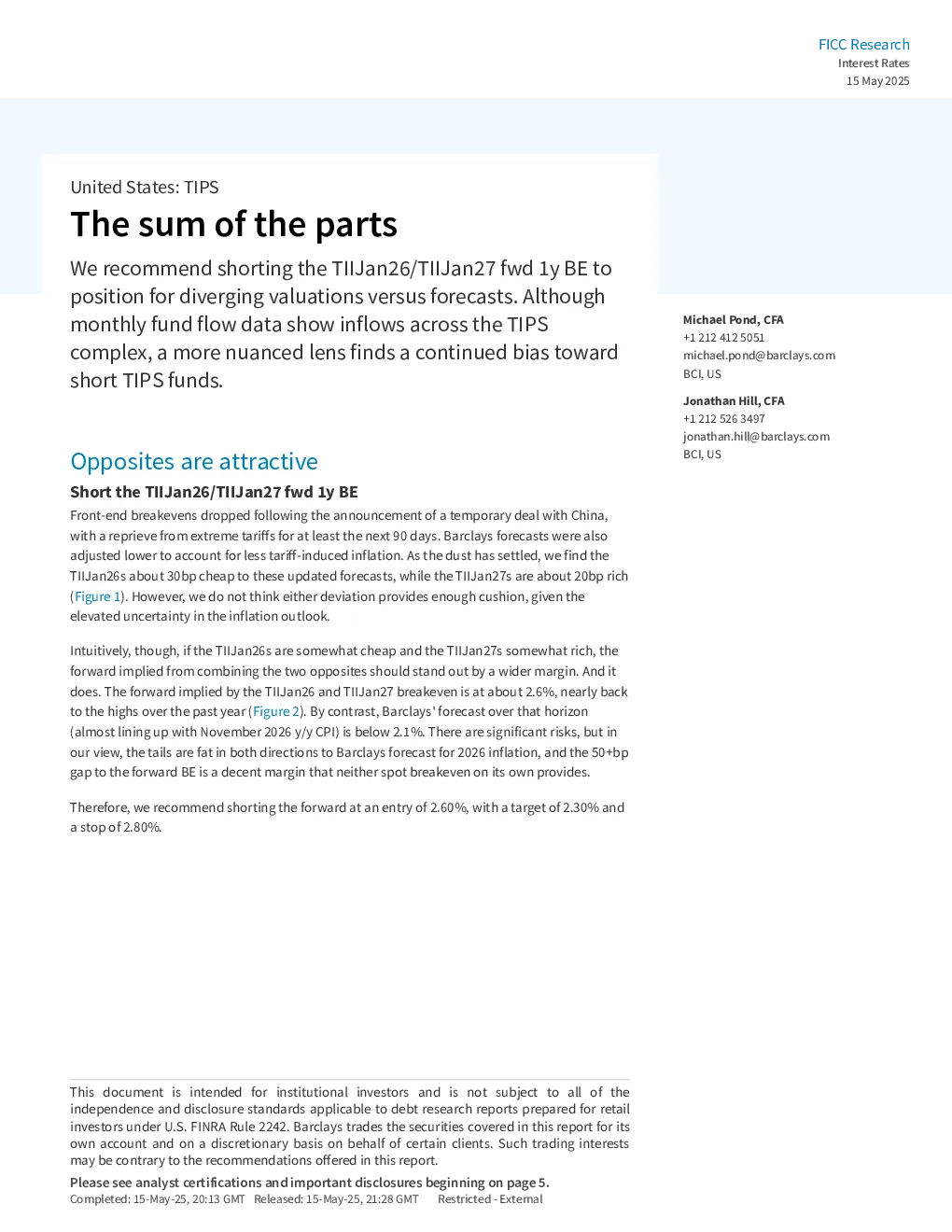
United States: TIPS The sum of the parts We recommend shorting the TIIJan26/TIIJan27 fwd 1y BE toposition for diverging valuations versus forecasts. Althoughmonthly fund flow data show inflows across the TIPScomplex, a more nuanced lens finds a continued bias towardshort TIPS funds. Michael Pond, CFA+1 212 412 5051michael.pond@barclays.comBCI, US Jonathan Hill, CFA+1 212 526 3497jonathan.hill@barclays.comBCI, US Opposites are attractive Short the TIIJan26/TIIJan27 fwd 1y BE Front-end breakevens dropped following the announcement of a temporary deal with China,with a reprieve from extremetariffsfor at least the next 90 days. Barclays forecasts were alsoadjusted lower to account for lesstariff-inducedinflation. As the dust has settled, we find theTIIJan26s about 30bp cheap to these updated forecasts, while the TIIJan27s are about 20bp rich(Figure 1). However, we do not think either deviation provides enough cushion, given theelevated uncertainty in the inflation outlook. Intuitively, though, if the TIIJan26s are somewhat cheap and the TIIJan27s somewhat rich, theforward implied from combining the two opposites should stand out by a wider margin. And itdoes. The forward implied by the TIIJan26 and TIIJan27 breakeven is at about 2.6%, nearly backto the highs over the past year (Figure 2). By contrast, Barclays' forecast over that horizon(almost lining up with November 2026 y/y CPI) is below 2.1%. There are significant risks, but inour view, the tails are fat in both directions to Barclays forecast for 2026 inflation, and the 50+bpgap to the forward BE is a decent margin that neither spot breakeven on its own provides. Therefore, we recommend shorting the forward at an entry of 2.60%, with a target of 2.30% anda stop of 2.80%. Source: Barclays Research Beware monthly granularity in dynamic markets One support for front-end breakeven valuations has been, and continues to be, persistentinflows into short TIPS funds (tracking either the 0-5y or 1-5y TIPS benchmarks). Although Aprilhad inflows into both short- and longer-duration TIPS funds, this may be aone-offresponse that in essence was a jump in stagflationary risk (Figure 4). By our calculations, short TIPS fundsreceived inflows of $856mn in April, while other TIPS funds received a very similar $861mn flow. However, the similarity of the net April flow masks a few nuances. These are net monthly flows,and given the intra-month volatility in April, it is likely an overly simplistic takeaway to brushoffthe full month as an 'inflow month'. For instance, in the hyper-volatile trading conditionsimmediatelyafter'Liberation Day' but before the delay, there could have been sharp outflowsthat would not be captured with net monthly flows. Instead, leaning on higher-frequency flowmetrics could add insight into underlying dynamics. For instance, for non-short ETFs (whichhave daily fund flow tracking), while there was a sizable inflow ($406mn) on April 3, since then,there have been five separate days of $100mn+ outflows (including on Wednesday this week at$135mn) and zero $100mn+ inflows. Short TIPS ETFs, by contrast, have had five $100mn+ inflowdays since the beginning of April and only one $100mn+ outflow. As a result, in general, wecontinue to believe we are in the midst of a re-balancing towards shorter TIPS with less realduration exposure. While, all else equal, this should put upward pressure on front-end breakevens (includingperhaps the TIIJan26/TIIJan27 forward breakeven discussed above), one key nuance is that pre-COVID, front-end breakevens would consistently trade cheap to forecasts due to the lack of anatural buyer and higher energy beta exposure. While inflows into short TIPS funds may haveincreased front-end demand, energy volatility remains, so it is not obvious that breakevensshould flip to perpetually rich to forecasts, in our opinion. However, even if that were the case,that would imply strong upside relative performance potential for the TIIJan26 BE (which ischeap versus forecasts), and if that occurs, it would cheapen the TIIJan26/TIIJan27 BE, all elseequal. FIGURE 4. Cumulative fund flows to TIPS ETFs since July 2020 by type FIGURE 5. Cumulative one-year fund flows to TIPS ETFs ($bn) Analyst(s) Certification(s):We, Michael Pond, CFA and Jonathan Hill, CFA, hereby certify (1) that the views expressed in this research report accurately reflect our personal views about any or all of the subject securities or issuers referred to in this research report and (2) no part of our compensation was, is or will be directly orindirectly related to the specific recommendations or views expressed in this research report. Important Disclosures: Barclays Research is produced by the Investment Bank of Barclays Bank PLC and itsaffiliates(collectively and each individually, "Barclays"). All authors contributing to this research report are Research Analysts unless otherwise indicated. The publication date at the top of the report reflectsthe local time