您的浏览器禁用了JavaScript(一种计算机语言,用以实现您与网页的交互),请解除该禁用,或者联系我们。[ACT Research]:高等教育中的基本技能发展:学生和教职员工的视角 - 发现报告

高等教育中的基本技能发展:学生和教职员工的视角

AI智能总结
查看更多
高等教育中的基本技能发展:学生和教职员工的视角

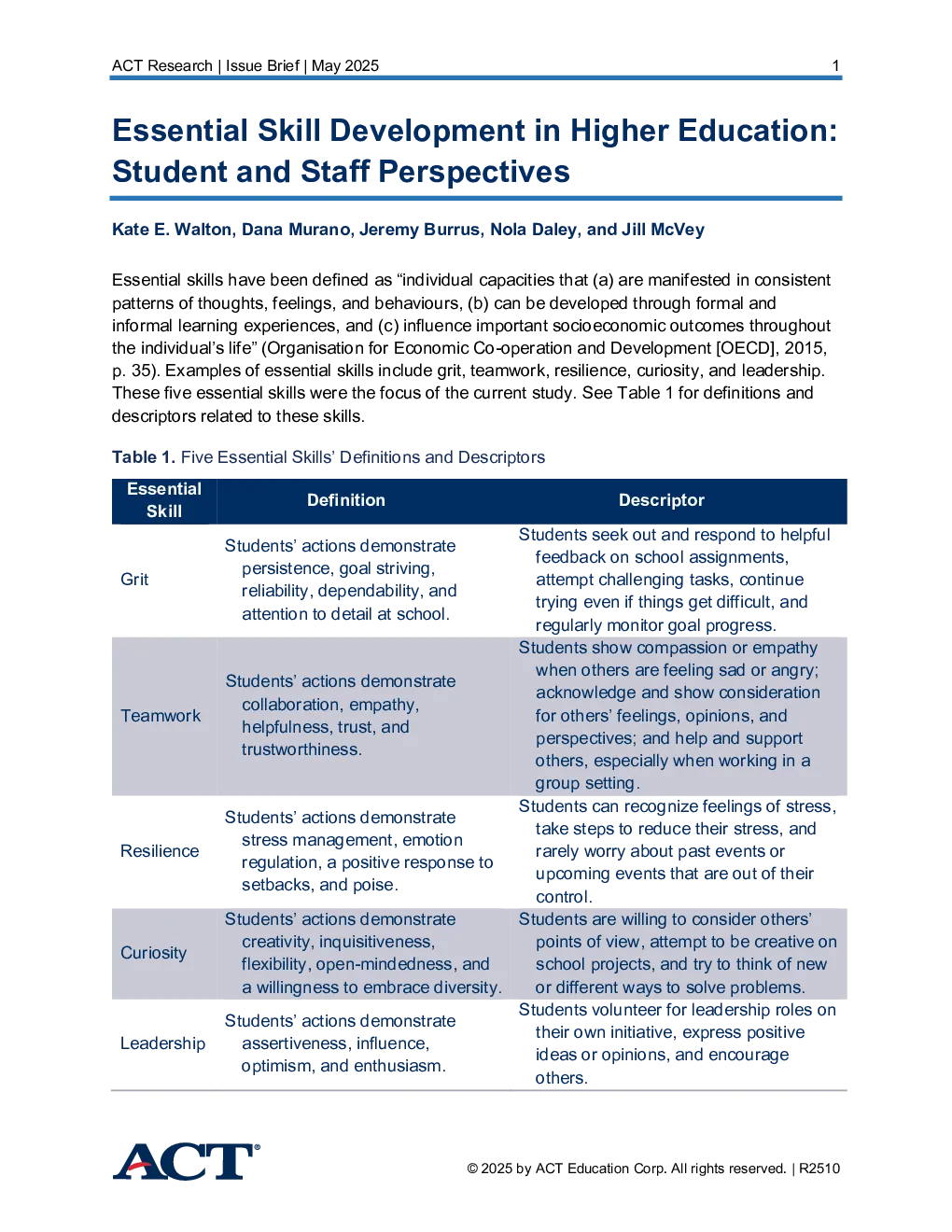
Essential Skill Development in Higher Education:Student and Staff Perspectives Kate E. Walton, Dana Murano, Jeremy Burrus, Nola Daley, and Jill McVey Essential skills have been defined as “individual capacities that (a) are manifested in consistentpatterns of thoughts, feelings, and behaviours, (b) can be developed through formal andinformal learning experiences, and (c) influence important socioeconomic outcomes throughoutthe individual’s life” (Organisation for Economic Co-operation and Development [OECD], 2015,p. 35). Examples of essential skills include grit, teamwork, resilience, curiosity, and leadership.These five essential skills were the focus of the current study. See Table 1 for definitions anddescriptors related to these skills. Essential skills are necessary for success in higher education and are highly valued byemployers. The World Economic Forum (2023), for example, reported that seven of the top 10core skills required for today’s workforce are essential skills. The good news is that, as part b ofthe OECD’s (2015; see above) definition suggests, essential skills can be developed bothnaturally (Roberts et al., 2006) and through intentional intervention. Cipriano and colleagues(2023) carried out a systematic review and meta-analysis to assess whether universal school-based essential skill development interventions for students in grades K–12 improve essentialskills and related outcomes; these researchers determined that students who participated insuch interventions exhibited fewer internalizing and externalizing behaviors and improved theiressential skills, academic achievement, perceptions of school climate, school functioning (e.g.,study skills, attendance), attitudes, and prosocial and civic behaviors. As a result of thesefindings, essential skill development is becoming increasingly popular. Currently, 27 states havestandards surrounding skill development (Collaborative for Academic, Social, and EmotionalLearning, n.d.), and there are many assessments and curricula available for K–12 stakeholders. However, the growth of essential skill development in K–12 has thus far outpaced the growth inhigher education, which unfortunately means that essential skill development is not as widelyapplied in college settings. As a result, students may be underprepared for college and theworkforce. There is certainly a need for essential skill development programming in highereducation (Conley & Donahue-Keegan, 2024). Some mental health promotion programs canenhance essential skills in college students (Conley, 2015), though not all programs are equallyefficacious. Conley evaluated 113 essential skill development–related prevention (i.e., programsdesigned to deter the development of poor skills) and promotion programs conducted in highereducation settings. Mindfulness interventions were particularly successful; to a lesser degree,programs aimed at cultivating skills in self-awareness (e.g., awareness of emotions), self-management (e.g., stress management), social awareness (e.g., compassion toward others),and relationship skills (e.g., empathy) were also successful. Although less successful, otherpromising intervention types included cognitive-behavioral, relaxation, and social skills. Since Conley’s (2015) review, essential skill development implementation has grown in highereducation, although it continues to lag far behind its implementation in K–12. Woolf (2023) offerssome examples of efforts in higher education: First, some institutions offer courses thatspecifically focus on essential skill development and aim to develop students’ skills. Second,some have established support services designed to support students’ mental health, well-being, and essential skills. Third, some institutions have implemented campus-wide initiativesaimed at promoting essential skills. Finally, some residential programs provide students withopportunities to develop essential skills. Overview of the Current Study In this research report, we share results from two surveys—one for high school and one forcollege students—that measured the desirability of essential skill development curricula incolleges. In addition, we report students’ attitudes and beliefs regarding essential skilldevelopment and their perceptions of the utility of developing essential skills. Last, we share qualitative results gleaned from college personnel about the desirability of essential skilldevelopment in colleges and the feasibility of its implementation. Research Questions •Do students feel prepared to enter college and the workforce?•Would increasing essential skills help students feel more prepared?•Do students perceive essential skills to be important for success in college and theworkforce?•Do students believe that essential skills can be improved?•Are essential skill development curricula in higher education desirable to students?•What types of essential skill development activities would students like in highereducation settings to hel