您的浏览器禁用了JavaScript(一种计算机语言,用以实现您与网页的交互),请解除该禁用,或者联系我们。 [国际能源署]:光伏系统的有功功率管理——最新技术和技术解决方案 - 发现报告

光伏系统的有功功率管理——最新技术和技术解决方案

电气设备 2024-01-15 国际能源署 坚守此念
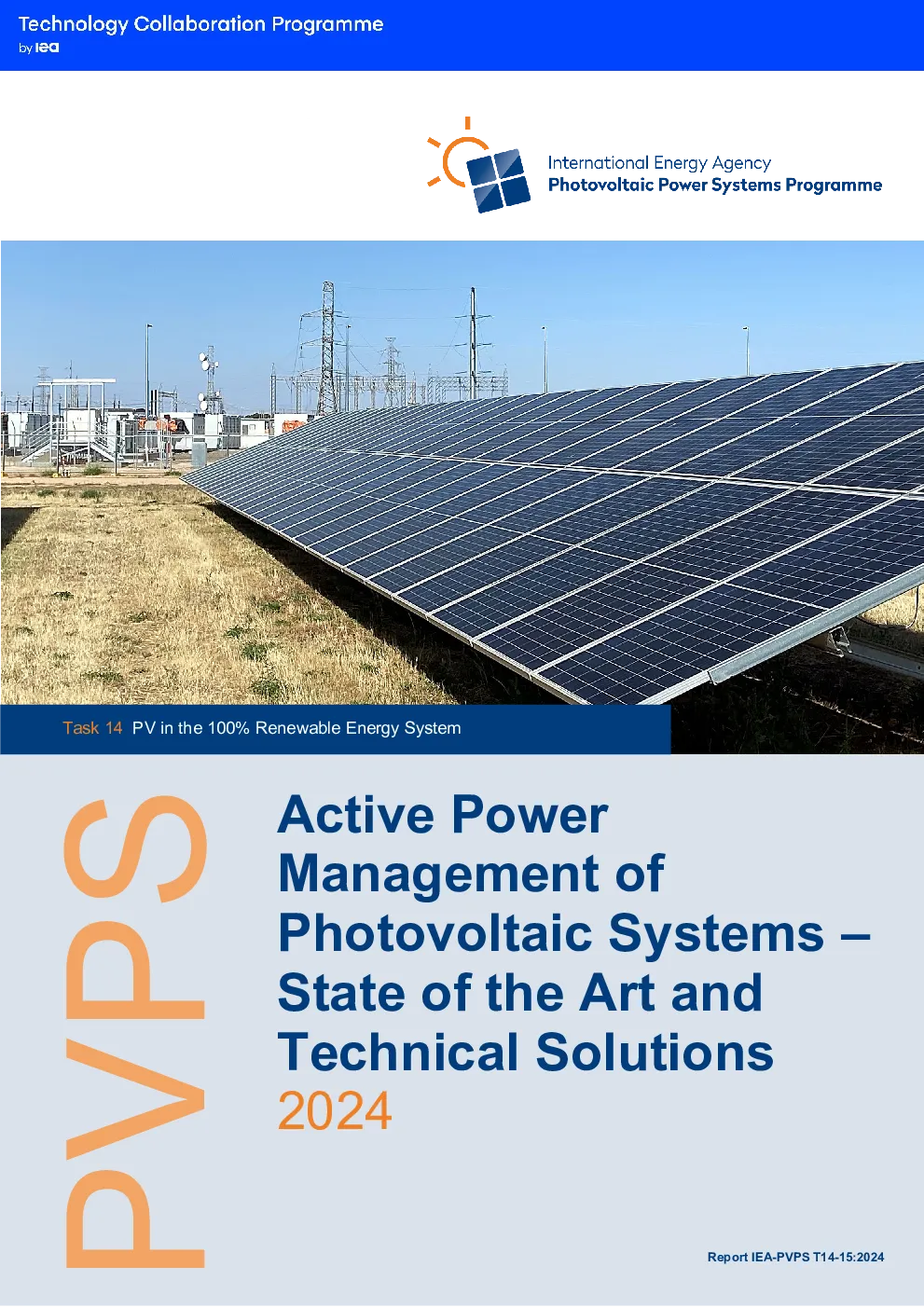
报告封面

Report IEA-PVPS T14-15:2024 What is IEA PVPS TCP?The International Energy Agency (IEA), founded in 1974, is an autonomous body within the framework of the Organizationfor Economic Cooperation and Development (OECD). The Technology Collaboration Programme (TCP) was created witha belief that the future of energy security and sustainability starts with global collaboration. The programme is made up of6.000 experts across government, academia, and industry dedicated to advancing common research and the applicationof specific energy technologies.The IEA Photovoltaic Power Systems Programme (IEA PVPS) is one of the TCP’s within the IEA and was established in1993. The mission of the programme is to “enhance the international collaborative efforts which facilitate the role ofphotovoltaic solar energy as a cornerstone in the transition to sustainable energy systems.” In order to achieve this, theProgramme’s participants have undertaken a variety of joint research projects in PV power systems applications. Theoverall programme is headed by an Executive Committee, comprised of one delegate from each country or organisationmember, which designates distinct ‘Tasks,’ that may be research projects or activity areas.The 25 IEA PVPS participating countries are Australia, Austria, Belgium, Canada, China, Denmark, Finland, France,Germany, Israel, Italy, Japan, Korea, Malaysia, Morocco, the Netherlands, Norway, Portugal, South Africa, Spain, Sweden,Switzerland, Thailand, Turkey, and the United States of America. The European Commission, Solar Power Europe, theSmart Electric Power Alliance, the Solar Energy Industries Association, the Solar Energy Research Institute of Singaporeand Enercity SA are also members.Visit us at:www.iea-pvps.orgWhat is IEA PVPS Task 14?The objective of Task 14 of the IEA Photovoltaic Power Systems Programme is to promote the use of grid-connected PVas an important source of energy in electric power systems. The active national experts from 15 institutions from aroundthe world are collaborating with each other within Subtask B – Operation and planning of power systems with highpenetration of Solar PV and Renewable Energy Sources (RES) – in order to share the technical and economicalexperiences, and challenges. These efforts aim to reduce barriers for achieving high penetration levels of PV Systems inElectricity Grids.AuthorsMain Content:Ch. Bucher, S. Chen, G. Adinolfi, R. Guerrero-Lemus, Y. Ogasawara, G. Heilscher, I. McGill,M. Said El Hamaoui, C. Kondzialka, D. Mende, J. Wiemer, R. Bruendlinger, A. Ghennioui, M. Said Elhamaoui,K. Ogimoto, E. Omine, Y. Ueda, J. Remund, A. Benazzouz, G. Graditi, T. Key.Editor:Ch. BucherDISCLAIMERThe IEA PVPS TCP is organised under the auspices of the International Energy Agency (IEA) but is functionally and legally autonomous.Views, findings and publications of the IEA PVPS TCP do not necessarily represent the views or policies of the IEA Secretariat or itsindividual member countriesCOVER PICTURETailem Bend Solar Power Farm, South AustraliaISBN978-3-907281-46-8 Active Power Management of Photovoltaic Systems – State of the Art and Technical Solutions Active Power Management of PhotovoltaicSystems –State of the Art and Technical SolutionsIEA PVPSTask 14PV in the 100 % Renewable Energy SystemReport IEA-PVPS T14-15:2024January 2024ISBN 978-3-907281-46-8 Acknowledgements........................................................................................................... 7List of abbreviations and Definitions.................................................................................. 8Executive summary........................................................................................................... 91Introduction............................................................................................................ 111.1Methodology and purpose of the report...................................................... 111.2Target audience ......................................................................................... 111.3Why PV Curtailment is a Reasonable Grid Integration Measure................. 121.4Value of Curtailed Energy .......................................................................... 131.5Alternatives to PV Power Curtailment......................................................... 141.6Curtailment at Point of Connection ............................................................. 141.7Limitations of the Scope of this Report ....................................................... 152Use Cases............................................................................................................. 162.1Comply with Transmission Grid Constraints (Capacity Constraints) ........... 162.2Comply with Distribution Grid Constraints .................................................. 162.3Comply with Grid Connection Constraints .................................................. 172.4Collaborative Grid Optimisation...................