经合组织经济调查:哥斯达黎加2025
 AI智能总结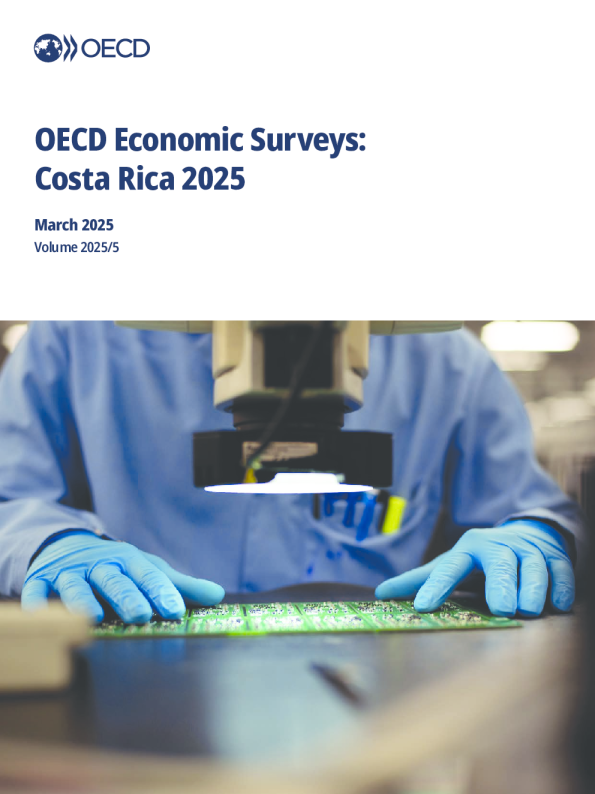
March 2025Volume 2025/5 OECD Economic Surveys:Costa Rica2025 This document, as well as any data and map included herein, are without prejudice to the status of or sovereignty overany territory, to the delimitation of international frontiers and boundaries and to the name of any territory, city or area. The statistical data for Israel are supplied by and under the responsibility of the relevant Israeli authorities. The use ofsuch data by the OECD is without prejudice to the status of the Golan Heights, East Jerusalem and Israeli settlements inthe West Bank under the terms of international law. Note by the Republic of Türkiye The information in this document with reference to “Cyprus” relates to the southern part of the Island. There is no singleauthority representing both Turkish and Greek Cypriot people on the Island. Türkiye recognises the Turkish Republic ofNorthern Cyprus (TRNC). Until a lasting and equitable solution is found within the context of the United Nations, Türkiyeshall preserve its position concerning the “Cyprus issue”. Note by all the European Union Member States of the OECD and the European UnionThe Republic of Cyprus is recognised by all members of the United Nations with the exception of Türkiye. Theinformation in this document relates to the area under the effective control of the Government of the Republic of Cyprus. Please cite this publication as: ISBN 978-92-64-72135-7 (print)ISBN 978-92-64-38987-8 (PDF)ISBN 978-92-64-91938-9 (HTML) OECD Economic SurveysISSN 0376-6438 (print)ISSN 1609-7513 (online) OECD Economic Surveys: Costa RicaISSN 2959-4987 (print)ISSN 2959-4995 (online) Photo credits:Cover photo courtesy of © Procomer Costa Rica. Foreword © Gianfranco Vivi/Shutterstock.com.Executive summary © Yingna Cai/Shutterstock.com. Corrigenda to OECD publications may be found at: https://www.oecd.org/en/publications/support/corrigenda.html.© OECD 2025 Attribution 4.0 International (CC BY 4.0) This work is made available under the Creative Commons Attribution 4.0 International licence. By using this work, you accept to be bound by the terms of this licence(https://creativecommons.org/licenses/by/4.0/).Attribution– you must cite the work.Translations– you must cite the original work, identify changes to the original and add the following text:In the event of any discrepancy between the original work and thetranslation, only the text of original work should be considered valid.Adaptations– you must cite the original work and add the following text:This is an adaptation of an original work by the OECD. The opinions expressed and arguments employed inthis adaptation should not be reported as representing the official views of the OECD or of its Member countries.Third-party material– the licence does not apply to third-party material in the work. If using such material, you are responsible for obtaining permission from the third party and forany claims of infringement.You must not use the OECD logo, visual identity or cover image without express permission or suggest the OECD endorses your use of the work.Any dispute arising under this licence shall be settled by arbitration in accordance with the Permanent Court of Arbitration (PCA) Arbitration Rules 2012. The seat of arbitration shallbe Paris (France). The number of arbitrators shall be one. Foreword This Economic Survey was prepared by Alberto González Pandiella and Alessandro Maravalle, under thesupervision of Aida Caldera Sánchez. Research assistance was provided by Mónica Quinzá Armenta,administrativeand editorial support by Gemma Martínez and communication assistance by Laura Fortin. This Survey is published under the responsibility of the Economic and Development Review Committee ofthe OECD. The Committee discussed the draft Survey on 10 December 2024. The cut-off date for dataused in the Survey is 14 February2025. Information about this and previous Surveys and more information about how Surveys are prepared isavailable athttps://www.oecd.org/en/topics/economic-surveys.html. Table of contents 3 Foreword Executive summary9 1 Sustaining growth and macroeconomic stability17 2 Enhancing equality of opportunities by increasing female labour participation andreducing informality51 3Supporting the green transition by diversifying renewables and strengthening waterand waste management67 4 Maximising trade benefits 80 FIGURES Figure1. Growth has been more resilient and stronger than in peer countries10Figure2. The fiscal deficit has been reduced12Figure3. Female labour force participation is low13Figure4. Only a quarter of Costa Rica’s population is connected to the sewerage network14Figure5. High-tech products are a growing share of Costa Rica’s exports15Figure1.1.GDP growth has been stronger than in peer countries18Figure1.2. The export sector has thrived and thedomestic part of the economy is also trending up19Figure1.3.The labour market has improved but participation is lower thanbefore the pandemic19Figure1.4.