经合组织经济调查:立陶宛2025
 AI智能总结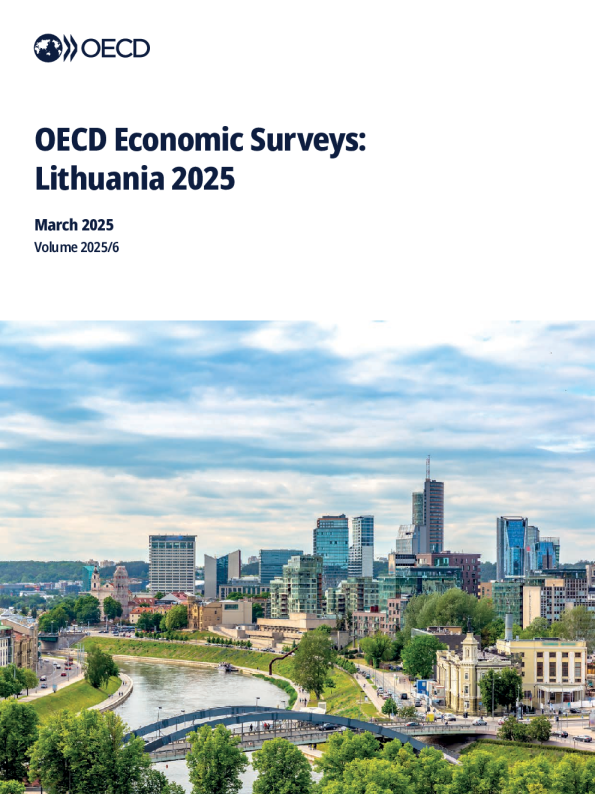
March 2025Volume 2025/6 OECD Economic Surveys:Lithuania2025 This Economic Survey was prepared by Pierre-Alain Pionnier and Donal Smith, under the supervision of Jens Arnold.Research assistance was provided by Tony Huang and Isabella Medina, editorial assistance by Emily Derry, ElodieLormel and Meral Gedik, and communication assistance by Laura Fortin. This Survey is published under the responsibility of the Economic and Development Review Committee of the OECD.The Committee discussedthe draft Survey on 5 November 2024. The cut-off date for data used in the Survey is3March 2025. Information about this and previous Surveys and more information about how Surveys are prepared is available athttps://www.oecd.org/en/topics/economic-surveys.html. Table ofcontents 3 Foreword Basic statistics of Lithuania, 20248 Executive Summary 10 1Harnessing the economic rebound to build fiscal space20 1.1. The economy is emerging from a downturn211.2. Inflation has cooled down after a record increase221.3. Economic activity is projected to pick up in 2025 and 2026281.4. Financial stability risks are broadly contained, but new risks may emerge291.5. Fiscal policy will need further adjustments to face future spending pressures35References50 2Raising productivity and strengthening institutions54 2.1. Productivity growth has rebounded recently, enabling further convergence552.2. Product market and insolvency regulations are among the most conducive to productivity growth inthe OECD562.3. Fostering innovation and digitalisation582.4. Further improving Lithuania’s public integrity and anti-corruption framework63References68 3Developing renewable energy sources and curbing emissions fromtransport and buildings71 3.1. Gross GHG emissions have hardly declined since 2000 and the economy is highly dependent onenergy imports723.2. Developing low-carbon energy sources743.3. Curbing GHG emissions from the transport sector763.4. Accelerating the renovation of buildings823.5. Adapting to climate-change risks84References87 4Addressing demographic challenges90 4.1. Addressing demographic change requires decisive policy action914.2. Mitigating the shrinking of the labour force944.3. Addressing the increase in public pension spending and ensuring adequacy1054.4. Improving health outcomes in a cost-effective way111References128 FIGURES Figure1. Lithuania has seen a rapid convergence of incomes towards OECD living standards11Figure2. Ageing-related expenditure will increase significantly13Figure3. Developing capital markets would help alleviate firms’ financial constraints14Figure4. Gross greenhouse gas emissions have hardly declined since the low point reached in 200015Figure5. Lithuania will face a major demographic shock16Figure1.1. Economic activity has started to rebound21Figure1.2. The labour force has grown significantly, but the labour market remains tight22Figure1.3. Inflation rose to one of the highest levels in the euro area23Figure1.4. Strong wage growth fuelled inflation23Figure1.5.Labour shortages contribute to stronger wage growth24Figure1.6. The gender wage gap has not decreased over the last decade25Figure1.7. Cost competitiveness has weakened but remains better than in neighbouring countries26Figure1.8. Exports of goods have suffered from competitiveness losses27Figure1.9. Imports and exports have been reoriented away from Russia and Belarus27Figure1.10. The Lithuanian financial system has sound fundamentals30Figure1.11. Despite the increase in interest rates, credit distribution remains robust31Figure1.12. Housing market risks should be closely monitored32Figure1.13. The number of Fintech firms registered in Lithuania has expanded fast33Figure1.14. Theassets of the Deposit Guarantee Scheme have increased along with deposits34Figure1.15. The fiscal deficit is expected to increase in 2025-2636Figure1.16. Public debt has been kept lower than in most OECD countries37Figure1.17. Fiscal sustainability requires building additional fiscal space38Figure1.18. The public sector is larger than in other OECD countries and paying a wage premium41Figure1.19. Satisfaction with publicservices is low42Figure1.20. Fiscal revenues are low43Figure1.21. The shadow economy represents more than 20% of GDP44Figure1.22. Digital payments should be further encouraged to reduce the VAT compliance gap45Figure1.23. The employment rates of low-and medium-skilled workers are relatively low47Figure1.24. Poverty risks are high for minimum wage workers who becomeunemployed47Figure1.25. The labour tax wedge is higher than the OECD average48Figure2.1. Lithuania’s productivity is catching up with Western Europe but a gap remains55Figure2.2. Aggregate productivity growth is driven by within-industry productivity developments56Figure2.3. Lithuania has further improved its product market regulations since 201857Figure2.4. The insolvency framework has become more conducive to productivity growth58Figure2.5. A significant proportion of firms are financial