您的浏览器禁用了JavaScript(一种计算机语言,用以实现您与网页的交互),请解除该禁用,或者联系我们。[美股财报]:FTAI航空有限公司-a 2025年季度报告 - 发现报告

FTAI航空有限公司-a 2025年季度报告

2025-05-05美股财报E***
AI智能总结
查看更多
FTAI航空有限公司-a 2025年季度报告

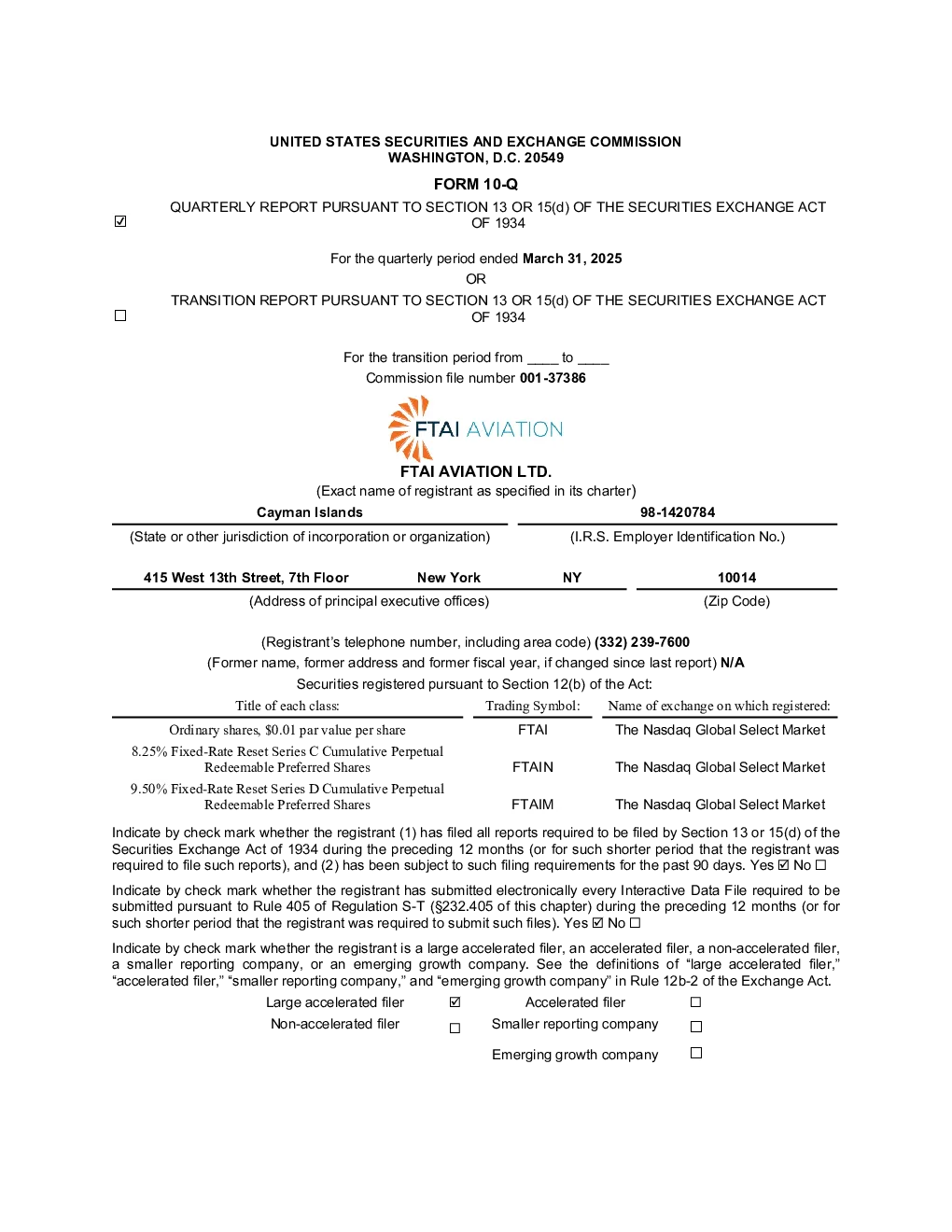
FORM 10-Q ☑QUARTERLY REPORT PURSUANT TO SECTION 13 OR 15(d) OF THE SECURITIES EXCHANGE ACTOF 1934 For the quarterly period endedMarch 31, 2025ORTRANSITION REPORT PURSUANT TO SECTION 13 OR 15(d) OF THE SECURITIES EXCHANGE ACTOF 1934 For the transition period from ____ to ____Commission file number001-37386 Indicate by check mark whether the registrant (1) has filed all reports required to be filed by Section 13 or 15(d) of theSecurities Exchange Act of 1934 during the preceding 12 months (or for such shorter period that the registrant wasrequired to file such reports), and (2) has been subject to such filing requirements for the past 90 days. YesNo Indicate by check mark whether the registrant has submitted electronically every Interactive Data File required to besubmitted pursuant to Rule 405 of Regulation S-T (§232.405 of this chapter) during the preceding 12 months (or forsuch shorter period that the registrant was required to submit such files). YesNo Indicate by check mark whether the registrant is a large accelerated filer, an accelerated filer, a non-accelerated filer,a smaller reporting company, or an emerging growth company. See the definitions of “large accelerated filer,”“accelerated filer,” “smaller reporting company,” and “emerging growth company” in Rule 12b-2 of the Exchange Act. Large accelerated filerAccelerated filerNon-accelerated filerSmaller reporting company☐Emerging growth company☐ If an emerging growth company, indicate by check mark if the registrant has elected not to use the extendedtransition period for complying with any new or revised financial accounting standards provided pursuant to Section13(a) of the Exchange Act. Indicate by check mark whether the registrant is a shell company (as defined in Rule 12b-2 of the Exchange Act).Yes☐No There were 102,555,975 ordinary shares outstanding at April 30, 2025. FORWARD-LOOKING STATEMENTS AND RISK FACTORS SUMMARY This report contains “forward-looking statements” within the meaning of the Private Securities Litigation Reform Act of1995. Forward-looking statements are not statements of historical fact but instead are based on our present beliefsand assumptions and on information currently available to us. You can identify these forward-looking statements bythe use of forward-looking words such as “outlook,” “believes,” “expects,” “potential,” “continues,” “may,” “will,”“should,” “could,” “seeks,” “approximately,” “predicts,” “intends,” “plans,” “estimates,” “anticipates,” “target,” “projects,”“contemplates” or the negative version of those words or other comparable words. Any forward-looking statementscontained in this report are based upon our historical performance and on our current plans, estimates andexpectations in light of information currently available to us. The inclusion of this forward-looking information shouldnot be regarded as a representation by us, that the future plans, estimates or expectations contemplated by us will beachieved. Such forward-looking statements are subject to various risks and uncertainties and assumptions relating to ouroperations, financial results, financial condition, business, prospects, growth strategy and liquidity. Accordingly, thereare or will be important factors that could cause our actual results to differ materially from those indicated in thesestatements. The following is a summary of the principal risk factors that make investing in our securities risky andmay materially adversely affect our business, financial condition, results of operations and cash flows. This summaryshould be read in conjunction with the more complete discussion of the risk factors we face, which are set forth inPart II, Item 1A. “Risk Factors” of this report. We believe that these factors include, but are not limited to: •changes in economic conditions generally and specifically in our industry sectors, and other risks relating tothe global economy, including, but not limited to, the Russia-Ukraine conflict, and any related responsesor actions by businesses and governments;•reductions in cash flows received from our assets, as well as contractual limitations on the use of our aviationassets to secure debt for borrowed money;•our ability to take advantage of acquisition opportunities at favorable prices;•our ability to realize the anticipated benefits of our strategic initiatives;•a lack of liquidity surrounding our assets, which could impede our ability to vary our portfolio in an appropriatemanner;•the relative spreads between the yield on the assets we acquire and the cost of financing;•adverse changes in the financing markets we access affecting our ability to finance our acquisitions;•customer or lessee defaults on their obligations;•our ability to renew existing contracts and enter into new contracts with existing or potential lessees;•the availability and cost of capital for future acquisitions;•concentration of a particular type of asset or in a particular sector;•competition within the