每周经济评论
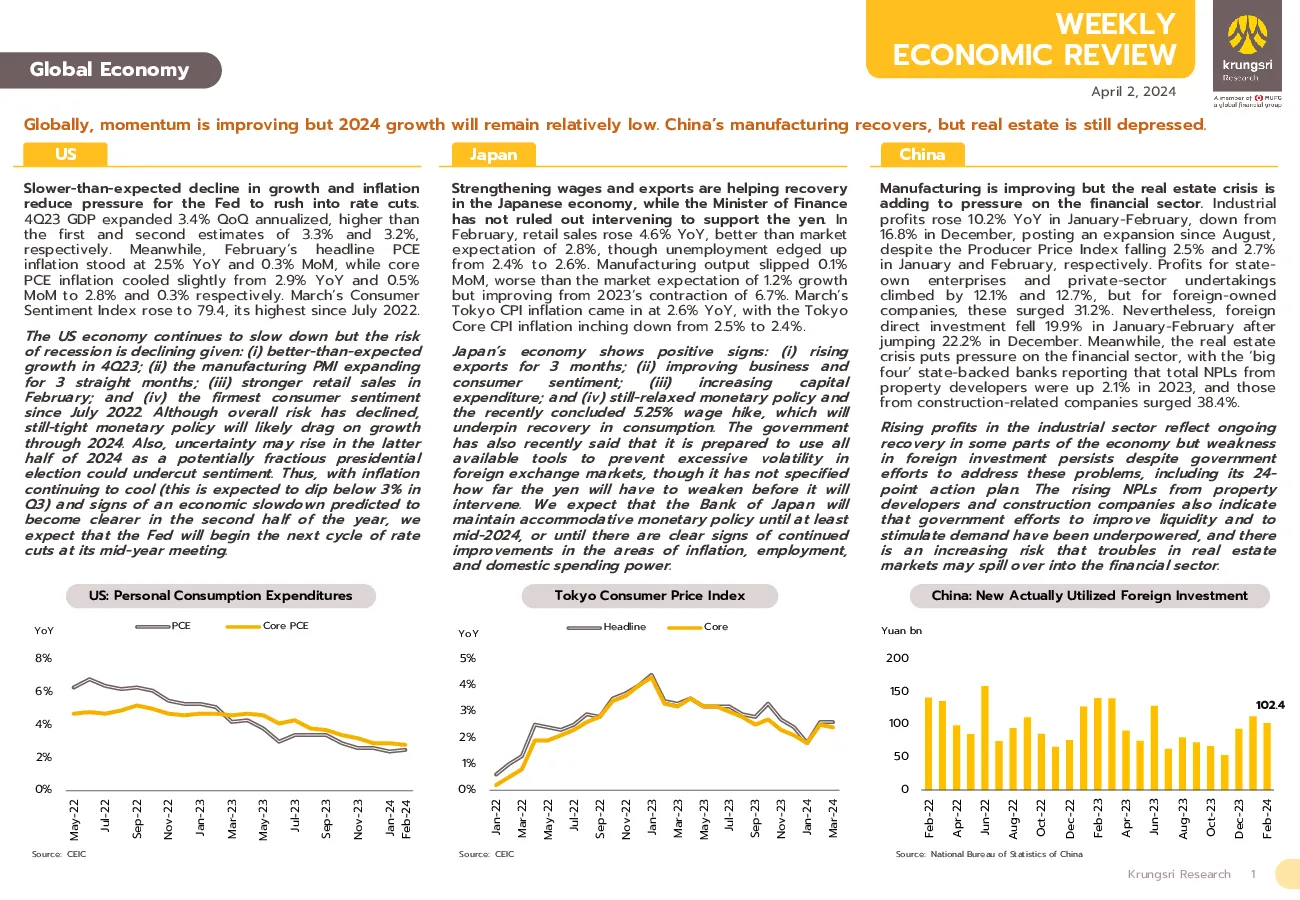
Globally, momentum is improving but2024growth will remain relatively low. China’s manufacturing recovers, but real estate is still depressed. US China Japan Slower-than-expected decline in growth and inflationreducepressure for the Fed to rush into rate cuts.4Q23 GDP expanded 3.4%QoQannualized, higher thanthefirst and second estimates of 3.3%and 3.2%,respectively.Meanwhile,February’sheadlinePCEinflation stood at 2.5% YoY and 0.3% MoM, while corePCE inflation cooled slightly from 2.9% YoY and 0.5%MoM to 2.8% and0.3%respectively. March’s ConsumerSentiment Index rose to 79.4, its highest since July 2022. Manufacturing is improving but the real estate crisis isaddingto pressure on the financial sector.Industrialprofits rose 10.2% YoY in January-February, down from16.8% in December, posting an expansion since August,despite the Producer Price Index falling 2.5% and 2.7%in January and February, respectively. Profits for state-ownenterprisesandprivate-sectorundertakingsclimbedby 12.1%and 12.7%,but for foreign-ownedcompanies,these surged 31.2%.Nevertheless,foreigndirectinvestment fell 19.9%in January-February afterjumping 22.2% in December. Meanwhile, the real estatecrisis puts pressure on the financial sector, with the ‘bigfour’ state-backed banks reporting that total NPLs fromproperty developers were up 2.1% in 2023, and thosefrom construction-related companies surged 38.4%. Strengthening wages and exports are helping recoveryin the Japanese economy, while the Minister of Financehas not ruled out intervening to support the yen.InFebruary, retail sales rose4.6% YoY, better than marketexpectation of2.8%, though unemployment edged upfrom2.4% to 2.6%. Manufacturing output slipped 0.1%MoM, worse than the market expectation of1.2% growthbut improving from2023’s contraction of6.7%. March’sTokyo CPI inflation came in at2.6% YoY, with the TokyoCore CPI inflation inching down from2.5% to2.4%. The US economy continues to slow down but the riskof recession is declining given: (i) better-than-expectedgrowth in 4Q23; (ii) the manufacturing PMI expandingfor3 straight months;(iii)stronger retail sales inFebruary;and(iv)the firmest consumer sentimentsinceJuly 2022.Although overall risk has declined,still-tight monetary policy will likely drag on growththrough 2024. Also, uncertainty may rise in the latterhalfof 2024 as a potentially fractious presidentialelection could undercut sentiment. Thus, with inflationcontinuing to cool (this is expected to dip below 3% inQ3) and signs of an economic slowdown predicted tobecomeclearer in the second half of the year,weexpect that the Fed will begin the next cycle of ratecuts at its mid-year meeting. Japan’s economy shows positive signs:(i)risingexportsfor 3 months;(ii)improving business andconsumersentiment;(iii)increasingcapitalexpenditure; and (iv) still-relaxed monetary policy andtherecently concluded 5.25%wage hike,which willunderpinrecovery in consumption.The governmenthas also recently said that it is prepared to use allavailabletools to prevent excessive volatility inforeign exchange markets, though it has not specifiedhowfar the yen will have to weaken before it willintervene.We expect that the Bank of Japan willmaintain accommodative monetary policy until at leastmid-2024, or until there are clear signs of continuedimprovementsin the areas of inflation,employment,and domestic spending power. Rising profits in the industrial sector reflect ongoingrecovery in some parts of the economy but weaknessinforeign investment persists despite governmenteffortsto address these problems,including its 24-pointaction plan.The rising NPLs from propertydevelopers and construction companies also indicatethatgovernment efforts to improve liquidity and tostimulate demand have been underpowered, and thereisan increasing risk that troubles in real estatemarkets may spill over into the financial sector. In February, Thai economy was largely driven by thetourism sector and overall economic growth remainedweak.The Bank of Thailand reports that in February,growthwas driven by services,in particular by thetourismsector,which enjoyed seasonally adjustedgrowthin arrivals and receipts of respectively 20.1%and9.3% MoMsa. Private investment and manufacturingoutputimprovedinsomeareas,whileprivateconsumptionremained flat.Exports excluding goldcontracted2.9%MoM sa.In addition,delays to thepassing of FY2024budget have meant that governmentspendingforbothregulardisbursementsandinvestment has slipped. Althoughexports expanded for the 7th month inFebruary, the sector facesa number ofchallenges.Datafromthe Ministry of Commerce show that exportsbrought in USD 23.4bn in February, but the 3.6% YoYexpansion was less than the forecast 4.4% and a declinefromJanuary’s 10.0%growth.Moreover,excluding oiland gold from the export figures brings this down to2.3%. Many of the major product categories performedgrowing exports, including rice (+53.6%), rubber (+31.7%),computers and computer equipment (+24.9%), iron, steeland