每周经济评论
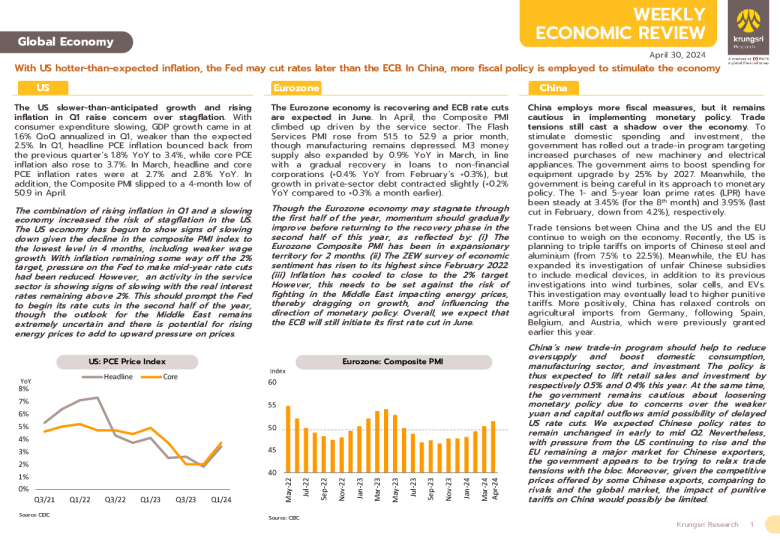
US China Eurozone Chinaemploys more fiscal measures,but it remainscautiousin implementing monetary policy.Tradetensionsstill cast a shadow over the economy.Tostimulatedomestic spending and investment,thegovernment has rolled out a trade-in program targetingincreasedpurchases of new machinery and electricalappliances. The government aims to boost spending forequipmentupgrade by 25%by 2027.Meanwhile,thegovernment is being careful in its approach to monetarypolicy. The1-and 5-year loan prime rates (LPR) havebeen steady at3.45% (for the8thmonth) and3.95% (lastcut in February, down from4.2%), respectively. The Eurozone economy isrecoveringand ECB rate cutsareexpected in June.In April,the Composite PMIclimbedup driven by the service sector.The FlashServicesPMI rose from 51.5 to 52.9 a prior month,thoughmanufacturing remains depressed.M3 moneysupplyalso expanded by 0.9%YoY in March,in linewitha gradual recovery in loans to non-financialcorporations(+0.4%YoY from February’s+0.3%),butgrowth in private-sector debt contracted slightly (+0.2%YoY compared to +0.3% a month earlier). TheUS slower-than-anticipated growth and risinginflationin Q1 raise concern over stagflation.Withconsumer expenditure slowing, GDP growth came in at1.6%QoQ annualized in Q1, weaker than the expected2.5%. In Q1, headline PCE inflation bounced back fromthe previous quarter’s1.8% YoY to3.4%, while core PCEinflation also rose to3.7%. In March, headline and corePCEinflation rates were at 2.7%and 2.8%YoY.Inaddition, the Composite PMI slipped to a4-month low of50.9in April. Though the Eurozone economy may stagnate throughthe first half of the year, momentum should graduallyimprove before returning to the recovery phase in thesecondhalf of this year,as reflected by:(i)TheEurozoneComposite PMI has been in expansionaryterritory for2months. (ii) The ZEW survey of economicsentiment has risen to its highest since February2022.(iii)Inflation has cooled to close to the 2%target.However,this needs to be set against the risk offightingin the Middle East impacting energy prices,therebydragging on growth,and influencing thedirection of monetary policy. Overall, we expect thatthe ECB will still initiate its first rate cut in June. The combination of rising inflation in Q1and a slowingeconomy increased the risk of stagflation in the US.The US economy has begun to show signs of slowingdown given the decline in the composite PMI index tothe lowest level in4months, including weaker wagegrowth. With inflation remaining some way off the2%target, pressure on the Fed to make mid-year rate cutshad been reduced. However,an activity in the servicesector is showing signs of slowing with the real interestrates remaining above2%. This should prompt the Fedto begin its rate cuts in the second half of the year,thoughthe outlook for the Middle East remainsextremely uncertain andthere is potential for risingenergy prices to add to upward pressure on prices. Trade tensions between China and the US and the EUcontinue to weigh on the economy. Recently, the US isplanning to triple tariffs on imports of Chinese steel andaluminium (from7.5% to 22.5%). Meanwhile, the EU hasexpanded its investigation of unfair Chinese subsidiesto include medical devices, in addition to its previousinvestigations into wind turbines, solar cells, and EVs.This investigation may eventually lead to higher punitivetariffs.More positively,China has relaxed controls onagriculturalimports from Germany,following Spain,Belgium,and Austria,which were previously grantedearlier this year. China’s new trade-in program should help to reduceoversupplyandboostdomesticconsumption,manufacturingsector,and investment.The policy isthusexpected to lift retail sales and investment byrespectively0.5% and0.4% this year. At the same time,thegovernment remains cautious about looseningmonetarypolicy due to concerns over the weakeryuan and capital outflows amid possibility of delayedUSrate cuts.We expected Chinese policy rates toremainunchanged in early to mid Q2.Nevertheless,with pressure from the US continuing to rise and theEU remaining amajor market for Chinese exporters,the government appears to be trying to relax tradetensions with the bloc. Moreover, given the competitiveprices offered by some Chinese exports, comparing torivals and the global market, the impact of punitivetariffs on China would possibly be limited. The BOT affirms the current policy rate is appropriate foreconomic conditions though it is ready to review in caseof unexpected economic situation.The Bank of Thailand(BOT) has said that at2.50%, the policy rate is in line withtheneeds of the economy and that authorities arepursuinga robust policy that will provide space torespond to future uncertainties. In addition, the BOT hasindicated that excessively accommodative interest rateswill allow risk to accumulate. Although interest rate cutswould reduce the debt burden over the short term, overalonger timeframe,this would increase levels ofindebtedness. Fo