每周经济评论
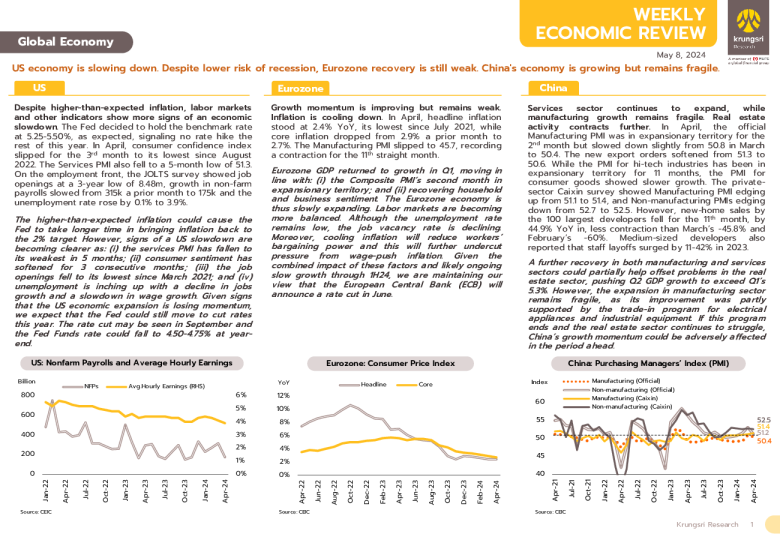
US economy is slowingdown. Despite lower risk of recession, Eurozone recovery is still weak. China's economy is growing but remains fragile. US China Eurozone Despite higher-than-expected inflation, labor marketsand other indicators show more signs of an economicslowdown.The Fed decided to hold the benchmark rateat5.25-5.50%, as expected, signaling no rate hike therest of this year. In April, consumer confidence indexslippedfor the 3rd month to its lowest since August2022. The Services PMI also fell to a5-month low of51.3.On the employment front, the JOLTS survey showed jobopenings at a3-year low of8.48m, growth in non-farmpayrolls slowed from315k a prior month to175k and theunemployment rate rose by0.1% to3.9%. Servicessectorcontinuestoexpand,whilemanufacturinggrowth remains fragile.Real estateactivitycontractsfurther.InApril,theofficialManufacturing PMI was in expansionary territory for the2ndmonth but slowed down slightly from 50.8 in Marchto 50.4. The new export orders softened from 51.3 to50.6. While the PMI for hi-tech industries has been inexpansionaryterritory for 11 months,the PMI forconsumer goodsshowed slower growth.The private-sector Caixin survey showed Manufacturing PMI edgingup from 51.1 to 51.4, and Non-manufacturing PMIs edgingdown from 52.7 to 52.5. However, new-home sales bythe 100 largestdevelopers fell for the 11th month,by44.9% YoY in, less contraction than March’s-45.8% andFebruary’s-60%.Medium-sizeddevelopersalsoreported that staff layoffs surged by 11-42% in 2023. Growthmomentum is improving but remains weak.Inflation is coolingdown.In April,headline inflationstood at2.4% YoY, its lowest since July 2021, whilecoreinflation dropped from 2.9%a prior month to2.7%. The Manufacturing PMI slipped to45.7, recordinga contraction for the11thstraight month. Eurozone GDP returnedto growth in Q1,movinginlinewith:(i)the Composite PMI’s second month inexpansionary territory; and (ii) recovering householdandbusiness sentiment.The Eurozone economy isthus slowly expanding. Labor markets are becomingmorebalanced.Although the unemployment rateremainslow,the job vacancy rate is declining.Moreover,cooling inflation will reduce workers’bargainingpower and this will further undercutpressurefromwage-pushinflation.Giventhecombined impact of these factors and likely ongoingslow growth through1H24, we are maintaining ourviewthat the European Central Bank(ECB)willannounce a rate cut in June. Thehigher-than-expected inflation could cause theFed to take longer time in bringing inflation back tothe2% target. However, signs of a US slowdown arebecoming clearer as: (i) the services PMI has fallen toits weakest in5 months; (ii) consumer sentiment hassoftenedfor 3 consecutive months;(iii)the jobopenings fell to its lowest since March2021; and (iv)unemploymentis inching up with a decline in jobsgrowth and a slowdown in wage growth. Given signsthat the US economic expansion is losing momentum,we expect that the Fed could still move to cut ratesthis year. The rate cut may be seen in September andthe Fed Funds rate could fall to4.50-4.75% at year-end. A further recovery in both manufacturing and servicessectors could partially help offset problems in the realestate sector, pushing Q2 GDP growth to exceed Q1’s5.3%. However, the expansion in manufacturing sectorremainsfragile,as its improvement was partlysupportedby the trade-in program for electricalappliancesand industrial equipment.If this programends and the real estate sector continues to struggle,China’s growth momentum could be adversely affectedin the period ahead. BOT reportedMarch economic growth slowed onweakerdomestic demand and a drop in foreignarrivalsafter an acceleration in previous months.Private consumption slipped in March (-0.8% MoMsaand-0.6%YoY),partly due to the ending of thegovernment’s Easy-E-Receipt scheme, led by lowerspendingon non-durable goods.Spending ondurable goods continued to slide. Private investmentindexalso fell in the month(-1.4%MoM sa,-1.5%YoY),with drops seen in expenditure on bothmachineryand construction.Foreign arrivals alsodeclinedfrom 3.35m a prior month to 2.98m inMarch. Seasonally adjusted exports (excluding gold)improvedslightly from the previous month(+2.1%MoMsa)but dropped on a year-on-year basis(-10.2% YoY). Aprilheadline inflation turned positive for the firsttime in7months. Although this will likely return to theofficial target range later in the year,2024 inflationmay average less than1%.In April, headline inflationrosefrom-0.47%YoY in March to 0.19%,the firstpositive rate since October2023. This was a result of:(i)rising global oil prices and the ending of somesubsidyon diesel price;and(ii)the impact of thedrought on farm yields, which hasin particular pushedupthe prices of fresh fruit and vegetables.Coreinflation (which excludes raw food and energy prices)remained unchanged at0.37% YoY. During the first4monthsof the year,headline and core inflationaveraged-0.55% and0.42%respectively. We see headline inflat