每周经济评论
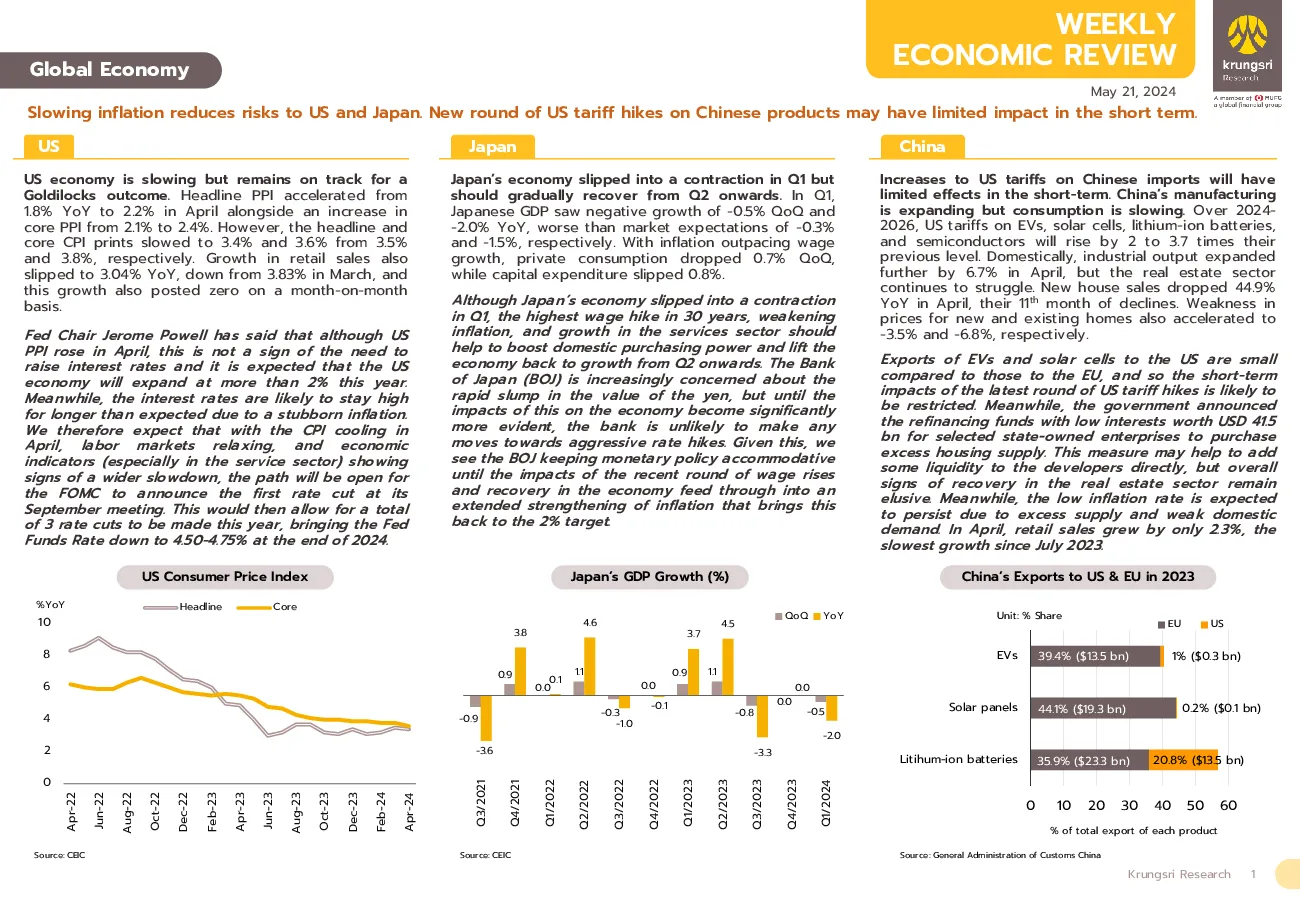
Slowing inflation reduces risks to US and Japan. New round of US tariff hikes on Chinese products may have limited impact intheshort term. US China Japan US economy is slowing but remains on track for aGoldilocksoutcome.Headline PPI accelerated from1.8%YoY to 2.2%in April alongside an increase incore PPI from 2.1% to 2.4%. However, the headline andcore CPI prints slowed to 3.4% and 3.6% from 3.5%and3.8%,respectively.Growth in retail sales alsoslipped to 3.04% YoY, down from 3.83% in March, andthisgrowth also posted zero on a month-on-monthbasis. Increasesto US tariffs on Chinese imports will havelimited effects in the short-term. China’s manufacturingis expanding but consumption is slowing.Over 2024-2026, US tariffs on EVs, solar cells, lithium-ion batteries,andsemiconductors will rise by 2 to 3.7 times theirprevious level. Domestically, industrial output expandedfurtherby 6.7%in April,but the real estate sectorcontinues to struggle. New house sales dropped 44.9%YoY in April, their 11th month of declines. Weakness inprices for new and existing homes also acceleratedto-3.5% and-6.8%, respectively. Japan’s economy slipped into a contraction in Q1 butshouldgradually recover from Q2 onwards.In Q1,Japanese GDP saw negative growth of-0.5%QoQand-2.0% YoY, worse than market expectations of-0.3%and-1.5%, respectively. With inflation outpacing wagegrowth,private consumption dropped 0.7%QoQ,while capital expenditure slipped 0.8%. Although Japan’s economy slipped into a contractionin Q1, the highest wage hike in 30 years, weakeninginflation, and growthin the services sector shouldhelp to boost domestic purchasing power and lift theeconomy back to growth from Q2 onwards. The Bankof Japan (BOJ) is increasingly concerned about therapidslump in the value of the yen,but until theimpacts of this on the economy become significantlymoreevident,the bank is unlikely to make anymoves towards aggressive rate hikes. Given this, wesee the BOJ keeping monetary policy accommodativeuntil the impacts of the recent round of wage risesand recovery in the economy feed through into anextended strengthening of inflation that brings thisback to the 2% target. Fed Chair Jerome Powell has said that although USPPI rose in April, this is not asign of the need toraise interest rates and it is expected that the USeconomywill expand at more than 2%this year.Meanwhile, the interest rates are likely to stay highfor longer than expected due to a stubborn inflation.Wetherefore expect that with the CPI cooling inApril,labormarketsrelaxing,andeconomicindicators (especially in the service sector) showingsigns of a wider slowdown, the path will be open fortheFOMC to announce the first rate cut at itsSeptember meeting. This would then allow for a totalof 3 rate cuts to be made this year, bringing the FedFunds Rate down to 4.50-4.75% at the end of 2024. Exportsof EVs and solar cells to the US are smallcompared to those to the EU, and so the short-termimpacts of the latest round of US tariff hikes is likely tobe restricted. Meanwhile, the government announcedthe refinancing funds with low interests worth USD 41.5bn for selected state-owned enterprises to purchaseexcess housing supply. This measure may help to addsome liquidity to the developers directly, but overallsignsof recovery in the real estate sector remainelusive. Meanwhile, the low inflation rate is expectedto persist due to excess supply and weak domesticdemand. In April, retail sales grew by only 2.3%, theslowest growth since July 2023. 1Q24 GDPgrew 1.5% YoY and 1.1%QoQ sa. KrungsriResearchis reviewing our economic forecast.TheNESDCofficially reported that the Thai economyexpanded1.5%in 1Q24,above expectations by themarket(+0.8%in a Reuters survey)and KrungsriResearch (+0.7%). The growth slightly decelerated from1.7% in 4Q23. The key factor driving growth in 1Q24wasstronger tourism sector which helped to boostprivate consumption (+6.9%) and exports of services(+24.8%).However,growth of goods exports turnednegative (-0.2%) and public investment (-27.7%) alsocontracted sharply. Consumer and industrial sentiment indices slipped atthe start of 2Q24, reflecting the fragility of economicrecovery.In April, the consumer sentiment index fellfor the second month, slipping from 63.0 in March to62.1 on consumer worries over slow economic growthandthe ending of government subsidies for diesel,which is then allowing prices for this to rise. The ThaiIndustrial Sentiment Index also weakened from 92.4 inMarch to 90.3as a result ofsoft domestic demand, thetightening of purse strings by consumers, and worriesover the impact on costs of rising diesel pump pricesand concerns over the government’s plan to raise thedaily minimum wage to THB 400 nationwide. Thailand’s seasonally adjusted GDP in 1Q24 grew by+1.1%(QoQ sa),well above expectations by themarketand Krungsri Research(+0.6%and+0.5%,respectively).This indicates the Thai economy hasescapeda technical recession after recording acontraction (-0.4%QoQ) in 4