每周经济评论
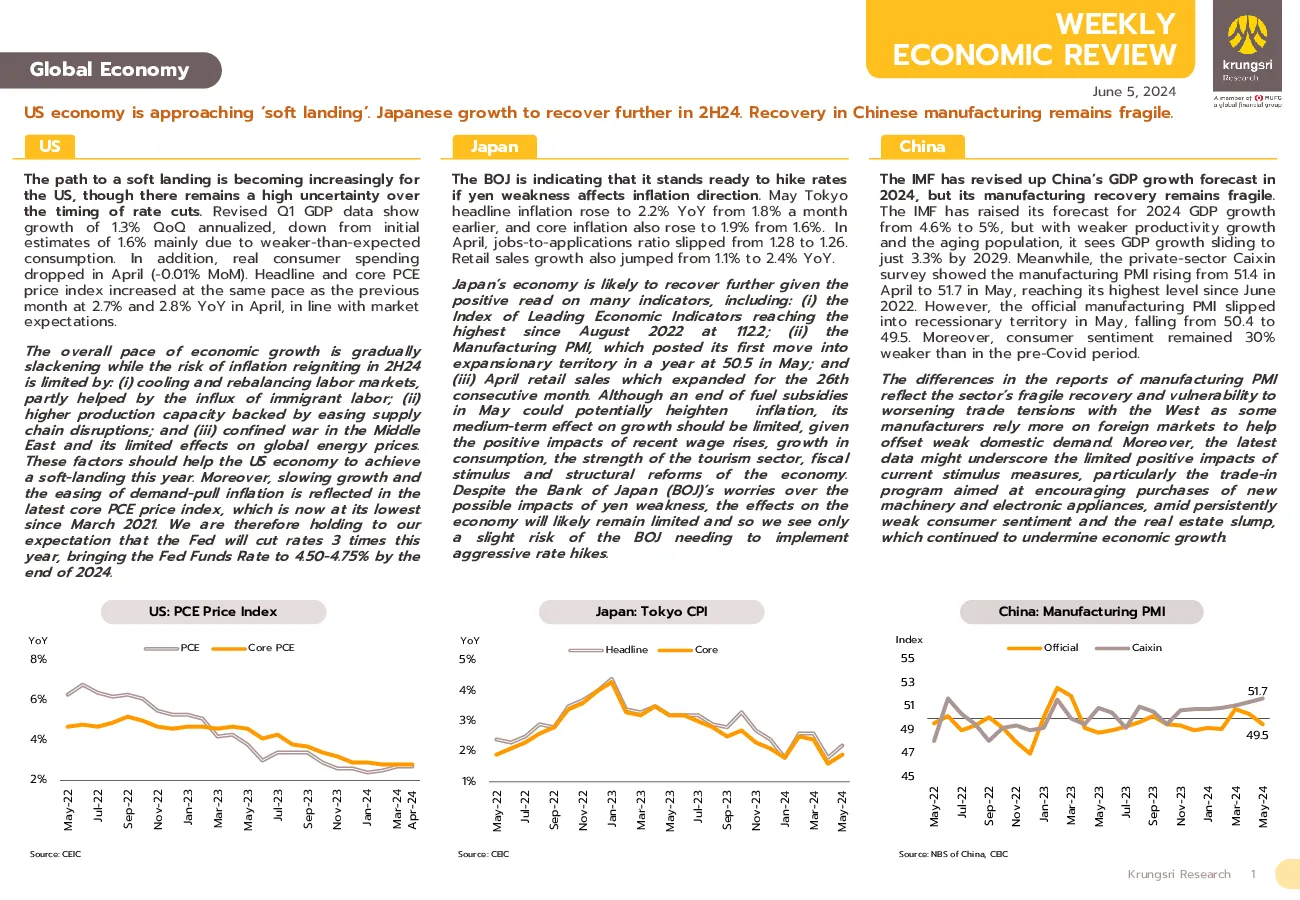
US economy is approaching‘soft landing’. Japanese growth to recover further in2H24. Recovery in Chinese manufacturing remains fragile. US China Japan The path to a soft landing is becoming increasingly forthe US, though there remains a high uncertainty overthetiming of rate cuts.Revised Q1 GDP data showgrowthof 1.3%QoQ annualized,down from initialestimates of 1.6% mainly due to weaker-than-expectedconsumption.In addition,real consumer spendingdropped in April (-0.01% MoM). Headline and core PCEprice index increased at the same pace as the previousmonth at 2.7% and 2.8% YoY in April, in line with marketexpectations. The IMF has revised up China’s GDP growth forecast in2024, but its manufacturing recovery remains fragile.The IMF hasraised its forecast for 2024 GDP growthfrom 4.6% to 5%, but with weaker productivity growthand the aging population, it sees GDP growth sliding tojust 3.3% by 2029. Meanwhile, the private-sector Caixinsurvey showed the manufacturing PMI rising from 51.4 inApril to 51.7 in May, reaching its highest level since June2022. However,the official manufacturing PMI slippedinto recessionary territory in May, falling from 50.4 to49.5.Moreover,consumer sentiment remained 30%weaker than in the pre-Covid period. The BOJ is indicating that it stands ready to hike ratesif yen weakness affects inflation direction.May Tokyoheadline inflation rose to 2.2% YoY from 1.8% a monthearlier, and core inflation also rose to 1.9% from 1.6%.InApril, jobs-to-applications ratio slipped from 1.28 to 1.26.Retail sales growth also jumped from 1.1% to 2.4% YoY. Japan’s economy is likely to recover further given thepositiveread on many indicators,including:(i)theIndexof Leading Economic Indicators reaching thehighestsinceAugust2022at112.2;(ii)theManufacturingPMI,which posted its first move intoexpansionary territory in a year at 50.5 in May; and(iii)April retail sales which expanded for the 26thconsecutive month. Although an end of fuel subsidiesinMay could potentially heighteninflation,itsmedium-term effect on growth should be limited, giventhe positive impacts of recent wage rises, growth inconsumption, the strength of the tourism sector, fiscalstimulusand structural reforms of the economy.Despitethe Bank of Japan(BOJ)’s worries over thepossible impacts of yen weakness, the effects on theeconomy will likely remain limited and so we see onlyaslight risk of the BOJ needing to implementaggressive rate hikes. Theoverall pace of economic growth is graduallyslackening while the risk of inflation reigniting in 2H24is limited by: (i) cooling and rebalancing labor markets,partlyhelped by the influx of immigrant labor;(ii)higher production capacity backed by easing supplychain disruptions; and (iii) confined war in the MiddleEast andits limited effects on global energy prices.These factors should help the US economy to achievea soft-landing this year. Moreover, slowing growth andthe easing of demand-pull inflation is reflected in thelatest core PCE price index, which is now at its lowestsinceMarch 2021.We are therefore holding to ourexpectationthat the Fed will cut rates 3 times thisyear, bringing the Fed Funds Rate to 4.50-4.75% by theend of 2024. Thedifferences in the reports of manufacturing PMIreflect the sector’s fragile recovery and vulnerability toworseningtrade tensions with the West as somemanufacturers rely more on foreign markets to helpoffsetweak domestic demand.Moreover,the latestdata might underscore the limited positive impacts ofcurrentstimulus measures,particularly the trade-inprogramaimed at encouraging purchases of newmachinery and electronic appliances, amid persistentlyweak consumer sentiment and the real estate slump,which continued to undermine economic growth. Thaieconomy has continued to recover through Q2,drivenby tourism sector and domestic spending,butoveralleconomic growth this year may underperformexpectations.The Bank of Thailand (BOT) reports that inApril,the economy continued to grow thanks to theimproving performance of the services sector, which wasitself lifted by increased income from tourism (+7.1% MoMsa)and a rise in the total number of foreign arrivals(+4.4%). Following declines in March, domestic demand isalso up, with private consumption and investment risingby respectively +1.6% and +5.0%. Exports excluding goldclimbed+4.8%,mirroring a+3.5%increase in industrialoutput. However, ongoing sluggishness and the rise in thecostof living(driven by higher pump prices)isundercutting consumer sentiment. Thelatest medium-term fiscal plan reflects thatThailand's fiscal stability faces increasing risks.At acabinetmeetingheldon28May2024,thegovernment agreed to increase budget expenditureforfiscal year(FY)2024 by extending the budgetdeficitfrom THB 693bn to THB 805bn.This will beused to fund the government’s digital wallet policy,which it hopes will provide additional stimulus to theeconomy.Fiscal plans for FY2025-2028 have alsobeenrevised,most importantly with regard to thedownward re