您的浏览器禁用了JavaScript(一种计算机语言,用以实现您与网页的交互),请解除该禁用,或者联系我们。[SEforALL]:能源转型:解决全球三重危机的催化剂 - 发现报告

能源转型:解决全球三重危机的催化剂

化石能源2023-07-20SEforALL文***
AI智能总结
查看更多
能源转型:解决全球三重危机的催化剂

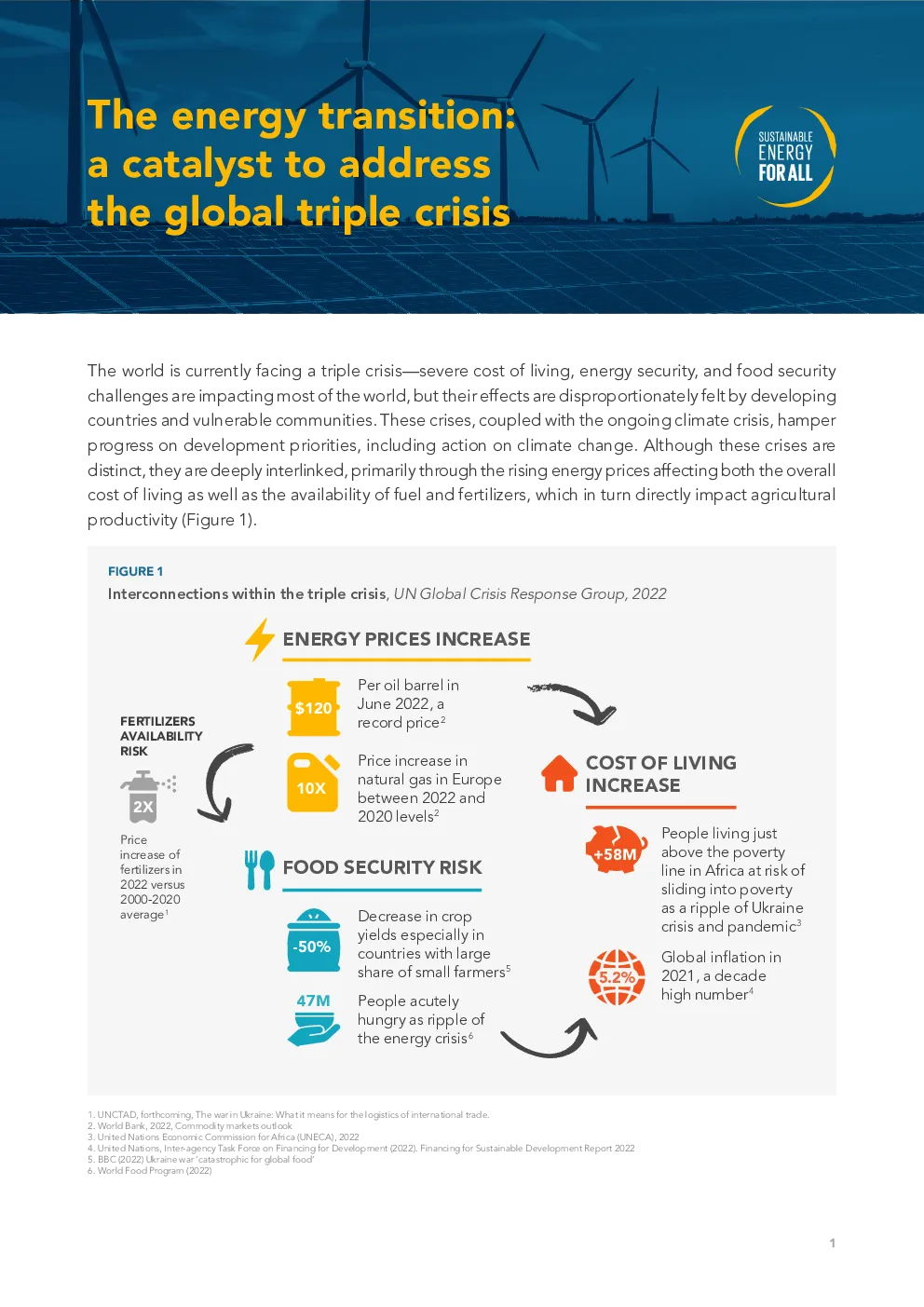
The world is currently facing a triple crisis—severe cost of living, energy security, and food securitychallenges are impacting most of the world, but their effects are disproportionately felt by developingcountries and vulnerable communities. These crises, coupled with the ongoing climate crisis, hamperprogress on development priorities, including action on climate change. Although these crises aredistinct, they are deeply interlinked, primarily through the rising energy prices affecting both the overallcost of living as well as the availability of fuel and fertilizers, which in turn directly impact agriculturalproductivity (Figure 1). FIGURE 1 Interconnections within the triple crisis,UN Global Crisis Response Group, 2022 The global energy transition towards cleaner and more sustainable energy sources for all sectors presentsa significant opportunity to address these crises through its cost benefits, job creation potential, localmarket creation, and climate benefits. FIGURE 2 Electricity output from renewable sources, TWh,IEA 2022 World Energy Balances Countries around the world, in particular developing countries that face a disproportionate amount ofclimate vulnerabilities, have demonstrated a deep commitment to advancing the uptake of renewableenergy to meet their development goals. However, evidence shows that uptake has been lagging inemerging markets and developing economies (EMDEs). The pace of growth of renewables generationhas decreased in the Global South (-1pp. in annual growth rate between 2000-2020 versus 1990-2000)while it significantly increased in the Global North (+3pp.) and China/India (+7pp.) in the last 20 years(Figure 2). This is especially challenging as energy demand in developing countries continues to riseconsistently year-on-year. The slow pace of renewables deployment in emerging markets and developing economies (EMDEs)versus developed countries is mainly due to two core elements: the lack of access to capital and thehigh cost of capital in those countries. LACK OF ACCESS TO CAPITAL In 2021, EMDEs accountedfor two-thirds of the world’spopulation but only one-thirdof total energyinvestment. The gap growsfurther with only 20% ofglobal investment in cleanenergy technologies goingto emerging and developingeconomies, not includingChina (Figure 3). FIGURE 3 Key indicators for emerging markets and developing economies(EMDEs), 2021,IEA 2023 World Energy Investment Report A striking example is Africa in which total energy supply investments have been shrinking with thedecline in fossil fuel investment not offset by the increase in renewables investment (Figure 4). FIGURE 4 HIGH COST OF CAPITAL The capital that is flowing into developing and emerging economies is not only limited in scale, but isalso often prohibitively priced, with significantly higher interest rates prevailing in developing countries(Figure 5). This high cost of capital significantly diminishes the economic advantage of renewableenergy solutions in developing countries, further limiting the pace and scale of their uptake. FIGURE 5 Indicators of economy-wide cost of capital for debt (government bond + debt risk premium) forcountries at various development stages, Nominal value, 2020,IEA For instance, assuming asimilar cost of technologyfor solar PV in the globalmarket of USD 1 million/MW financed through 30%equity and 70% debt, thecost of capital would raisethe cost of technology toUSD 1.7 million in Pakistanversus USD 1.1 million inthe United States, a 57%difference (Figure 6). FIGURE 6 Solar panels cost comparison between a developingcountry and a developed country, million USD/MW Consequently, it becomes apparent that the energy transition requires as much innovation in marketdesign and access to finance as it does in technology innovation and unit economics. The risk profile ofclean energy solutions is intimately intertwined with the broader financial crisis faced by EMDEs, whichcontinues to prohibit those with the least contribution to the climate crisis, and the worst affected by it,to act decisively and at scale on climate mitigation without interventions that address this twin financechallenge. Hence, to unlock renewable energy consumption, systemic catalytic financial solutions arerequired and can be delivered through targeted actions across three objectives (Figure 7). FIGURE 7 Actions to deliver systemic catalytic financial solutions to support renewables scale up OBJECTIVES