Trading Years for Wildlife: An investigation into wildlife crime from the perspectives of offenders in Namibia
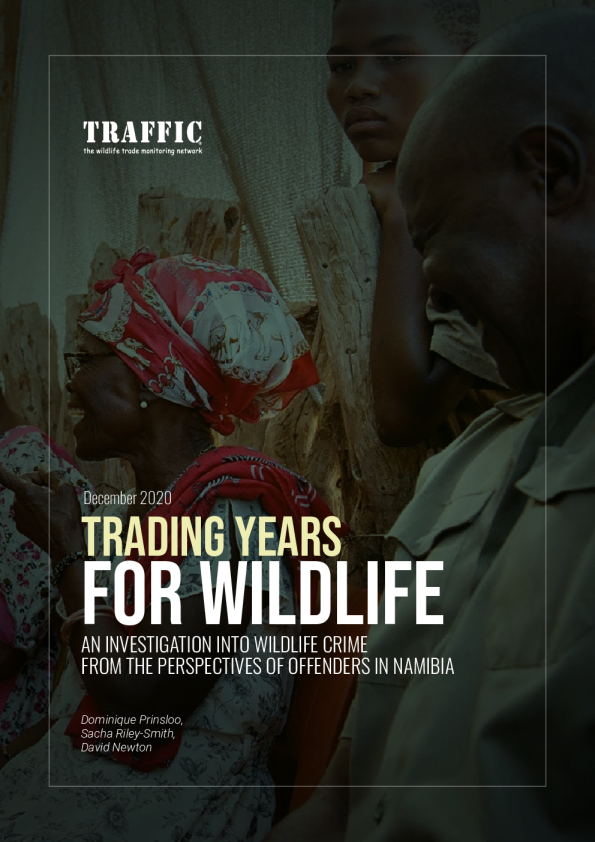
FOR WILDLIFE AN INVESTIGATION INTO WILDLIFE CRIMEFROM THE PERSPECTIVES OF OFFENDERS IN NAMIBIA Dominique Prinsloo,Sacha Riley-Smith,David Newton TRAFFIC REPORT Reproduction of material appearing inthis report requires writtenpermissionfrom the publisher. Thedesignationsofgeographicalentitiesin this publication,and thepresentationof the material,do notimplythe expression of any opinionwhatsoever on the part of TRAFFIC orits supporting organisations concerningthelegal status of any country,territory, or area, or of its authorities,or concerning the delimitation of itsfrontiers or boundaries. This report was made possible withthe generous support of the Americanpeoplethrough the United StatesAgency for International Development(USAID).Thecontentsaretheresponsibility of TRAFFIC and do notnecessarily reflect the views of USAIDor the United States Government. SUGGESTED CITATION Prinsloo, D., Riley-Smith, S., Newton, D.(2020).Trading Years for Wildlife: Aninvestigation into wildlife crime from theperspectives of offenders in Namibia.Cambridge, UK. Lead Author Dominique Prinsloo PROJECT SupervisorAdam Pires Published by: TRAFFICInternational,Cambridge,United Kingdom. © TRAFFIC 2020. Copyright of materialpublished in this report is vested inTRAFFIC.UK Registered Charity No.1076722 ISBN:978-1-911646-31-0 Design Marcus Cornthwaite COVER photo This photo was taken for Save The RhinoTrust at DeRiet village in Namibia wherecommunities are working together tocombat wildlife crime – Hugh Lippe. table ofcontents INTRODUCTION AND SUMMARYForewordProject backgroundAcronyms and abbreviationsOverviewMethodologyInterview processEthics, limitations, language, sample, exchange rate page 14 Results AND DISCUSSIONWho?What?Where?How?Why?Legal proceedings page 45 CONCLUSIONSRecommendations page 50 ReferencesImage credits page 52Annex I: Acts, Offences, and Pleas FOREWORDNAMIBIAN CORRECTIONAL SERVICE As a member of the International Corrections and Prisons Association (lCPA) as well as the African Correctional ServicesAssociation (ACSA) , Namibia strives to be Africa’s leader in the provision of correctional services. The Namibian CorrectionalService (NCS) aims to actively promote policies and standards for humane and effective correctional policies and practices. The promulgation of the Correctional Service Act, 2012 (Act No. 9 of 2012) which replaced the Prisons Act, 1998 (Act No. 17 of1998) brought about a significant change to support modem correctional approaches. NCS has amended its organisationalstructure to align to the new correctional approach, where all offices have staff dedicated to rehabilitation and reintegrationas well as performance management to implement the Offender Risk Management Correctional Strategy (ORMCS). The ORMCS suggests, essentially, that no two offenders are alike in terms of what factors may have precipitated theiroffending, the ‘risk’ they may present for future offending, the ‘needs’ that they may have and in terms of their motivation toaddress those needs and work towards changing their lifestyles. The ORMCS aims to assess and document these differences so that: i.offenders can be managed more effectively according to the risk/needs profiles they represent and gives direction toefforts at possible reintegration and ii.correctional officers, through this increased understanding of the risk/needs profiles of the offenders they manage,can become more active and focused in their interactions, thereby once again enhancing security within correctionalfacilities and contributing more directly to the challenge of offender reintegration. Upon the initial reception and objective security classification of offenders, it is vitally important for correctional officers toknow about the seriousness of the offender’s crime, their role or involvement in the crime and the value of any illegal propertyforming the subject of their case. All these factors affect the offender’s risk profile and ultimately the approach used by NCSfor their management, rehabilitation and reintegration. This information is not readily available for offenders involved inwildlife crimes and how they fit in the bigger picture of the illegal wildlife trade (IWT). When TRAFFIC approached NCS in 2019 proposing research involving interviewing wildlife crime inmates in CorrectionalFacilities in Namibia, we were excited to endorse this study and were grateful that a gap in our knowledge of wildlife crimewould be fulfilled. This report exceeds our expectations and the knowledge gained on socio-demographic and psychographicinformation will be taken into account for future strategy development. I would like to commend TRAFFIC on this report and the recommendations thereof. We look forward to working with TRAFFICagain in the future and continue to increase our knowledge on wildlife crimes and the offenders who commit them. Raphael Tuhafeni Hamunyela Commissioner-General of Namibian Correctional ServiceMinistry of Ho