Nicaragua: 2024 Article IV Consultation-Press Release; Staff Report; and Statement by the Executive Director for Nicaragua
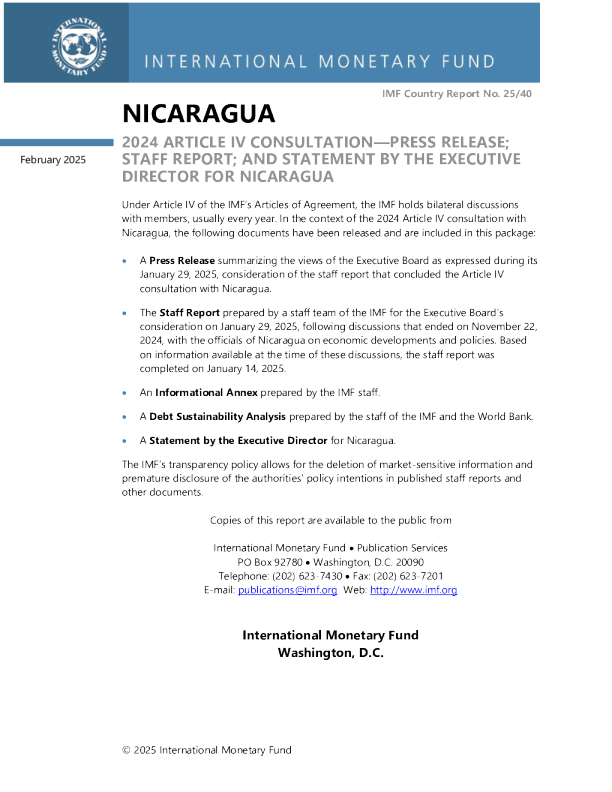
2024ARTICLE IV CONSULTATION—PRESS RELEASE;STAFF REPORT; AND STATEMENT BY THE EXECUTIVEDIRECTOR FORNICARAGUA Under Article IV of the IMF’s Articles of Agreement, the IMF holds bilateral discussionswith members, usually every year. In the context of the2024Article IV consultation withNicaragua, the following documents have been released and are included in this package: •APress Releasesummarizing the views of the Executive Board as expressed during itsJanuary 29, 2025,consideration of the staff report that concluded the Article IVconsultation withNicaragua. •TheStaff Reportprepared by a staff team of the IMF for the Executive Board’sconsideration onJanuary 29, 2025, following discussions that ended onNovember 22,2024, with the officials ofNicaraguaon economic developments and policies. Basedon information available at the time of these discussions, the staff report wascompleted onJanuary 14, 2025. •AnInformational Annexprepared by the IMFstaff. •ADebt Sustainability Analysisprepared by the staff of the IMF and the World Bank. •AStatement by the Executive DirectorforNicaragua. TheIMF’s transparency policy allows for the deletion of market-sensitive information andpremature disclosure of the authorities’ policy intentions in published staff reports andother documents. Copies of this report are available to the public from International Monetary Fund•Publication ServicesPO Box 92780•Washington, D.C. 20090Telephone: (202) 623-7430•Fax: (202) 623-7201E-mail:publications@imf.org Web:http://www.imf.org International Monetary FundWashington, D.C. IMF Executive Board Concludes2024Article IV ConsultationwithNicaragua FOR IMMEDIATE RELEASE Washington, DC–February7, 2025:The Executive Board of the International MonetaryFund (IMF) concluded the Article IVconsultation1withNicaragua. Nicaragua’s economic performance remains robust, underpinned by prudent macroeconomicpolicies and very strong remittance flows. The economycontinues to be open and resilient,ona backdrop oftransfers of private property to the state, international sanctions, and areorientation of official financing. Real GDP growth accelerated to around 4½ percent in 2023and the first half of 2024, from about 3.8 percent in 2022, on the back of robust domesticdemand, while inflation declined. Twin fiscal and externalaccount surpluses are leading to adecline in the public debt-to-GDP ratio and the accumulation of strong buffers. Real GDP growth is projected to moderate to 4 percent in the near term and to 3.5 percent inthe medium-term, amid a slower pace of remittances growth, limited labor contribution togrowth due to recent emigration, and cautious private sector investment decisions.International reserves are expected to grow at a slower pace than in the recent period, withnarrowing of fiscal and current account surpluses as the authorities’ increase publicinvestment. Risks to the outlook are broadly balanced in the short-termand to thedownside in the mediumterm. Upside risks include stronger domestic demand, while downside risks include lowerglobal growth, a deterioration in the terms of trade, natural disasters, stricter and widerinternational sanctions, and a change in immigrationpolicies in the U.S.In addition, goingforward, domestic and international political developments, and deterioration of the rule of lawmay also impact economic performance by potentially increasing the cost of doing business. Executive Board Assessment2 Executive Directors agreed with the thrust of the staff appraisal. They welcomedNicaragua’srobust growth, declining inflation and public debt, and fiscal sector and current accountsurpluses, supported by prudent macroeconomic policies and high remittances. While notingthe positive outlook, Directors stressed that risks are to the downside, including from naturaldisasters, international sanctions, and U.S. immigration policies. They underscored theimportance of continued efforts to safeguard macroeconomic stability, strengthen buffers, andsupport higher and more inclusive growth. Directors welcomed the authorities’ commitment to preserving fiscal sustainability, whilesupporting growth. Efforts to strengthen domestic revenue mobilization, enhance spendingefficiency, and support higher capital and social spending are important. Noting the limitedavailability of concessional financing, Directors highlighted the importance of prudent debtmanagement to safeguard debt sustainability. They underscored the need to mitigate fiscalrisks by strengthening fiscal transparency, enhancing oversight of state owned enterprises,and reforming the pension system. Directors agreed that monetary policy should remain focused on supporting price stability andthe exchange rate regime and highlighted the criticality of policy coordination. Theyrecommended that the Central Bank of Nicaragua adjust monetary and exchangeratepolicies, as needed, enhance communication, and strengthen monetary policy transmission.Directors encouraged steadfast im