您的浏览器禁用了JavaScript(一种计算机语言,用以实现您与网页的交互),请解除该禁用,或者联系我们。[经济合作与发展组织]:政策制定者保护和促进公民空间实用指南 - 发现报告

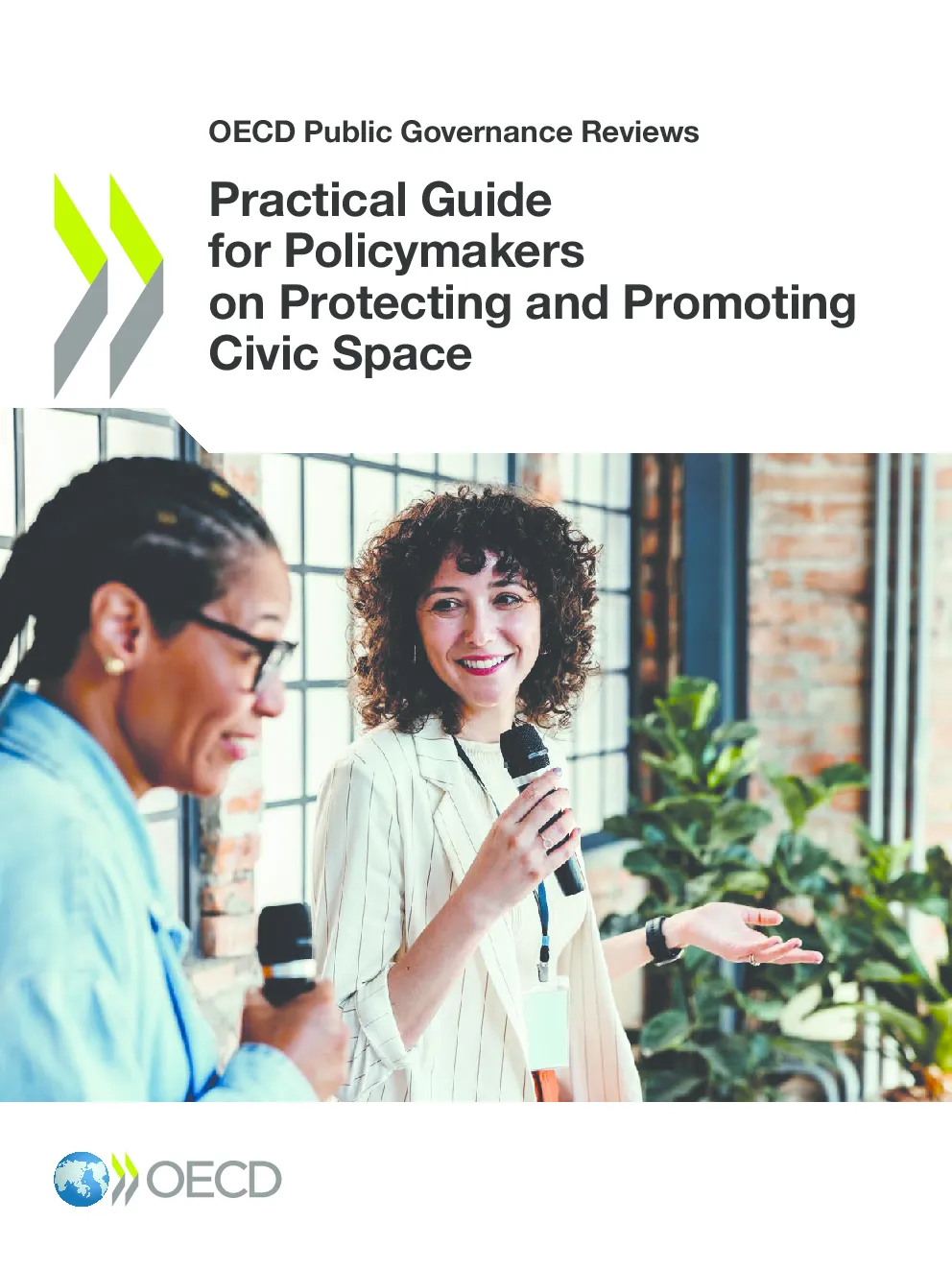
政策制定者保护和促进公民空间实用指南

AI智能总结
查看更多
政策制定者保护和促进公民空间实用指南

Practical Guidefor Policymakerson Protecting and PromotingCivic Space OECD Public Governance Reviews Practical Guidefor Policymakerson Protecting and PromotingCivic Space This document, as well as any data and map included herein, are without prejudice to the status of or sovereignty overany territory, to the delimitation of international frontiers and boundaries and to the name of any territory, city or area. The statistical data for Israel are supplied by and under the responsibility of the relevant Israeli authorities. The use ofsuch data by the OECD is without prejudice to the status of the Golan Heights, East Jerusalem and Israeli settlements inthe West Bank under the terms of international law. Please cite this publication as: OECD (2024),Practical Guide for Policymakers on Protecting and Promoting Civic Space, OECD Public Governance Reviews,OECD Publishing, Paris, https://doi.org/10.1787/6c908b48-en. ISBN 978-92-64-58990-2 (print)ISBN 978-92-64-76132-2 (PDF)ISBN 978-92-64-57133-4 (HTML)ISBN 978-92-64-98943-6 (epub) OECD Public Governance ReviewsISSN 2219-0406 (print)ISSN 2219-0414 (online) Photo credits:Cover © JLco Julia Amaral/Shutterstock.com. Attribution 4.0 International (CC BY 4.0)This work is made available under the Creative Commons Attribution 4.0 International licence. By using this work, you accept to be bound by the terms of this licence(https://creativecommons.org/licenses/by/4.0/).Attribution– you must cite the work.Translations– you must cite the original work, identify changes to the original and add the following text:In the event of any discrepancy between the original work and thetranslation, only the text of original work should be considered valid.Adaptations– you must cite the original work and add the following text:This is an adaptation of an original work by the OECD. The opinions expressed and arguments employed inthis adaptation should not be reported as representing the official views of the OECD or of its Member countries.Third-party material– the licence does not apply to third-party material in the work. If using such material, you are responsible for obtaining permission from the third party and forany claims of infringement.You must not use the OECD logo, visual identity or cover image without express permission or suggest the OECD endorses your use of the work.Any dispute arising under this licence shall be settled by arbitration in accordance with the Permanent Court of Arbitration (PCA) Arbitration Rules 2012. The seat of arbitration shallbe Paris (France). The number of arbitrators shall be one. Foreword Over the past decade, countries have increasingly recognised civic spaceas a cornerstone of functioningdemocracies. Civic space isdefined as the set of legal, policy, institutional and practical conditionsnon-governmental actors need to access information, express themselves, associate, organise andparticipate in public life.OECDmembercountriesexplicitly recognised the need to protect and promotecivic space as part of the OECD Reinforcing Democracy Initiative(RDI), through the Ministerial Declarationadopted in Luxembourg in 2022. Thisguide contributes to the broader objectives of thisInitiative (RDI): protecting and promoting a vibrantand protected civic space is central to its pillar 2,in particular,which focuses on enhancing participation,representation, and openness in public life. By fostering a more inclusive and participatory environment,pillar 2 aims to strengthen democratic processes and ensure that all citizens have meaningful opportunitiesto engage in public decisionmaking.The 2024 results of theOECD Survey on Drivers of Trust in PublicInstitutionsshow that only about three in ten people across the OECD think that the political system letspeople like them have a say in what government does and that government woulduse inputs from a publicconsultation. Given how closely tied these perceptions are to trust in government, these findings underlinethe need for governments to strengthen meaningful engagement and participation opportunities. The OECD’s work on civic space is anchored in theOECD Recommendation on Open Government;civicspace is understood as a crucial enabler of more transparent, accountable, inclusive, and sustainablepublic decisionmaking. In 2019, research and analysis in this area was united under the umbrella of theOECD Observatory of Civic Space. In 2022, the OECD publishedThe Protection and Promotion of Civic Space: Strengthening Alignment withInternational Standards and Guidance. The reportoffers a comparative perspective on the protection andpromotion of civic space based on data from 52 countries (33 OECDmembercountriesand 19 non-members), complemented by a review of key trends, challenges, and opportunities. It also includes teninterrelated, high-level recommendations and measures for countries to consider, providing a pathway forgovernments, public administrations, legislatures and independent oversight institutions to st