您的浏览器禁用了JavaScript(一种计算机语言,用以实现您与网页的交互),请解除该禁用,或者联系我们。[IUCN]:2024-2028年Cercocebus和Mandrillus保护行动计划 - 发现报告

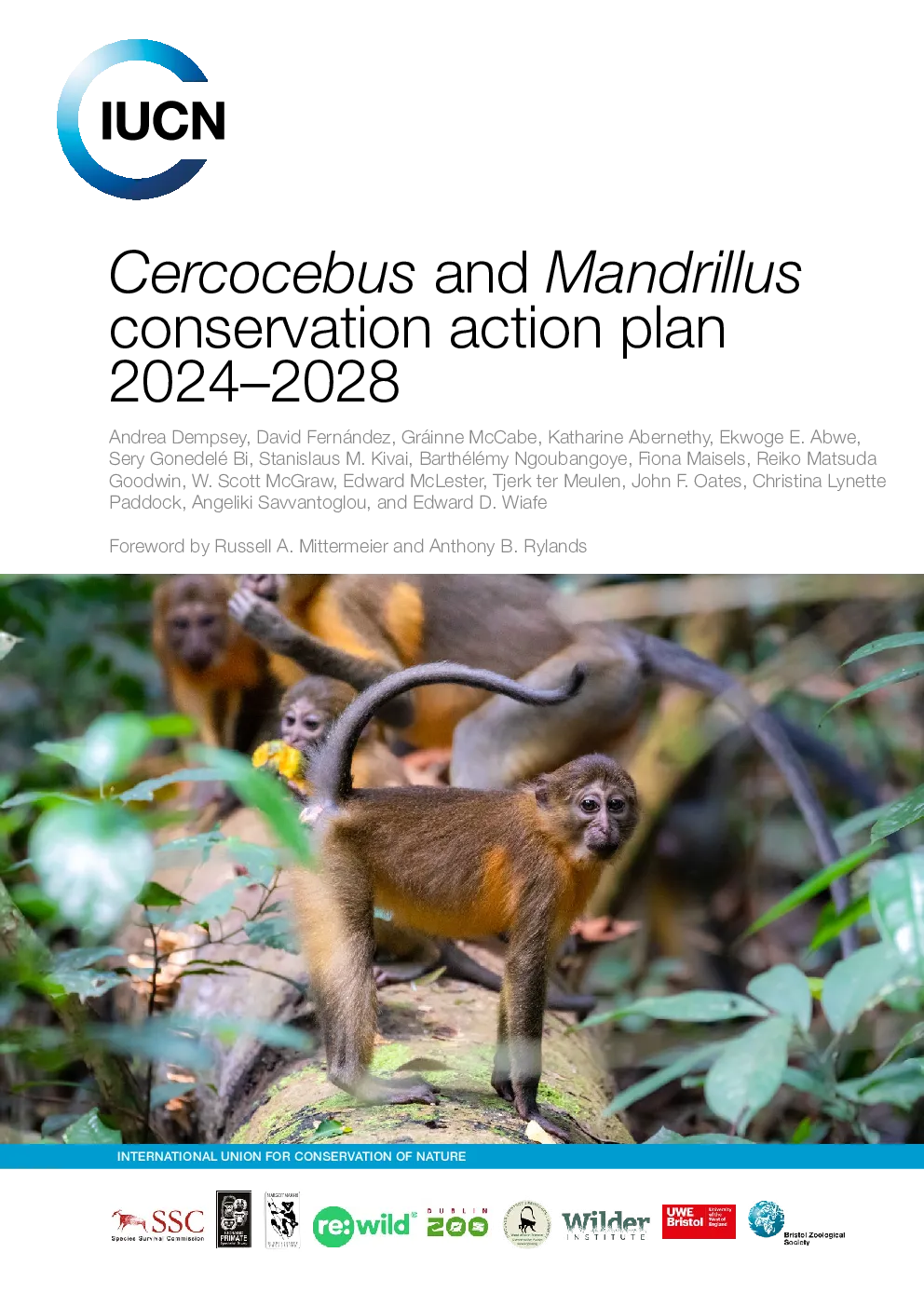
2024-2028年Cercocebus和Mandrillus保护行动计划

2024-10-28-IUCNC***
2024-2028年Cercocebus和Mandrillus保护行动计划

Andrea Dempsey, David Fernández, Gráinne McCabe, Katharine Abernethy, Ekwoge E. Abwe,Sery Gonedelé Bi, Stanislaus M. Kivai, Barthélémy Ngoubangoye, Fiona Maisels, Reiko MatsudaGoodwin, W. Scott McGraw, Edward McLester, Tjerk ter Meulen, John F. Oates, Christina LynettePaddock, Angeliki Savvantoglou, and Edward D. Wiafe Foreword by Russell A. Mittermeier and Anthony B. Rylands About IUCN IUCN is a membership Union uniquely composed of both government and civil society organisations. It provides public, privateand non-governmental organisations with the knowledge and tools that enable human progress, economic development andnature conservation to take place together. Created in 1948, IUCN is now the world’s largest and most diverse environmental network, harnessing the knowledge, resourcesand reach of more than 1,400 Member organisations and around 16,000 experts. It is a leading provider of conservation data,assessments and analysis. Its broad membership enables IUCN to fill the role of incubator and trusted repository of bestpractices, tools and international standards. IUCN provides a neutral space in which diverse stakeholders including governments, NGOs, scientists, businesses, localcommunities, Indigenous Peoples’ Organisations and others can work together to forge and implement solutions toenvironmental challenges and achieve sustainable development. Working with many partners and supporters, IUCN implements a large and diverse portfolio of conservation projects worldwide.Combining the latest science with the traditional knowledge of local communities, these projects work to reverse habitat loss,restore ecosystems and improve people’s well-being. www.iucn.org https://x.com/IUCN/ IUCN Species Survival Commission With over 9,500 members, the Species Survival Commission (SSC) is the largest of the seven expert Commissions of IUCNand enables IUCN to influence, encourage and assist societies to conserve biodiversity by building knowledge on the statusand threats to species, providing advice, developing policies and guidelines, facilitating conservation planning, and catalysingconservation action. Members of SSC belong to one or more of the 160 Specialist Groups, Red List Authorities, Task Forces and ConservationCommittees, each focusing on a taxonomic group (plants, fungi, mammals, birds, reptiles, amphibians, fishes and invertebrates),or a disciplinary issue, such as sustainable use and livelihoods, reintroduction of species, wildlife health, climate change andconservation planning. https://www.iucn.org/our-union/commissions/species-survival-commission IUCN SSC Primate Specialist Group The Primate Specialist Group (PSG) is concerned with the conservation of more than 700 species and subspecies ofprosimians, monkeys, and apes. Its particular tasks include carrying out conservation status assessments, the compilation ofaction plans, making recommendations on taxonomic issues, and publishing information on primates to inform IUCN policyas a whole. The PSG facilitates the exchange of critical information among primatologists and the professional conservationcommunity. The PSG Chair is Dr. Russell A. Mittermeier and the Deputy Chairs are Anthony B. Rylands, Christoph Schwitzer,Leandro Jerusalinsky, Kim E. Reuter, and Andie Ang. www.primate-sg.org CercocebusandMandrillusconservation action plan2024–2028 Andrea Dempsey1*, David Fernández2†*, Gráinne McCabe3‡*, Katharine Abernethy4,5, Ekwoge E. Abwe6,7, SeryGonedelé Bi8, Stanislaus M. Kivai9, Barthélémy Ngoubangoye10, Fiona Maisels11,12, Reiko Matsuda Goodwin13,W. Scott McGraw14, Edward McLester15, Tjerk ter Meulen16, John F. Oates17, Christina Lynette Paddock18,Angeliki Savvantoglou19, and Edward D. Wiafe20 The designation of geographical entities in this work, and the presentation of the material, do not imply the expression ofany opinion whatsoever on the part of IUCN or other participating organisations concerning the legal status of any country,territory, or area, or of its authorities, or concerning the delimitation of its frontiers or boundaries. The views expressed in this work do not necessarily reflect those of IUCN or other participating organisations. IUCN is pleased to acknowledge the support of its Framework Partners who provide core funding: Ministry of Foreign Affairs,Denmark; Ministry for Foreign Affairs, Finland; Government of France and the French Development Agency (AFD); Ministryof Environment, Republic of Korea; Ministry of the Environment, Climate and Sustainable Development, Grand Duchy ofLuxembourg; the Norwegian Agency for Development Cooperation (Norad); the Swedish International DevelopmentCooperation Agency (Sida); the Swiss Agency for Development and Cooperation (SDC) and the United States Departmentof State. This publication has been made possible in part by funding from the Margot Marsh Biodiversity Foundation, the Primate ActionFund of Re:wild, and Dublin Zoo. TABLE OF CONTENTS Foreword by Russell A. Mitterme