全球供应链网络与制造业的变革
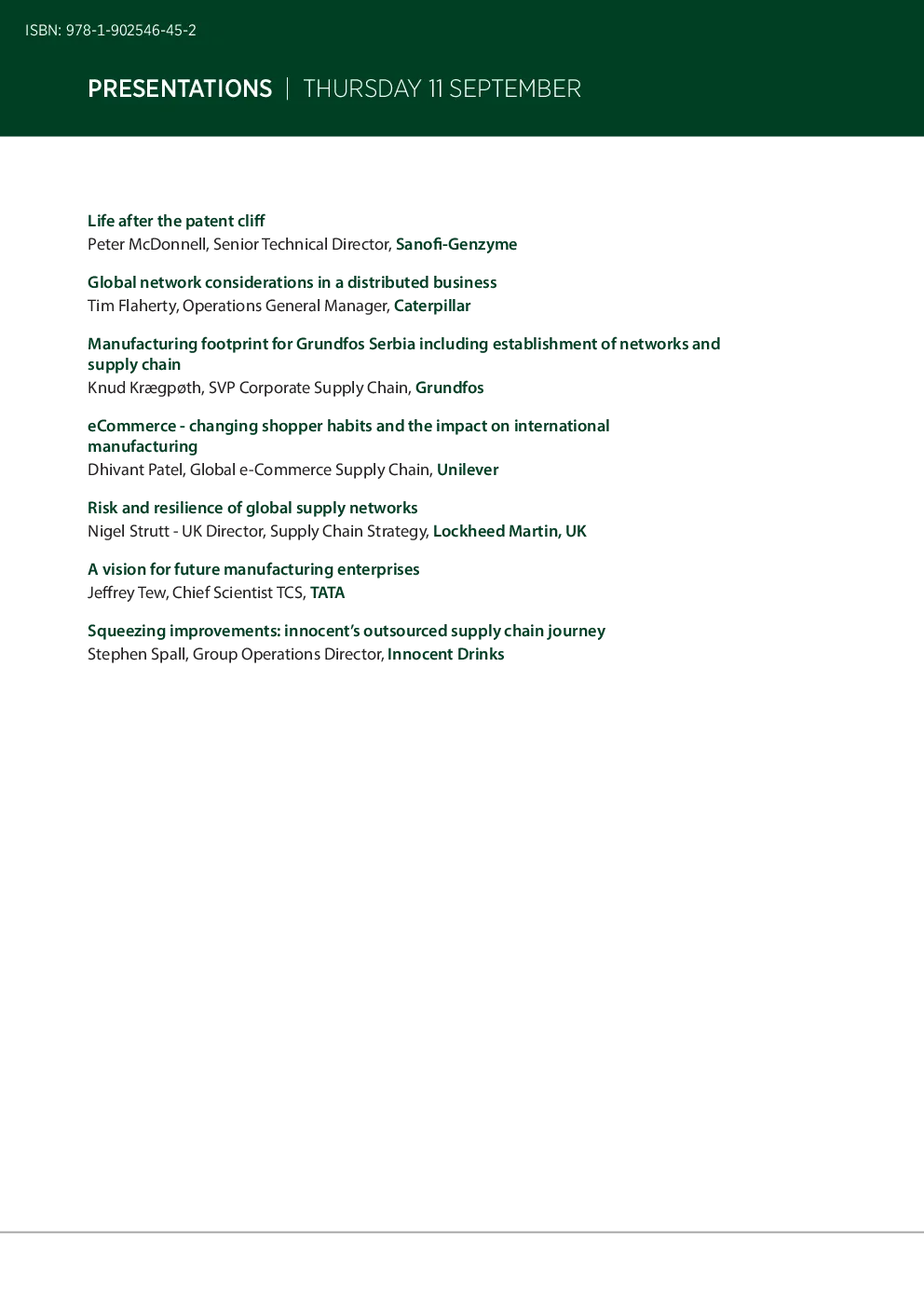
Life after the patent cliffPeter McDonnell, Senior Technical Director,Sanofi-Genzyme Global network considerations in a distributed businessTim Flaherty, Operations General Manager,Caterpillar Manufacturing footprint for Grundfos Serbia including establishment of networks andsupply chainKnud Krægpøth, SVP Corporate Supply Chain,Grundfos eCommerce - changing shopper habits and the impact on internationalmanufacturingDhivant Patel, Global e-Commerce Supply Chain,Unilever Risk and resilience of global supply networksNigel Strutt - UK Director, Supply Chain Strategy,Lockheed Martin, UK A vision for future manufacturing enterprisesJeffrey Tew, Chief Scientist TCS,TATA Squeezing improvements: innocent’s outsourced supply chain journeyStephen Spall, Group Operations Director,Innocent Drinks Co-editor-in-chief, Journal of Supply Chain Management; James Evans Rees DistinguishedProfessor of Supply Chain at the Farmer School of Business, Miami University Supply chain evolution - an emerging scienceProfessor Bart L. MacCarthyEuropean Editor, The International Journal of Production Economics; Professor ofOperations Management, Nottingham University Business School Academic panel discussion‘Publishing and special issue opportunities for research on new supply chains and global value networks’ RESEARCH THEMES| SESSION ONE: 10.30 RESEARCH THEMES| SESSION TWO: 13.15 RESEARCH THEMES| SESSION THREE: 15.00 Disclaimer ●The views expressed in this presentation are those of theauthor and do not reflect the thinking of Sanofi or its affiliates.The purpose of this presentation is to sponsor debate. Thecontent does not indicate any strategic direction that Sanofi isimplementing, unless otherwise stated. Errors and omissionsare the author’s alone. Topics The current state of Pharmaceutical Industry ●History ●Pre- 2000s •Vertically “integrated” - insular•Blockbuster focussed•Priorities: Sales & Marketing > R&D >> Manufacturing and Supply Chain ●Noughties •Selected functions outsourced•Still hoping for blockbusters…….beginning of patent cliff!•Priorities: Sales & Marketing > R&D >> Manufacturing and Supply Chain ●Future ●Short term •More biologics•Personalised medicines•More complete packages developing – diagnostics, devices, services,etc. ●Long term……. What has changed in Pharma? ●In 1970s, 1980s and 1990s Pharma could do no wrong ●Steady stream of new products to meet unmet medical needs●Highly respected by public and a highly desirable career●Some of the most admired companies in the world●Very profitable, even though no company had 6% total market share●Lots of “me too” drugs produced ●Since then…. ●Number of new drugs coming through has fallen drastically●Costs have risen exorbitantly●Mergers and acquisitions have more than decimated the industry workforce●Scandals have successively hit the industry●Costs of healthcare rising – payers have to care about this!●Agencies have become much more risk averse, requiring REMs and OutcomeStudies●The rise and rise of Shareholder Value Commonly held beliefs about pharma The answer for big pharma is Biotech Biotech is seen as less susceptible to sudden loss of exclusivity●In EU biosimilars guidance is well established●In US situation remains unclear with clinical studies required to showbioequivalence ●In mammalian cell culture the Product is the Process ●Mammalian cell culture did not exist as a manufacturing platform untilabout 30 years ago●Manufacturing science is slowly supplanting the “black arts” approach ●Cost to market for biologics is lower, due to greater targetting●Studies at Tufts and Duke Universities do not support this Are injections really the preferred route of administration?●Some progress is being made in delivery systems, but it is very slow Start-ups are better at discovery ●Most start-ups fail ●This situation is a great risk in the UK, as government priorities switch tosupport of research in applied science Pharma manufacturing is high tech. ●Reliance on the Patent system promotes this view ●Do patents truly capture innovation in the Pharma industry?●How do other industries manage to succeed without? Pharma costs are high because of excessive regulation •Aerospace/defence•Foods•Auto industry•Airlines ●Pharma has an almost unique need to claim to be different•Bespoke tracking systems for cold chain distribution validation•Fresh trout from New Zealand arrives in food stores withoutexcessive cost All of the big disease areas have been solved ●Why do we need another drug for lowering cholesterol orreducing blood pressure? ●Most drugs do not work for most people●Clinical trials are very large to protect the public who get nobenefit from a drug suffer no harm●“The chasm reflects obsolete policies and rules put in place toregulate ignorance, not knowledge.” (Peter Huber, 2013) ●Too many people are not receiving treatment●Double blind trials preclude adaptive designs based uponBayesian statistics All big Pharma cares about is m