您的浏览器禁用了JavaScript(一种计算机语言,用以实现您与网页的交互),请解除该禁用,或者联系我们。 [安卓信用保险]:金属和钢铁行业趋势 2024 年 5 月 - 发现报告

金属和钢铁行业趋势 2024 年 5 月

钢铁 2024-05-02 安卓信用保险 Lee
报告封面

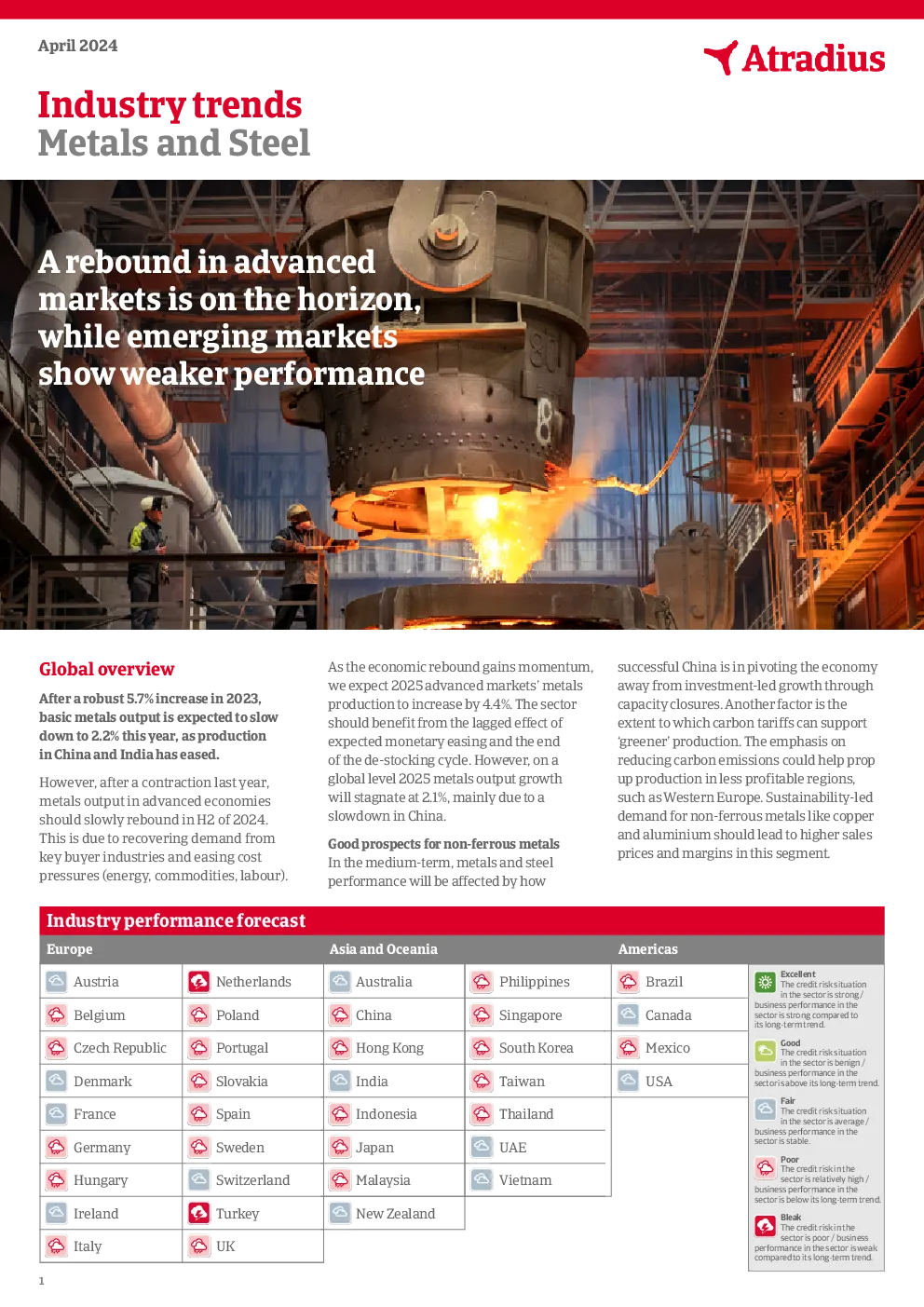
Industry trendsMetals and Steel A rebound in advancedmarkets is on the horizon,while emerging marketsshow weaker performance successful China is in pivoting the economyaway from investment-led growth throughcapacity closures. Another factor is theextent to which carbon tariffs can support‘greener’ production. The emphasis onreducing carbon emissions could help propup production in less profitable regions,such as Western Europe. Sustainability-leddemand for non-ferrous metals like copperand aluminium should lead to higher salesprices and margins in this segment. As the economic rebound gains momentum,we expect 2025 advanced markets’ metalsproduction to increase by 4.4%. The sectorshould benefit from the lagged effect ofexpected monetary easing and the endof the de-stocking cycle. However, on aglobal level 2025 metals output growthwill stagnate at 2.1%, mainly due to aslowdown in China. Global overview After a robust 5.7% increase in 2023,basic metals output is expected to slowdown to 2.2% this year, as productionin China and India has eased. However, after a contraction last year,metals output in advanced economiesshould slowly rebound in H2 of 2024.This is due to recovering demand fromkey buyer industries and easing costpressures (energy, commodities, labour). Good prospects for non-ferrous metalsIn the medium-term, metals and steelperformance will be affected by how Industry trendsMetals and Steel Strengths and growth drivers Constraints and downside risks Green metals and steel.Demand for green metals and steel isgrowing, particularly from EV manufacturers as they increasinglyinclude Scope 3 emissions within decarbonisation strategies.(These are the carbon emissions generated in the production ofvehicle materials.) Clean energy transition.Transitioning to greener productioncarries high capital intensity and costs, which can be compoundedby difficulties in sourcing finance (especially for smaller andmedium-sized businesses). Many could find it difficult to passon higher costs to customers. Overcapacity.Historically, the steel industry has been seen asvital to national interests, and domestic production has beenencouraged and protected. But increased globalisation has led toexcess capacity and consolidation has been slow. China, the biggestcontributor to overcapacity, has only recently started to shut downexcess capacity. Increased competitiveness.Increased demand for green metalsand steel by automotive and also areas such as wind turbineproduction, means green producers can gain a competitiveadvantage over manufacturers that are slower to transition. Emerging markets.Growing urbanisation is driving demandfor new housing and infrastructure improvement projects.This is resulting in increased demand for metals/steel fromconstruction businesses in emerging markets. Supply chain issues.Securing and developing sustainable supplychains can be a challenge, especially for mining, transportationand materials processing. This could lead to sourcing andcommodity deficits for metals and steel producers. Metals and Steel outlookAmericas Canada USA A rebound after two years of contraction No recovery yet We expect basic metals output to increaseby only 0.2% in 2024 after a 1.6% contractionlast year. Weak domestic demand and highinterest rates are having a negative impacton the steel segment, and higher input costsare affecting businesses’ margins. We expect US basic metals output to increaseby 3.2% in 2024 and 4.5% in 2025. The sectorbenefits from a solid economic performance,with GDP forecast to grow 2.4% this year. The Infrastructure Investment and Jobs Actis providing stimulus for metals and steelconsuming sectors. In the infrastructuresegment, power plant projects continue togrow in order to ensure energy resilience.In addition, energy and sustainabilityprojects driven by the Inflation ReductionAct will sustain metals and steel demand.The government is developing domesticcritical mineral capacities, which will benefitnon-ferrous metal production. That said,steel prices are currently low and labourexpenses remain high, putting pressureon the margins of steel producers. The non-ferrous metals subsector has faredsomewhat better, due to higher sales prices.In line with an expected economic rebound,basic metals production is forecast to grow3.7% in 2025. Bleak The credit risk in the sector ispoor / business performancein the sector is weak comparedto its long-term trend. Energy prices are much lower in the USthan in other regions, due to the size of USdomestic energy production. Therefore,US metals and steel producers have acompetitive advantage over their peersin Europe and Japan. Metals and Steel outlookAsia Pacific China India A contraction expected for next year Growth to accelerate again in 2025 We expect Chinese basic metals outputgrowth to slow down to 2% in 2024 (afterit was up 8.7% in 2023) and to contract by0.2% next year, due to weakness in the steelsegment. Steel supply exceed