您的浏览器禁用了JavaScript(一种计算机语言,用以实现您与网页的交互),请解除该禁用,或者联系我们。 [汇丰]:AI热潮消退后全球贸易将走向何方 - 发现报告

AI热潮消退后全球贸易将走向何方

商贸零售 2026-07-20 汇丰 徐红金
报告封面

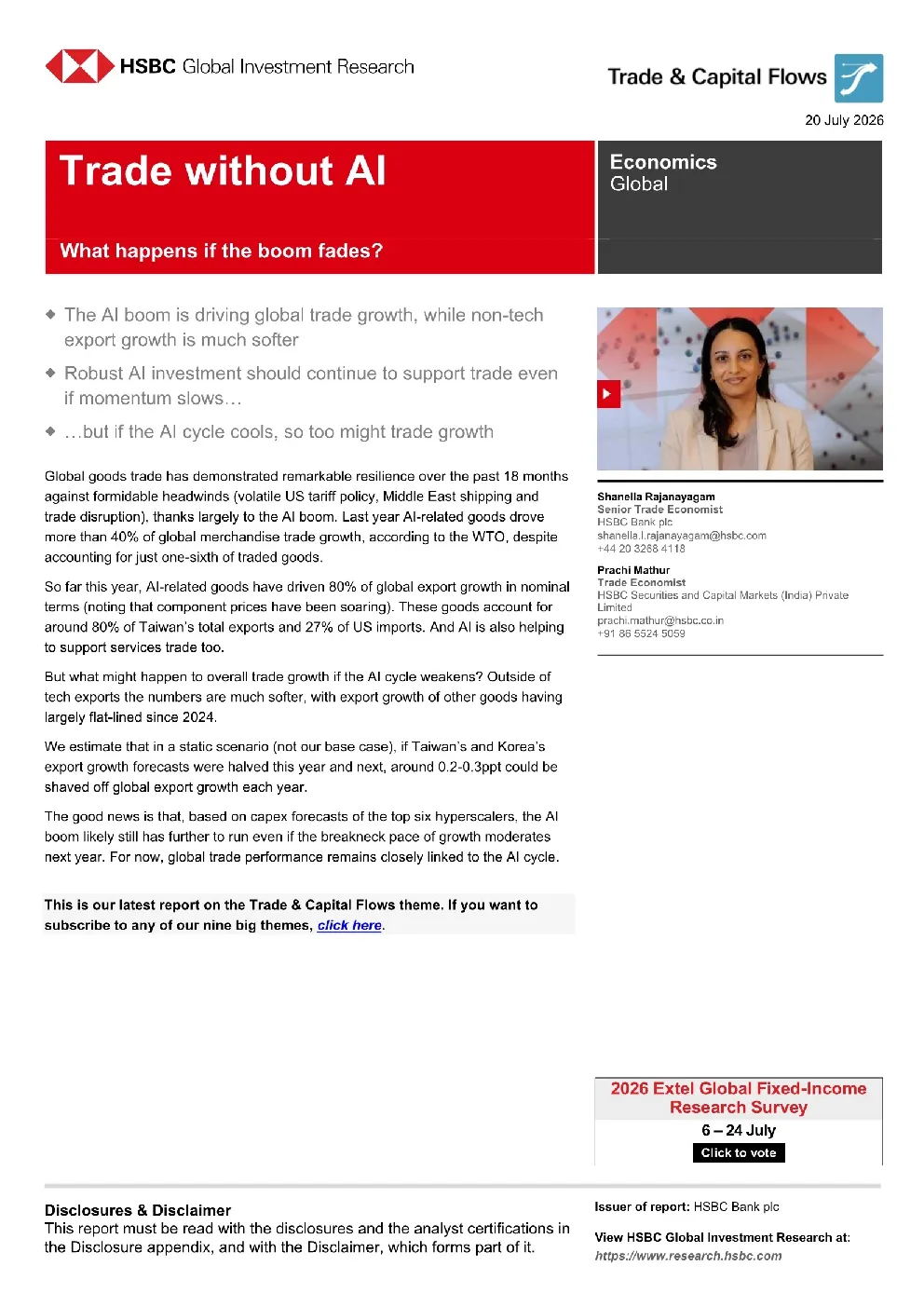
Global What happens if the boom fades? exportgrowthismuchsofter Robust Al investment should continue to support trade evenif momentum slows.. + ...but if the Al cycle cools, so too might trade growth against formidable headwinds (volatile Us tarff policy, Middle East shipping andtrade disruption), thanks largely to the Al boom. Last year Al-related goods drovemore than 40% of global merchandise trade growth, according to the WTO, despiteaccounting for just one-sixth of traded goods. Senior Trade EconomistHSBC Bank plcshanella.l.rajanayagam@hsbc.com+44 20 3268 4118Prachi Mathur HSBC Securities and Capital Markets (India) PrivateLimitedprachi.mathur@hsbc.co.in+918655245059 So far this year, Al-related goods have driven 80% of global export growth in nominalterms (noting that component prices have been soaring). These goods account foraround 80% of Taiwan's total exports and 27% of US imports. And Al is also helpingto support services trade too. But what might happen to overall trade growth if the Al cycle weakens? Outside oftech exports the numbers are much softer, with export growth of other goods havinglargely flat-lined since 2024. We estimate that in a static scenario (not ourbase case), if Taiwan's and Korea'sexportgrowthforecasts were halved this year andnext,around 0.2-0.3ppt could beshaved off global export growth each year. The good news is that, based on capex forecasts of the top six hyperscalers, the Alboomlikelystillhasfurthertorunevenifthebreakneckpaceofgrowthmoderatesnext year.For now, global trade performance remains closely linked to the Al cycle. This is ourlatest report on theTrade&Capital Flows theme.If youwant tosubscribetoanyof ourninebigthemes,clickhere Issuer of report: HSBC Bank plcViewHSBCGlobalInvestmentResearchat:https://www.research.hsbc.com goods (as defined by the World Trade Organization) account for nearly 20% of global goods trade,up from 14% on average in 2024 (chart 1). Trade in these products accounted for more than 40% ofannual global trade growth last year and, by our estimates, around 80% of y-o-y export growth in Q12026aloneinnominalterms world trade growth one-fifth of global exports...% shareAl-enabling exports in total world exports % share ThereisnoregionwhereAlmattersmoreforexportsthanAsia(chart3).OurAsiaEconomistsInesLamand Frederic Neumann recently wrote extensively about how Al is reshaping Asian trade (seeShared circuits,25June2026).As our colleagues pointout,manyAsian economies arebenefitingfromtheAlboom-fromTaiwanandKoreawhichdominatehardware,toASEANeconomieswhichprovide key inputs. Just recently, mainland China's hi-tech exports were up nearly 40% y-o-y in thefirst half of this year (see China trade: Surging higher, 14 July 2026). 80%ofTaiwan'sexportsareAl-related Together,mainlandChina(18%),Taiwan(14%)andHongKong(12%)represented44%oftotalglobal Al-related exports in 1Q2026 in value terms, while nearly half of such imports was accountedfor by the US (19%), mainland China (18%) and Hong Kong (12%). Europe accounts for about 20%of Al-enabling flows in both directions. chain. The share of Al-enabling goods in total US imports has nearly doubled since the beginning of2025 mostly due to soaring component prices (chart 6).For comparison, the value of Us Al importswas up 60% y-o-y in the first five months of this year, while volumes were up just 8%.6....withthesegoodsnowaccountingfor TheAlboom isnotonlysupportinggoodstrade, butcross-border servicesflowstoo.Exportsof digitally delivered services (e.g. cloud computing services, financial services, other businessservices)grew 10% y-0-y in 2025, and now accounts for 55% (USD5.3trn) of total global servicesexports. Looking further ahead, WTO modelling estimates that exports of digitally delivered services Digital services exports couldbenefit the most from Al But what if the Al boom starts to fade? In its June 2026 Annual Economic Report, the Bank forInternational Settlements (BiS)noted that previous investment booms-for example around“canalmaniaofthe1830sandthedotcomboomofthelate1990s-all endedwithaneventualreversalininvestment and induced economy-wide recessions (chart 7).2 Given the scaleand pace of currenttech investments, the BiS argues there is a risk that today's Al boom could follow a similar path. Risk that Al investment couldreverse in time nearly 23% annually in 2026 and by 12% in 2027, and Korea's exports to increase by 7.8% and3.1% in 2026 and 2027, respectively (chart 8). Mainland Chinese export volumes are also set togrow by 7.5% in 2026 and 4.3% in 2027, according to IMF estimates. On the import side, our USeconomistRyanWangisforecastingvolumegrowthof4.5%thisyearand3.1%next.Tonote,allthese forecasts are on a real basis forgoods and services trade.By way of example, if Taiwan's and Korea's export growth forecasts were to halve this year and next, world export growth could decline by 0.2-0.3ppt each year, by our estimates. We would expect alarger impact at the aggregate level if