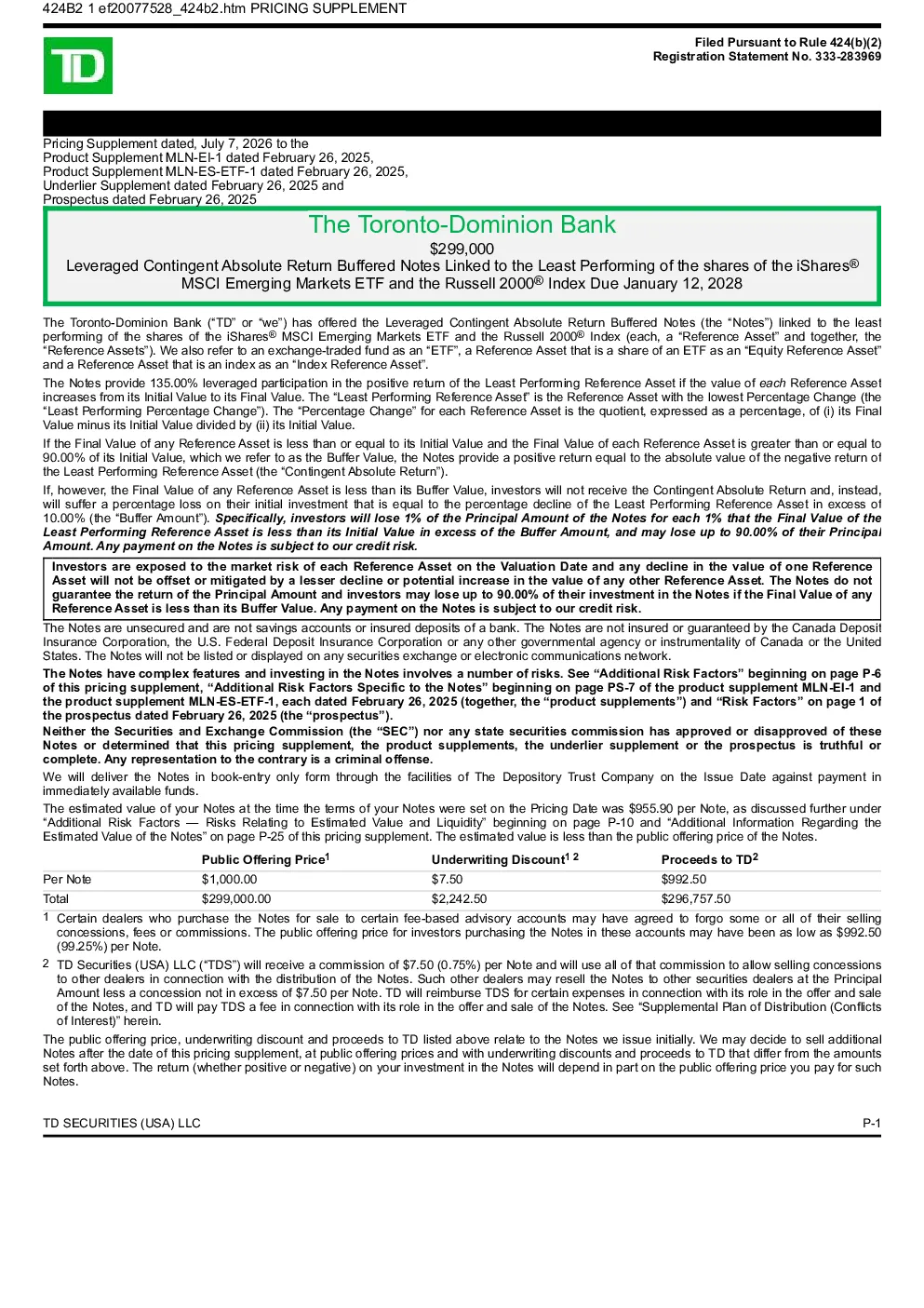
The Toronto-Dominion Bank (TD) has offered Leveraged Contingent Absolute Return Buffered Notes linked to the least performing of the shares of the iShares®MSCI Emerging Markets ETF and the Russell 2000®Index. The Notes provide 135.00% leveraged participation in the positive return of the Least Performing Reference Asset if its value increases from the Initial Value to the Final Value. If the Final Value of any Reference Asset is less than or equal to its Initial Value but greater than or equal to 90.00% of its Initial Value (the Buffer Value), the Notes provide a positive return equal to the absolute value of the negative return of the Least Performing Reference Asset (the Contingent Absolute Return). However, if the Final Value of any Reference Asset is less than its Buffer Value, investors will suffer a percentage loss on their initial investment equal to the percentage decline of the Least Performing Reference Asset in excess of 10.00% (the Buffer Amount), potentially losing up to 90.00% of their Principal Amount.
Key Features and Risks:
- Return Characteristics: The Notes do not guarantee the return of the Principal Amount and investors may lose up to 90.00% of their investment if the Final Value of any Reference Asset is less than its Buffer Value. The return on the Notes may change significantly despite only a small change in the Final Value of the Least Performing Reference Asset.
- Reference Asset Risks: Investors are exposed to the market risk of each Reference Asset on the Valuation Date. The risk of losing some or almost all of their initial investment at maturity is greater if the Notes are linked to the least performing of multiple Reference Assets compared to a single Reference Asset.
- Leveraged and Buffered Structure: The Notes offer leveraged participation in the positive return of the Least Performing Reference Asset but come with a buffer value that limits the potential for loss.
- Estimated Value and Liquidity: The estimated value of the Notes is less than the public offering price and is based on TD's internal funding rate and pricing models. There may be little or no secondary market for the Notes, and any secondary market prices will likely be less than the public offering price.
- Hedging and Conflicts of Interest: There are potential conflicts of interest between investors and the Calculation Agent, as well as between investors and TD or its affiliates due to hedging activities and other business relationships.
- Credit Risk: Investors are subject to TD’s credit risk, and any decrease in TD’s credit ratings or increase in the credit spreads charged by the market will adversely affect the market value of the Notes.
- Taxation: The U.S. tax treatment of the Notes is uncertain, and investors should consult their tax advisors. Canadian tax considerations also apply, particularly for non-resident holders.
Summary of Risks:
- Market Risk: Significant risk of loss due to the performance of the Reference Assets.
- Leverage and Buffer: High leverage and buffer value can lead to substantial losses if the Reference Assets perform poorly.
- Liquidity Risk: Limited secondary market and potential for significant losses if sold before maturity.
- Credit Risk: Dependence on TD’s ability to meet its financial obligations.
- Tax Uncertainty: Unclear tax treatment in both the U.S. and Canada, requiring consultation with tax advisors.
Conclusion:
The Notes are complex financial instruments with high risks, including the potential for significant loss due to their leveraged and buffered structure, exposure to the market risks of multiple Reference Assets, and limited liquidity. Investors should carefully consider these risks and consult with their investment, legal, tax, and accounting advisors before investing.