摩根士丹利闪迪SNDK投资者关系主管参与非交易路演强调AI需求驱动及利润率韧性提升
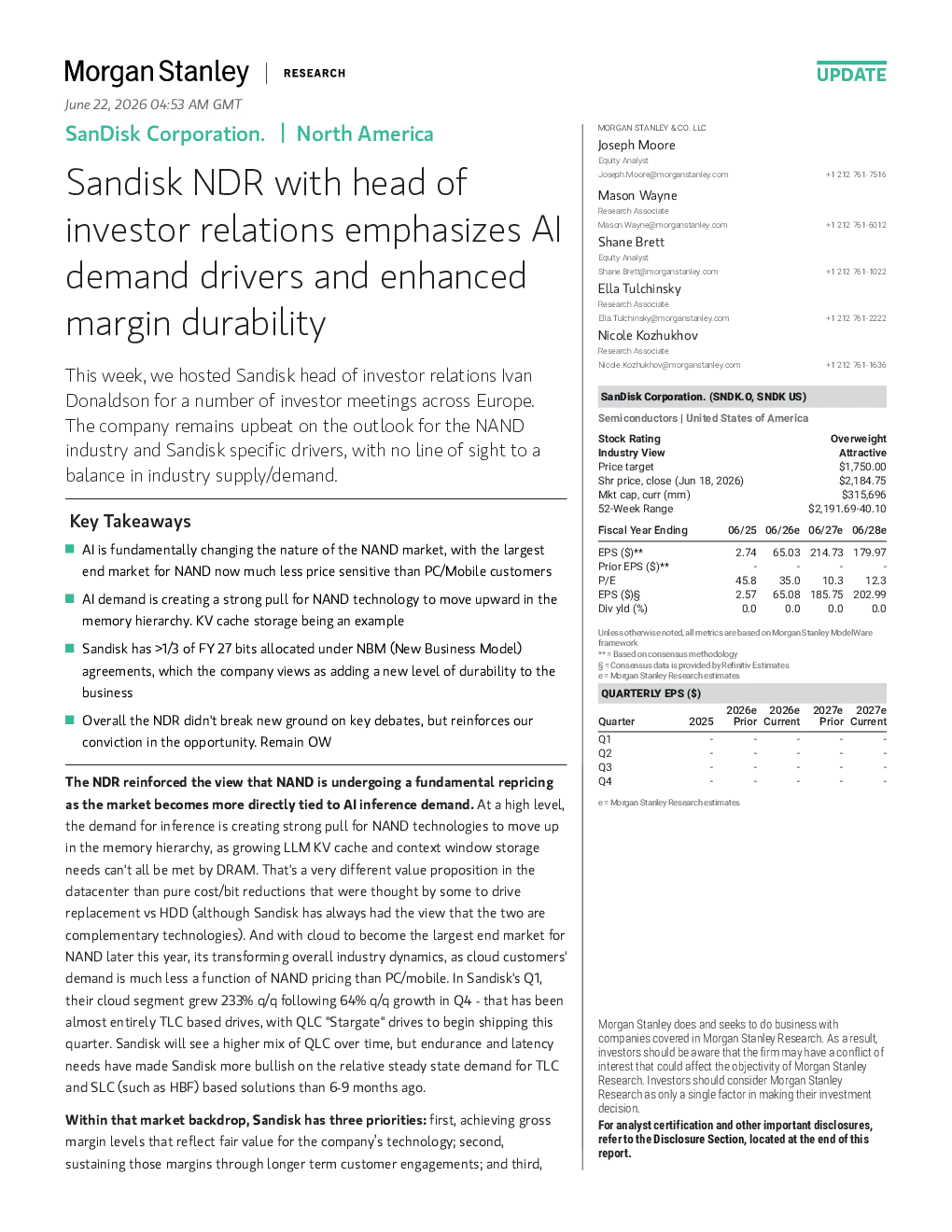
June 22, 2026 04:53 AM GMT SanDisk Corporation.| North America Morgan Stanley & Co. LLC Joseph MooreEquity AnalystJoseph.Moore@morganstanley.com+1 212 761-7516 Sandisk NDR with head ofinvestor relations emphasizes AIdemand drivers and enhancedmargin durability Mason WayneResearch AssociateMason.Wayne@morganstanley.com +1 212 761-6012 Shane BrettEquity AnalystShane.Brett@morganstanley.com+1 212 761-1022 This week, we hosted Sandisk head of investor relations IvanDonaldson for a number of investor meetings across Europe.The company remains upbeat on the outlook for the NANDindustry and Sandisk specific drivers, with no line of sight to abalance in industry supply/demand. SanDisk Corporation. (SNDK.O, SNDK US) Key Takeaways AI is fundamentally changing the nature of the NAND market, with the largestend market for NAND now much less price sensitive than PC/Mobile customers AI demand is creating a strong pull for NAND technology to move upward in thememory hierarchy. KV cache storage being an example Sandisk has >1/3 of FY 27 bits allocated under NBM (New Business Model)agreements, which the company views as adding a new level of durability to thebusiness Overall the NDR didn't break new ground on key debates, but reinforces ourconviction in the opportunity. Remain OW The NDR reinforced the view that NAND is undergoing a fundamental repricingas the market becomes more directly tied to AI inference demand.At a high level,the demand for inference is creating strong pull for NAND technologies to move upin the memory hierarchy, as growing LLM KV cache and context window storageneeds can't all be met by DRAM. That's a very different value proposition in thedatacenter than pure cost/bit reductions that were thought by some to drivereplacement vs HDD (although Sandisk has always had the view that the two arecomplementary technologies). And with cloud to become the largest end market forNAND later this year, its transforming overall industry dynamics, as cloud customers'demand is much less a function of NAND pricing than PC/mobile. In Sandisk's Q1,their cloud segment grew 233% q/q following 64% q/q growth in Q4 - that has beenalmost entirely TLC based drives, with QLC "Stargate" drives to begin shipping thisquarter. Sandisk will see a higher mix of QLC over time, but endurance and latencyneeds have made Sandisk more bullish on the relative steady state demand for TLCand SLC (such as HBF) based solutions than 6-9 months ago. Morgan Stanley does and seeks to do business withcompanies covered in Morgan Stanley Research. As a result,investors should be aware that the firm may have a conflict ofinterest that could affect the objectivity of Morgan StanleyResearch. Investors should consider Morgan StanleyResearch as only a single factor in making their investmentdecision. Within that market backdrop, Sandisk has three priorities:first, achieving grossmargin levels that reflect fair value for the company’s technology; second,sustaining those margins through longer term customer engagements; and third, For analyst certification and other important disclosures,refer to the Disclosure Section, located at the end of thisreport. growing the business. Management believes step one — achieving high margins —has largely been accomplished. The second phase, sustainability, is still in progresswith Sandisk continuing to engage with customers around what they call newbusiness model agreements (NBMs). As far as the third phase, Sandisk is continuingto invest and plan the business around a mid to high-teens bit growth profile,something they think provides a good level of growth without oversupplying themarket. On NBMs, Sandisk has already locked in more than one-third of FY27 bits underthese agreements,with that percentage to grow over time. In terms of duration,the largest agreements are generally 3–5 years, but some are shorter. Theseagreements include both fixed-price or cap-and-floor structures, with fixed pricingassociated with the shortest duration. Every deal is different in terms of product mixand duration, but margins are similar to the current 80% level at those floor ASPs.That said, Sandisk does not view signing these agreements as creating a headwind toASP increases near term, as the value proposition is to provide supply assurance tocustomers who are willing to give Sandisk demand assurance, not to trade marginfor visibility. Sandisk did not give a number for the percentage of bits it would like covered byNBMs, but management said 70–80% is probably the practical upper bound givencustomer concentration considerations and the fact that not all end markets orcustomers fit that model. Data center could, in theory, be largely covered by NBMs,but consumer, auto, and industrial markets are less likely to fit. Management alsonoted that not all customers have the balance sheet to support these commitments. Management is also confident on the enforceability of NBMs, with current dealsvery different from commitments