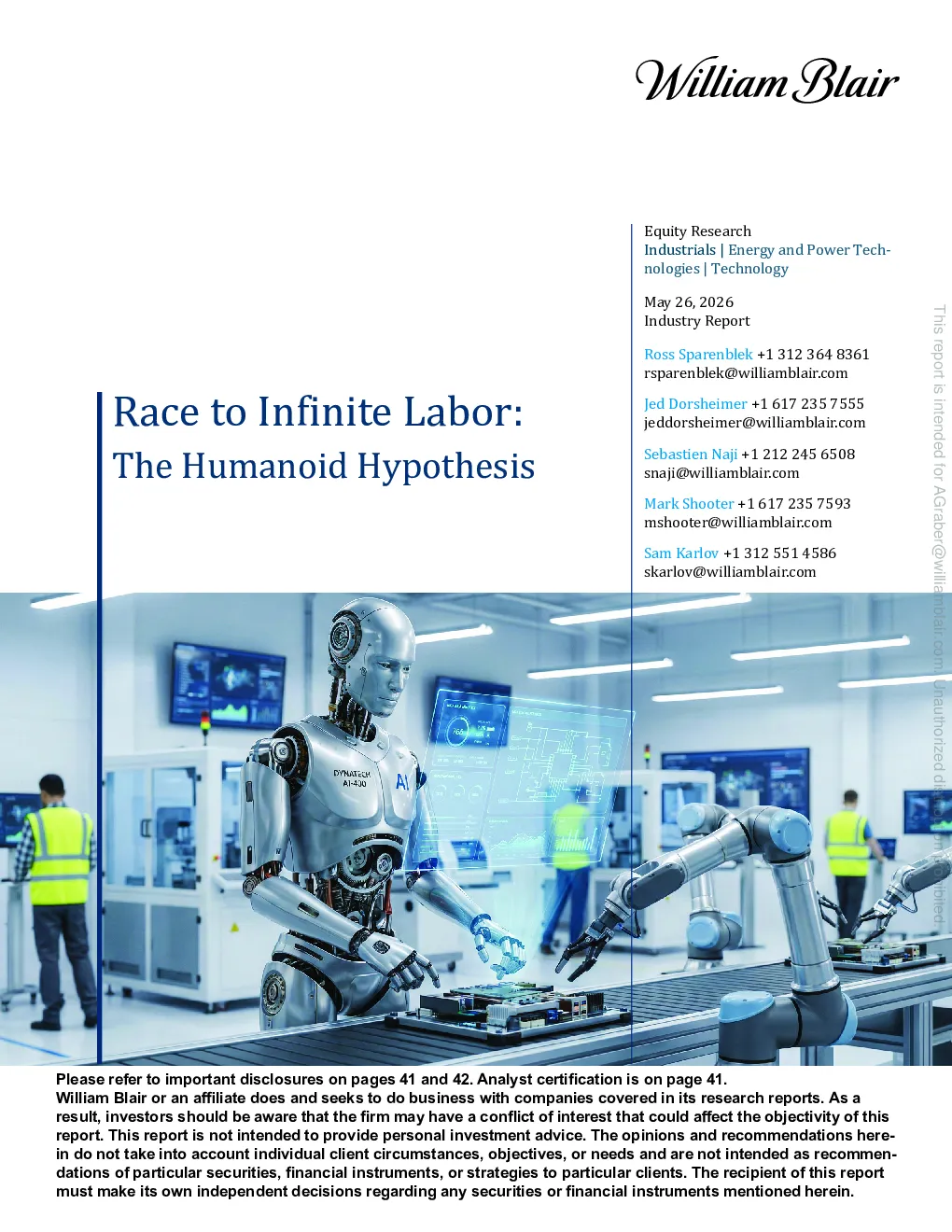
Please refer to important disclosures on pages 41 and 42. Analyst certification is on page 41.William Blair or an affiliate does and seeks to do business with companies covered in its research reports. As aresult, investors should be aware that the firm may have a conflict of interest that could affect the objectivity of thisreport. This report is not intended to provide personal investment advice. The opinions and recommendations here- Humanoids, Want or Need?..............................................................................................3The New Arms Race: National Security Concerns De-risk Path to Commercialization....7Major Bottlenecks to Scaling Humanoid Robotics.........................................................14From Prototypes to Millions: Milestones and KPIs to Monitor......................................19Framing the Opportunity................................................................................................21Ways to Play Humanoid Robotics...................................................................................22Layers of Humanoid Technology Stack...........................................................................26Leading Humanoid OEMs................................................................................................30Appendix: Tesla’s Optimus.............................................................................................32 amount of work one person can do. The loom, steam engine, electricity, production line, and in-dustrial robotics all increased the leverage on human labor. We argue that we have hit a lull inrevolutionary leaps in manufacturing technology; instead, we have relied on shifting work globallyto where human labor is the cheapest. Western countries then focused on energy-light sectors like physical layer of the economy. Goods still need to be moved, assembled, repaired, and maintained.Infrastructure still needs to be built and serviced, warehouses still need picking, and factories stillneed tending. AI models can plan and reason, but they do not execute in the physical world. The Humanoid robotics offer the next revolution in productivity, eliminating the labor cost compo-nent of the equation to allow capital- and labor-heavy industries to be redistributed globally again.Traditional industrial robotics are evolutionary, are designed task-specific, and require workflowsto be redesigned around them. Humanoids are biomimetic, with the goal to be task-agnostic and The Want: Human Labor LibertyThe natural appeal of humanoids is to unburden humans of unfulfilling labor and enable us to devote our finite time to more meaningful pursuits. Viewed through Maslow’s hierarchy of needs,removing routine physical labor allows time and energy to shift toward higher-value activities likesciences, arts, athletics, and leisure. A meaningful portion of human time is spent on repetitive,low-satisfaction physical tasks. Entire sectors of the economy rely on mundane and unfulfillingtasks, like cleaning, carrying, sorting, stocking, maintenance, assembly line manufacturing, as wellas routine household chores like laundry, dishes, and vacuuming. The value proposition is not just The Need: Improved Productivity to Meet Structural ConcernsThe stronger argument is not that humanoids are desirable, but that they are necessary to increase the productive function to grow the U.S. economy fast enough to sustain our national debt andprevent a debt spiral and runaway inflation. At the same time, we are entering a global decouplingas the rise of China contends with U.S. hegemony, creating a bifurcated and multipolar geopoliticalenvironment. This reshoring, or dual sourcing of supply chains, further strains productivity, as we 31% today, with projections approaching 50% by 2060. The U.S. is faring slightly better than Europeand Japan due to migration, but the trend is clear for all Western countries. The U.S. Census Bureauindicates that by 2030 all baby boomers will be over 65, and by 2034 older adults are expected to The challenges in China are even more acute, as decades of the one-child policy have put the coun-try on course to see the largest absolute population decline of any country through 2050. Whilethe two-child policy was implemented in early 2016, the four-year COVID lockdown has led to anaverage fertility rate of just 1.08 over the last 5 years (2020 to 2024) and just 1.01 in 2024 (UN At a high level, economic output can be simplified into four inputs: energy, labor, capital, and pro-ductivity. To the first point, technological advancements have steadily reduced energy intensityglobally over the 21st century, as shown in exhibit 4. However, in addition to the shift towardredundant manufacturing, demand for data centers is beginning to put immense pressure on thegrid. Energy can only grow as fast as the slowest component of the supply chain, with grid inter- Humanoids may not be a want after all, but a need for the Un