Epic Fury行动改变了一切:谁赢了(英)2026
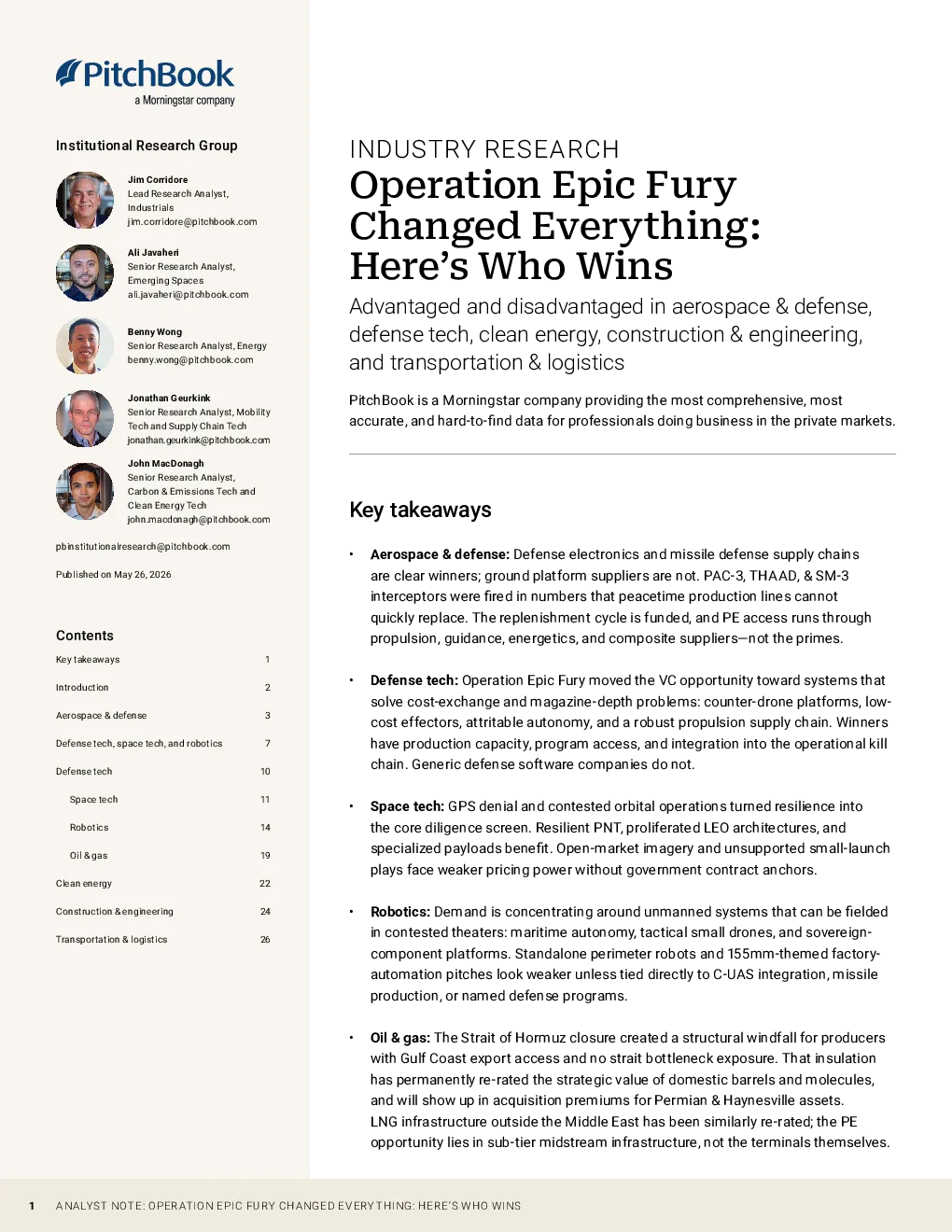
研究所机构 行业研究 史诗级愤怒行动改变了一切:赢家是谁? Lead Research Analyst,Industrialsjim.corridore@pitchbook.com吉姆·科里多雷 ali.javaheri@pitchbook.com阿里·贾瓦赫尔伊高级研究分析师新兴空间 航空航天与国防、国防技术、清洁能源、建筑与工程、交通与物流领域的优势与劣势 Senior Research Analyst, Energybenny.wong@pitchbook.com王文斌 Senior Research Analyst, MobilityTech and Supply Chain Techjonathan.geurkink@pitchbook.com乔纳森·吉尔金克 彭博(PitchBook)是Morningstar公司的一家子公司,为在私募市场进行商业活动的专业人士提供最全面、最准确且难以获取的数据。 Senior Research Analyst,Carbon & Emissions Tech andClean Energy Techjohn.macdonagh@pitchbook.com约翰·麦克唐纳 关键要点 pbinstitutionalresearch@pitchbook.com • 航空航天与国防:国防电子和导弹防御供应链是明确的赢家;地面平台供应商则不然。PAC-3、THAAD和SM-3拦截弹的数量级发射,已超出平时生产线快速补充的能力。补充周期有资金保障,而私募股权(PE)的介入途径涉及推进、制导、能源以及复合材料供应商,而非核心承包商。 2026年5月26日发布 内容 • 防务技术:史诗狂怒行动将虚拟货币(VC)投资机会推向了解决成本交换和弹匣深度问题的系统:反无人机平台、低成本执行器、可消耗性自主系统和强大的推进供应链。获胜者拥有生产能力、项目准入权,以及融入作战杀伤链的能力。而通用型防务软件公司则不具备这些。 • 航天技术:GPS拒止和竞争性轨道行动使弹性成为核心尽职调查标准。弹性PNT、普及的低地球轨道架构和专业有效载荷受益。缺乏政府合同支撑的开放市场图像和小型发射业务面临较弱的定价能力。 • 机器人技术:需求正集中于可在竞争性战场部署的无人系统:海上自主系统、战术小型无人机和主权组件平台。除非直接与C-UAS(反无人机系统)集成、导弹生产或特定的国防项目相关,否则独立的周界机器人和以155毫米炮弹为主题的工厂自动化方案看起来吸引力较弱。 • 石油和天然气:霍尔木兹海峡的关闭为拥有墨西哥湾沿岸出口渠道且不受海峡瓶颈影响的产商创造了结构性超额收益。这种隔离效应永久性地重塑了国内桶和分子的战略价值,并将体现在对皮莫恩和海恩斯维尔资产的收购溢价中。中东以外的液化天然气基础设施也经历了类似的重新估值;PE(私募股权)的机会在于次级中游基础设施,而非终端本身。 • 清洁能源:高油价和气价将改善近期运营清洁能源资产的经济性。这场冲突强化了国内清洁能源的长期政策依据——但同时也提高了投入成本,并推迟了依赖新风电和大型太阳能项目的新电价下调。 • 建筑 & 工程:荷姆兹海峡的关闭使国内能源安全成为立法优先事项,并叠加了本已加速的电网建设。美国电气承包市场预计到2030年将达到2950亿美元,公共公司交易价格处于历史性的估值溢价水平,整合浪潮仍在继续。住宅及商业建筑则面临相反的动态:受石油驱动的通胀使得近期降息可能性降低,冲击了已较去年同期开工率下降7.3%的住房市场。 • 运输与物流:在2023年至2024年淡季市场期间,那些转向更便宜数字平台的托运人重新回归,与承运人关系深厚的货运代理因此受益。空运和海运正承受最直接的冲击——海湾枢纽中断、霍尔木兹海峡交通崩溃以及战争风险保险费的飙升,这些影响将波及这些领域,并持续到主要冲突结束之后。 引言 “史诗之怒”行动——美国与以色列针对伊朗的军事行动于2026年2月28日启动,在持续38天的大规模战斗后,于4月7日达成停火。“联合部队”发射了数百枚弹道导弹拦截器,消耗了数千枚精确制导武器,并且完全从空中、海上和电子频谱领域执行了此次行动。没有美军地面部队参与持续的地域作战。这一单一事实,其影响之巨,不亚于行动中发生的任何其他事件,同样深刻地影响着投资相关的考量。 伊朗关闭霍尔木兹海峡——全球约20%的海上石油和液化天然气贸易通常流经此地——导致数十年来最大的能源供应中断。布伦特原油在峰值时突破每桶120美元。航空煤油价格同比翻了一番以上。海峡的航运量下降超过90%,船只改道绕行非洲,给供应链增加了数周和显著的成本。进入冲突前,建筑材料成本已较去年同期高6%,而能源和运输成本在供应链各环节的上涨给其带来了进一步的压力。 我们要求我们的工业团队识别每个覆盖领域的优势类别和劣势类别,特别关注我们投资组合中的私募股权和风险投资公司。每个部分都包括获奖类别的尽职调查标准,以及从PitchBook数据中获取的私募收购目标清单。 Lead Research Analyst, Industrialsjim.corridore@pitchbook.com吉姆·科里多雷 航空航天与国防 优势 国防电子 此次冲突验证了电子战、反无人机、雷达和任务计算的重要性。伊朗在霍尔木兹海峡部署了GPS干扰和欺骗措施,伊朗相关组织在整个行动期间针对美国防御网络发动了攻击,而单向攻击无人机需要持续的反无人机响应。整个空中战役依赖于电子战(EW)、感知和通信系统来运行。2027财年五角大楼预算材料显示,电子战和感知相关账户大幅增加。对于该领域的PE(私募股权)赞助商而言,随着战略公司为整合此次冲突证明不可或缺的次级能力而展开竞争,其退出倍数应有所扩大。 导弹防御供应链 PAC-3 MSE、THAAD和SM-3 Block IIA拦截器在38天内发射数量已超出了和平时期生产线快速补充的能力。每枚拦截器的单位成本从数百万美元到超过2500万美元不等。重建库存需要多年采购合同,并通过次级供应链进行。PE不能购买洛克希德·马丁或RTX。它可以购买那些一级供应商依赖以扩大生产所需的推进系统、制导电子、复合材料和能料供应商。2027财年的预算申请证实了这一周期已获得资金。 弱势 陆基地面平台供应商 美国地面部队未在伊朗参战。这场冲突不会为坦克、装甲车或战术轮式车辆舰队带来需求刺激,反而会与那些已大规模消耗预算的类别争夺预算份额。补充拨款以及2027财年的申请资金将流向拦截机、电子战系统和可消耗无人机。私募股权支持的地面平台供应商在接下来一个或两个预算周期内将面临不太有利的融资环境——并非因为平台已过时,而是因为它们在这场刚刚决定胜负的预算争论中落败。 高成本ISR无人机供应商 MQ-9死神在38天内记录了17次确认损失,向国防规划者提供了一份关于将采购转向廉价易损系统的文件记录的作战案例。五角大楼的复制计划已经指向这个方向;史诗之怒为其提供了政治动力。为高价传统情报、监视和侦察平台服务的整个次级生态系统面临着采购天花板,这个天花板更有可能停滞不前或缩小,而不是增长。 Senior Research Analyst, Emerging Spacesali.javaheri@pitchbook.com阿里·贾瓦赫尔伊 国防技术、航天技术和机器人技术 本节涵盖受冲突影响最严重的风险投资支持层:软件、自主系统、弹性导航、无人机系统以及可消耗性供应链。史诗怒火并未创造这些市场,但它加速了其背后的预算逻辑。共同点是成本:五角大楼需要能够比传统精密平台更快、更便宜地扩展的系统。 优势 反无人机综合平台及效应器 战争暴露了反无人机系统的核心成本交换问题:用于拦截价值15,000至50,000美元的沙赫德级威胁的拦截器成本高达100万美元至1200万美元。随着JIATF-401建立常设基地防御渠道,2027财年反无人机系统预算申请达210亿美元,2025财年采购量增长三倍,需求正变得结构性。风险投资机会存在于那些开发集成探测-跟踪-打击平台以及低成本动能或定向能效应器的初创公司。Anduril的200亿美元Lattice合同确立了平台层;效应器层仍存在争议且对风险投资开放。 易受攻击的自主性、单向攻击无人机与滞空弹药 史诗级愤怒暴露了弹药库深度的危机:美国消耗的汤姆霍克和JASSM-ER主要库存远快于当前生产所能补充的速度。唯一可扩展的解决方案是负担得起的大规模生产。SpektreWorks的3.5万美元LUCAS无人机是采购原型。随着2027财年请求约为540亿美元用于无人机及相关技术,可消耗系统正成为准则。初创公司被收购是结构性问题,因为主要成本结构无法满足经济性要求。 弹药级推进(跨领域使能技术) 弹药级推进系统是反无人机效应器、易损自主性和单向攻击无人机的基础,这些都依赖于受约束的电机、推进剂和能源供应链。关键的尽职调查瓶颈包括唯一的威廉姆斯F107涡扇发动机以及对中国提炼的稀土磁体的潜在DFARS限制。 国防技术 弱势 防御软件,未集成杀伤链 战时采购正集中在作战AI工作流程上——Maven、Lattice、Hivemind以及新兴的JADC2架构,而非通用的国防SaaS。Maven已扩展至超过25000名国防部用户,并正朝着记录项目地位发展;Lattice已获得价值200亿美元的陆军平台合同。没有记录项目的通用国防软件 进入这些平台的集成路径面临销售困境。获胜者拥有明确的生产能力、操作人员熟悉的背景,以及与LLM无关的架构和本地部署能力。 航天技术 优势 弹性GPS替代定位 弹性定位导航(PNT)是少数几个受伊朗战争重置价值计算(VC calculus)的领域。霍尔木兹海峡的GPS干扰、星链(Starlink)的退化以及F-15E的干扰反制升级,将低地球轨道(LEO)GPS替代方案从一项投机性假设转变为紧急采购优先事项。Xona的1.7亿美元C轮融资明确提到了霍尔木兹干扰问题。由于主要承包商竞争有限,替代定位是栈中创业公司能够获取的最高置信度机会之一。 低地球轨道卫星的激增 PWSA验证了从传统地球同步轨道(GEO)卫星转向分布式低地球轨道(LEO)架构,以实现弹性感知、通信和导弹追踪。最近的奖项——第三批次(Tranche 3)35亿美元、BAE 12亿美元的导弹预警层、Andromeda 18亿美元的车辆以及Golden Dome的SHIELD资金——表明该架构现已签约落地,而非停留在理论层面。约克(York)的首次公开募股(IPO)和阿佩克斯(Apex)每年生产200颗以上的卫星目标,则强化了产业规模化的论点。 弱势 公开市场商业地球观测图像 2026年4月,Planet Labs中东地区图像采集中断重新激活了快门控制,将其视为一项真正的政策风险。对于纯像素亚级商业地球观测公司而言,现在面临战时变现受限、国家航空航天局(NRO)的三方合同结构,以及来自对手开源情报(OSINT)使用带来的更高中断风险。国防需求依然强劲,但缺乏专用传感器、机密访问权限或非公开市场应用场景的公司,其商业收入在结构上受到限制。 响应式/小型启动,无政府合同支撑 维克斯·海泽(Victus Haze)的发射计划推迟至2026年末表明,响应式发射需求仍停留在理论层面,而非商业上的稳固。除非得到国防部、太空部队或情报界合同的支撑,否则小型发射初创公司将面临来自SpaceX拼车发射服务的价格压力和收入前景不明朗的困境。市场正在增长,但纯商业的小型发射仍然难以获得承保。 机器人技术 优势 海上无人水面及水下航行器 霍尔木兹海峡封锁以及美国的海上封锁,使中央司令部成为海上自主行动的验证场。海军有限的扫雷能力暴露出明显的差距。萨罗尼克公司的1.75亿美元D轮融资、3.92亿美元海军原型合同、猛袭者(Marauder)的快速建造以及路易斯安那州造船厂的扩建,共同定义了其商业架构。英国、澳大利亚、法国、日本以及海