周末医疗动态:日本药品定价方案惹恼制药公司;可能最终损害患者利益
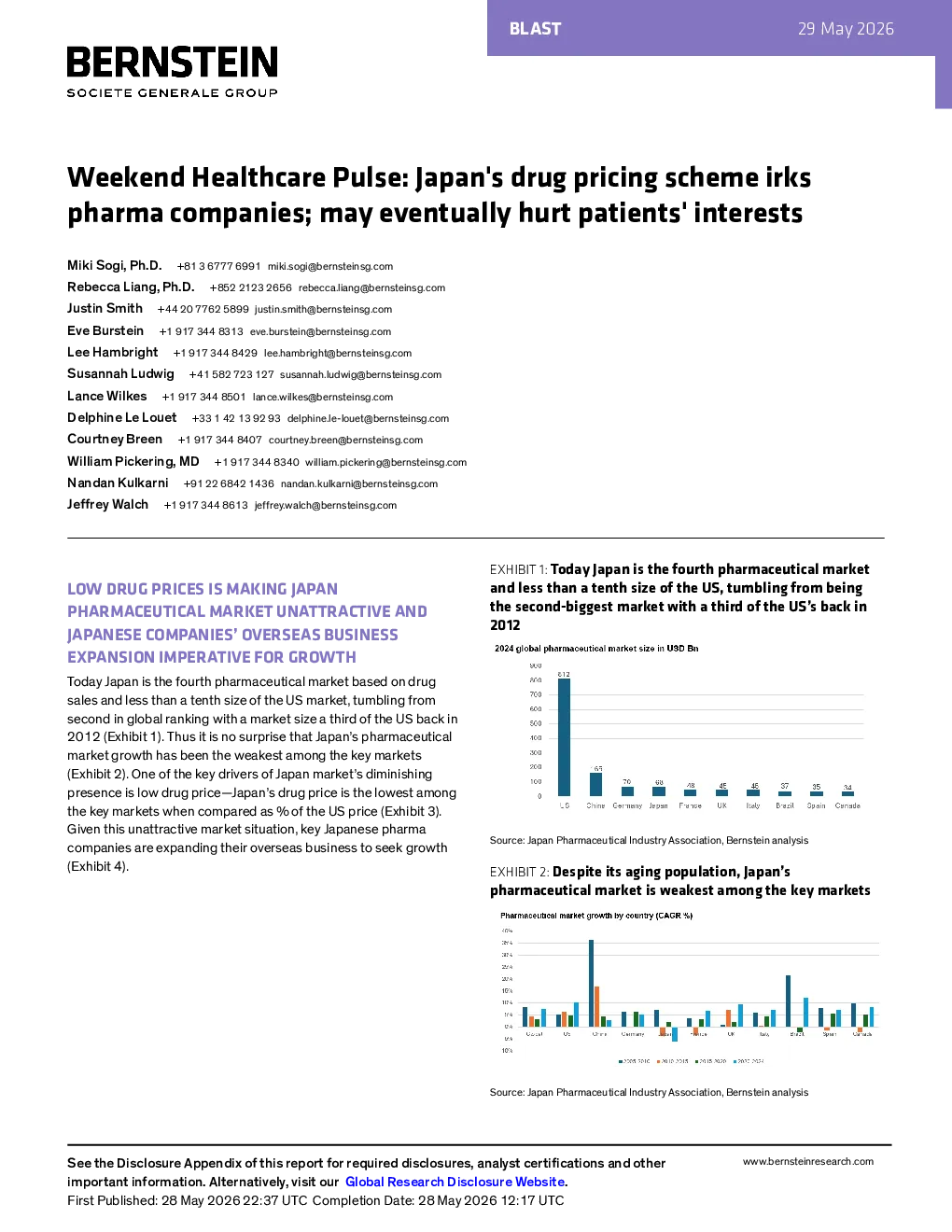
Miki Sogi, Ph.D.+81 3 6777 6991miki.sogi@bernsteinsg.com Rebecca Liang, Ph.D.+852 2123 2656rebecca.liang@bernsteinsg.comJustin Smith +44 20 7762 5899justin.smith@bernsteinsg.comEve Burstein+1 917 344 8313eve.burstein@bernsteinsg.comLee Hambright+1 917 344 8429lee.hambright@bernsteinsg.comSusannah Ludwig+41 582 723 127susannah.ludwig@bernsteinsg.comLance Wilkes+1 917 344 8501lance.wilkes@bernsteinsg.com Delphine Le Louet+33 1 42 13 92 93delphine.le-louet@bernsteinsg.comCourtney Breen+1 917 344 8407courtney.breen@bernsteinsg.com William Pickering, MD+1 917 344 8340william.pickering@bernsteinsg.comNandan Kulkarni+91 22 6842 1436nandan.kulkarni@bernsteinsg.comJeffrey Walch +1 917 344 8613jeffrey.walch@bernsteinsg.com EXHIBIT 1:Today Japan is the fourth pharmaceutical marketand less than a tenth size of the US, tumbling from beingthe second-biggest market with a third of the US’s back in LOW DRUG PRICES IS MAKING JAPANPHARMACEUTICAL MARKET UNATTRACTIVE AND Today Japan is the fourth pharmaceutical market based on drugsales and less than a tenth size of the US market, tumbling fromsecond in global ranking with a market size a third of the US back in2012 (Exhibit 1). Thus it is no surprise that Japan’s pharmaceuticalmarket growth has been the weakest among the key markets(Exhibit 2). One of the key drivers of Japan market’s diminishing 8). So containing the healthcare spending has been one of the keypriorities of the debt-ridden Japanese government. EXHIBIT 5:The productivity of Japan’s healthcare system isbetter than that of peer countries, delivering the longest life EXHIBIT 4:Given the unattractive domestic market situationwith low drug prices, key Japanese pharma companies are Health expenditure as % of GDP in 2022 The bubble size represents PPP-adjusted GDP per personSource: OECD, World Bank, Our World in Data, Bernstein analysis EXHIBIT 6:… yet its fast-growing aging population ischallenging healthcare expenditure... Japan is the fastest agingsociety─% of >65 yrs old increased from 22%to 29% over the past 15 years IN JAPAN, DUE TO THE PRICING SCHEME, DRUGPRICE IS AN EASY LEVER FOR HEALTHCARE COST JAPANESE GOVERNMENT HAS BEEN UNDER PRESSURETO CONTAIN HEALTHCARE EXPENDITURE IN THE FACE OF When measured based on the input and output, the productivity ofJapan’s healthcare system is arguably better than peer developedcountries as Japan delivers the longest life expectancy withoutspending more in terms of % of GDP (Exhibit 5; we acknowledgethat Japanese people’s healthier diet and other factors - e.g.,genetics, lifestyle - also contribute to their longevity). Yet Japan’s Source: Japan Ministry of Health, Labor and Welfare, Bernstein analysis EXHIBIT 9:Drug spending onlyaccounts for 16% of overall EXHIBIT 8:In Japan, 38% ofhealthcare expenditure isfunded by the federal or local Data in 2024 EXHIBIT 10:… yet was the fastest growing category within thehealthcare expenditure Health insurance funding representsemployee contribution and the insured’spremium DRUG SPENDING IS AN EASY LEVER FOR THE JAPANESEGOVERNMENT TO PULL IN ORDER TO CONTAIN While drug cost accounts for only 16% within Japan’s overallhealthcare expenditure, it was previously the fastest growthcategory unti the mid-2010’s (Exhibit 9, Exhibit 10). Thus, itbecame a clear target for the government's cost containmentefforts. In Japan, the government has a full control of drug pricesbecause almost all the drugs approved in Japan are reimbursedthrough the national health insurance (NHI, Japan has a universalhealth insurance system) and the government determines drugs’ IN JAPAN, THE GOVERNMENT HAS FULL CONTROLOF DRUG PRICING: PRICING AT LAUNCH AND MOST NEW DRUG PRICING IS BASED ON COMPARISONWITH ANALOGOUS EXISTING DRUGS IN COMBINATION In Japan, Ministry of Health, Labor and Welfare (MHLW) grantsnew drug an official NHI price within 60 days after its regulatoryapproval. This price is the amount to be reimbursed to the drugdispensers (i.e., pharmacies, hospitals, clinics) under the nationalhealth insurance scheme. Pharma companies can start promotingthe new drugs upon regulatory approval but have to wait for the There are two approaches to new drug pricing:comparison withanalogous existing drugs or COGS-basedif a similar does not In thecomparison approach, a new drug’s price is determinedbased on its “innovation” and “usefulness” vs the existing analogous drugs. A drug would receive a70—120% innovation premiumvs the comparatorif meeting all the following three categories:clinically meaningful, novel MOA; higher efficacy and/or safety; andobjectively proven improvement of the treatment approach for thetarget indications. A drug would receive a5—60% usefulness drug). The price revision used to be every other year yet, in 2021,the government introduced an off-year revision, which has become Innovative drugs are exempted from the annual price cut untilGx launch or 15 years after the launch under the Patent-periodPrice Maintenance Prog