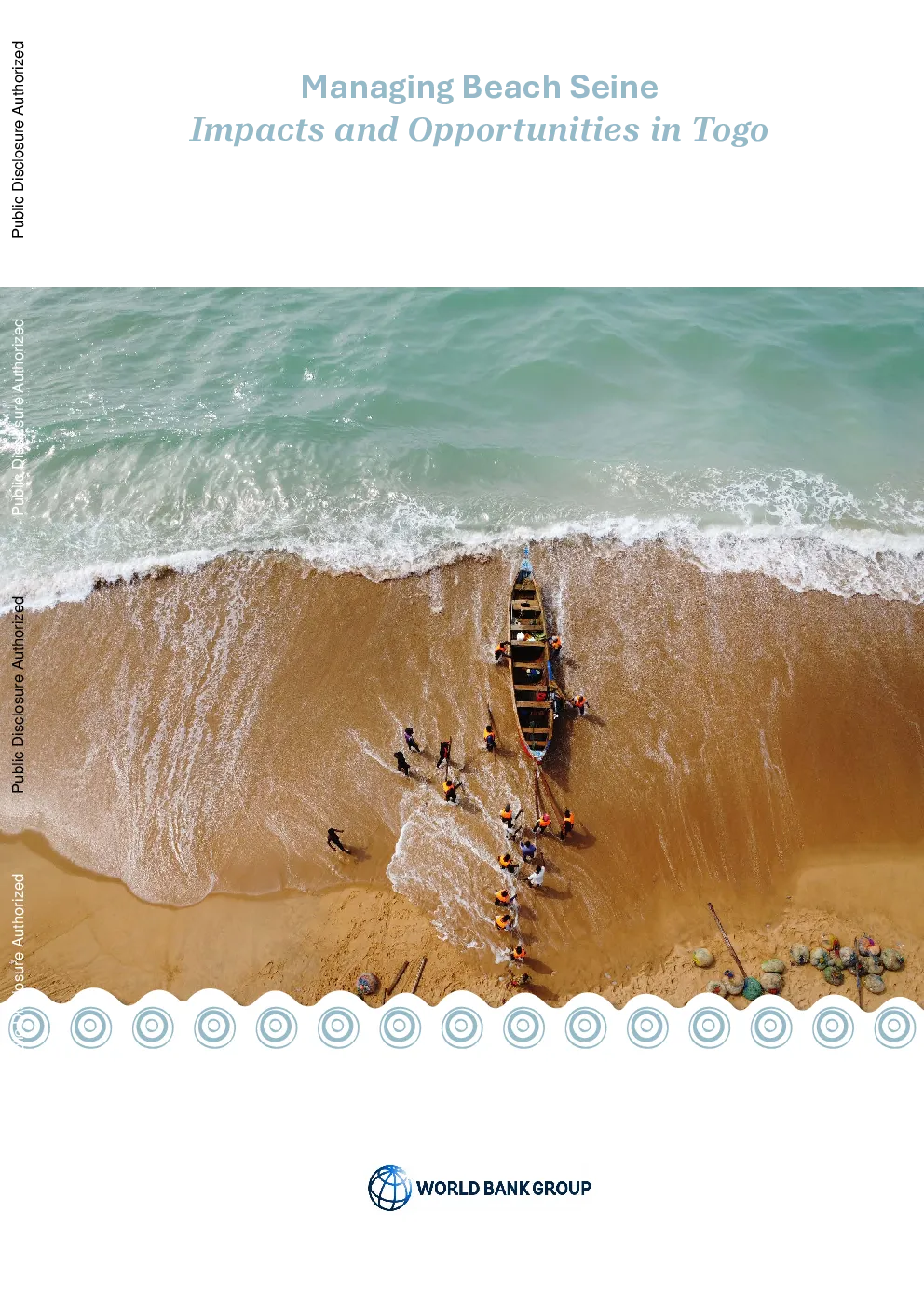
管理多哥海滩围网的影响与机遇
© 2026 The World Bank Group 1818 H Street NW, Washington DC 20433 Telephone: 202-473-1000 | Internet: www.worldbank.org Some rights reserved. This work is a product of the staff of The World Bank Group with external contributions. “The WorldBank Group” refers to the legally separate organizations of the International Bank for Reconstructionand Development (IBRD), the International Development association (IDA), the International Finance The World Bank Group does not guarantee the accuracy, reliability, or completeness of thecontent included in this work, or the conclusions or judgments described herein, and accepts noresponsibility or liability for any omissions or errors (including, without limitation, typographicalerrors and technical errors) in the content whatsoever or for reliance thereon. The boundaries, The findings, interpretations, and conclusions expressed do not necessarily reflect the views ofthe organizations of the World Bank Group, their respective Boards of Executive Directors, andthe governments they represent. The contents of this work are intended for general informational Some of the organizations of the World Bank Group or their affiliates may have an investment in,provideotheradviceorservicesto,orotherwisehaveafinancialinterestin,certainofthecompaniesand parties named herein. Nothing herein shall constitute or be construed or considered to be a Rights and Permissions The material in this work is subject to copyright. Because The World Bank Group encouragesdisseminationofitsknowledge,thisworkmaybereproduced,inwholeorinpart,fornoncommercialpurposes as long as full attribution to this work is given and all further permissions that may be All queries on rights and licenses should be addressed to World Bank Publications, The WorldBank Group, 1818 H Street NW, Washington, DC 20433, USA; e-mail: pubrights@worldbank org. Photos:Cover, Kpotivi Wilson-Bahun, 2023; page VII, Kpotivi Wilson-Bahun, 2023; pages 6-8,Benoit Caillart, 2023; page 11, Kpotivi Wilson-Bahun, 2023; page 14, Benoit Caillart, 2023; page16, Angnuureng et al., 2013; page 19, Kpotivi Wilson-Bahun, 2023. Managing Beach SeineImpacts and Opportunities in Togo Contents Acknowledgementsiv Abbreviations and Acronyms v Summaryvi 1.Introduction1 2.Beach Seining in Togo and its Neighboring Countries3 2.1.Overview of the Beach Seine Fishing Technique2.2.Number of Production Units and Geographical Distribution2.3.Beach Seine Sizes2.4.Beach Seine Catches 3.Regulatory Framework Governing Beach Seining Activities 3.1.Legal Framework and Enforcement Gaps 4.Status of Exploited Fish Stocks in the Region 5.1.Impact on Fish Resources 6.Coastal Protection and Impact on Beach Seining 6.1.Coastal Protection in Togo and Benin6.2.Impacts of Coastal Protection Works on Beach Seining 7.ConclusionBibliography 19 Acknowledgements This report was written by a team led by Benoit Caillart, Fisheries Management Expert andDirector, F&S Fisheries/Maritime Affairs, and including Sergio Vallesi, Ecological Economist,Hydro Nexus, and Kpotivi Wilson-Bahun, Environmental Specialist, World Bank. The WorldBank Task Team Leader for the report was Peter Kristensen, Lead Environmental Specialist, andthe team included Koffi Hounkpe, Senior Disaster Risk Management Specialist, and Komlan In conducting this study, the World Bank collaborated with the Food and Agriculture Organizationof the United Nations (FAO), considering its work on beach seine management in Togo andother countries in the Gulf of Guinea. The World Bank acknowledges FAO support to help Togo Abbreviations and Acronyms Summary This report examines beachseine fishing in the Gulf ofGuinea, with a particular focuson Togo, and analyzes howcoastal erosion and coastalprotection measures interact Context: Coastal Erosion and Fisheries under Pressure.Togo and Benin are among thecountries most severely affected by coastal erosion in West Africa. Despite their relatively shortcoastlines, both countries experience high erosion rates—reaching up to 30 meters (m) per yearin some areas—resulting in significant losses of land, infrastructure, and economic assets. In At the same time, fisheries play a critical role in food security and livelihoods.However,domestic fish production in Togo meets less than one quarter of national demand, resulting in a significant reliance on imports and persistent trade deficits. This dual challenge—coastaldegradation and pressure on fisheries—underscores the need for integrated and sustainable Role and Characteristics of Beach Seining.Beach seining is a traditional fishing method widelypracticed across Togo, Benin, Côte d’Ivoire, and Ghana. In Togo, 68 beach seine units wererecorded in 2025, with activity concentrated in specific coastal segments. While beach seiningcontributes only about 8 percent of total marine landings in Togo, it remains an important source The technique involves deploying large nets offshore and hauling them back to the beachusing