您的浏览器禁用了JavaScript(一种计算机语言,用以实现您与网页的交互),请解除该禁用,或者联系我们。 [德意志银行]:冉冉之星与堕落天使是否会保持平衡? - 发现报告

冉冉之星与堕落天使是否会保持平衡?

2026-04-21 - 德意志银行 等待花开
报告封面

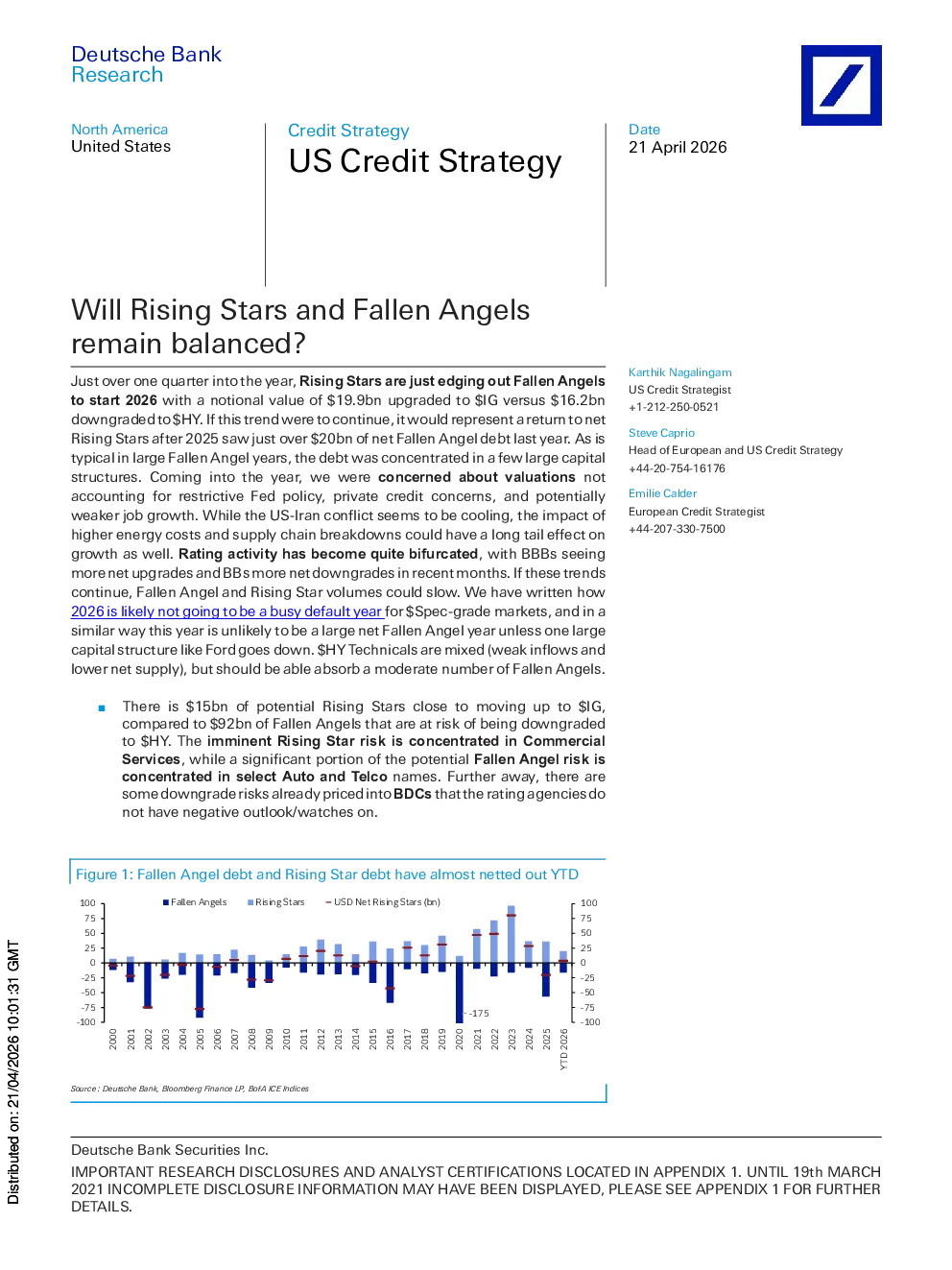
Karthik NagalingamUS Credit Strategist+1-212-250-0521 Just over one quarter into the year,Rising Stars are just edging out Fallen Angelsto start 2026with a notional value of $19.9bn upgraded to $IG versus $16.2bndowngraded to $HY. If this trend were to continue, it would represent a return to netRising Stars after 2025 saw just over $20bn of net Fallen Angel debt last year. As istypical in large Fallen Angel years, the debt was concentrated in a few large capitalstructures. Coming into the year, we wereconcerned about valuations notaccounting for restrictive Fed policy, private credit concerns, and potentiallyweaker job growth. While the US-Iran conflict seems to be cooling, the impact ofhigher energy costs and supply chain breakdowns could have a long tail effect ongrowth as well.Rating activity has become quite bifurcated, with BBBs seeingmore net upgrades and BBs more net downgrades in recent months. If these trendscontinue, Fallen Angel and Rising Star volumes could slow. We have written how2026 is likely not going to be a busy default year for $Spec-grade markets, and in asimilar way this year is unlikely to be a large net Fallen Angel year unless one largecapital structure like Ford goes down. $HY Technicals are mixed (weak inflows andlower net supply), but should be able absorb a moderate number of Fallen Angels. Steve CaprioHead of European and US Credit Strategy+44-20-754-16176 Emilie CalderEuropean Credit Strategist+44-207-330-7500 nThere is $15bn of potential Rising Stars close to moving up to $IG,compared to $92bn of Fallen Angels that are at risk of being downgradedto $HY. Theimminent Rising Star risk is concentrated in CommercialServices, while a significant portion of the potentialFallen Angel risk isconcentrated in select Auto and Telconames. Further away, there aresome downgrade risks already priced intoBDCsthat the rating agencies donot have negative outlook/watches on. Consumer Cyclicals lead imminent Fallen Angel risks, butmany Financial firms - including BDCs - are one step away Since our 2026 Outlook, higher-rates-for-longer, private credit concerns, andweaker job growth caused us tobe wary of consumer cyclical risk. Now higherenergy prices, which will have a higher floor even following some level ofnormalization of the Strait of Hormuz, can weigh even more on consumer-orientedsectors as we discussed in our Quarterly update last month. Using our Rising Star/FallenAngel methodology,rating agencies are also more concerned withconsumer risks in the short-term. The total debt at "imminent" (<0.75 adj. notches to $HY) downgrade risk is $92bn.These Fallen Angel risks remain concentrated in Ford ($45bn) with some inStellantis ($5bn) as well, and then the risk is split fairly evenly between ConsumerNon-Cyclicals, and Communications issuers. Financials and Utilities have thelargest stack of debt next closest to downgrade if conditions were to worsen. At an industry level, as noted above,Autos ($50bn) remain the largest currentFallen Angel risk,with the two large capital structures having now been flagged byrating agencies for over 6 months. Ongoing tariff costs and a pressured consumermean that headwinds remain for Autos generally. However past that, rating agencyoutlooks/watches are not indicating large imminent downgrade risks. Telecoms ($11bn imminently, and $2bn further away) and Electric Utilities ($4bnimminently and $37bn further away) are two of the next largest risks that investorsshould be aware of. The other sector that is not large within the $IG universe but isshowing some stress is BDCs. What was just ongoing rate risks last year has nowalsoseen increasing fundamental portfolio risks for BDCs("InvestmentCompanies" below), which have $18bn of debt that is between 0.75 and 1.5adjusted notches from being downgraded, and joining the FS KKR Fallen Angelfrom earlier this year. BDC pricing points to more potential downgrades BDCs have gotten a significant amount of interest in recent months as theinvestment vehicles offer markets a window into the larger private credit complex.BDC bonds make up a small portion of the overall $IG index (~1%), but as seenaboveBDCs represent a material proportion of the bonds at risk of becomingFallen Angelsin the medium term. $IG index eligible BDC bonds, which arepredominately BBB2/BBB3 rated, have traded in line with the broader $BB indexover the last few years. However, since Q4'25, when private credit concerns rose inthe fallout of First Brands and Tricolor,BDCs started to underperformgeneral $BBrisk. This underperformance took a leg wider in February on the back of AI-disruption fears in the Software space, where the BDCs are heavily concentrated.While the rating agencies have not put more negative outlooks on some of the debtthat is just one notch away from being downgraded, themarket is already pricingsome of that downgrade riskin. Where could some Rising Stars appear? There is just $15bn of potential Rising Stars that could be imminentl